Rivera-Torres Natalia, Banas Kelly, Bialk Pawel, Bloh Kevin M, Kmiec Eric B
Gene Editing Institute, Helen F. Graham Cancer Center and Research Institute, Newark, Delaware, United States of America.
Department of Medical Sciences University of Delaware, Newark, Delaware, United States of America.
PLoS One. 2017 Jan 4;12(1):e0169350. doi: 10.1371/journal.pone.0169350. eCollection 2017.
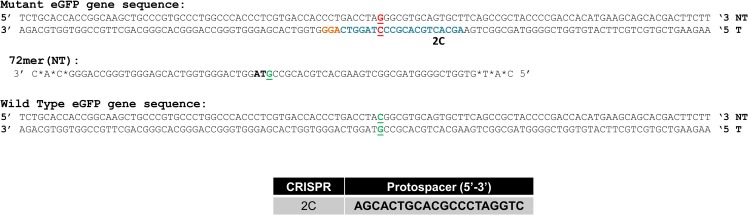
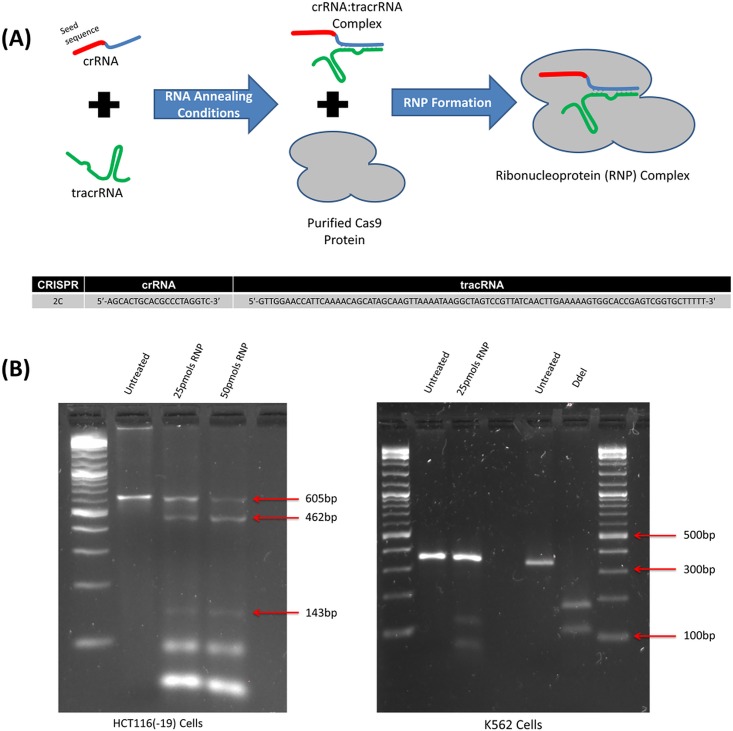
CRISPR/Cas9 and single-stranded DNA oligonucleotides (ssODNs) have been used to direct the repair of a single base mutation in human genes. Here, we examine a method designed to increase the precision of RNA guided genome editing in human cells by utilizing a CRISPR/Cas9 ribonucleoprotein (RNP) complex to initiate DNA cleavage. The RNP is assembled in vitro and induces a double stranded break at a specific site surrounding the mutant base designated for correction by the ssODN. We use an integrated mutant eGFP gene, bearing a single base change rendering the expressed protein nonfunctional, as a single copy target in HCT 116 cells. We observe significant gene correction activity of the mutant base, promoted by the RNP and single-stranded DNA oligonucleotide with validation through genotypic and phenotypic readout. We demonstrate that all individual components must be present to obtain successful gene editing. Importantly, we examine the genotype of individually sorted corrected and uncorrected clonally expanded cell populations for the mutagenic footprint left by the action of these gene editing tools. While the DNA sequence of the corrected population is exact with no adjacent sequence modification, the uncorrected population exhibits heterogeneous mutagenicity with a wide variety of deletions and insertions surrounding the target site. We designate this type of DNA aberration as on-site mutagenicity. Analyses of two clonal populations bearing specific DNA insertions surrounding the target site, indicate that point mutation repair has occurred at the level of the gene. The phenotype, however, is not rescued because a section of the single-stranded oligonucleotide has been inserted altering the reading frame and generating truncated proteins. These data illustrate the importance of analysing mutagenicity in uncorrected cells. Our results also form the basis of a simple model for point mutation repair directed by a short single-stranded DNA oligonucleotides and CRISPR/Cas9 ribonucleoprotein complex.
CRISPR/Cas9和单链DNA寡核苷酸(ssODNs)已被用于指导人类基因中单碱基突变的修复。在此,我们研究了一种旨在通过利用CRISPR/Cas9核糖核蛋白(RNP)复合物启动DNA切割来提高人类细胞中RNA引导的基因组编辑精度的方法。RNP在体外组装,并在围绕指定由ssODN校正的突变碱基的特定位点诱导双链断裂。我们使用一个整合的突变型eGFP基因,该基因有一个单碱基变化使表达的蛋白质无功能,作为HCT 116细胞中的单拷贝靶点。我们观察到突变碱基有显著的基因校正活性,这由RNP和单链DNA寡核苷酸促进,并通过基因型和表型读数进行验证。我们证明所有单个组分都必须存在才能获得成功的基因编辑。重要的是,我们检查了单独分选的校正和未校正的克隆扩增细胞群体的基因型,以寻找这些基因编辑工具作用留下的诱变足迹。虽然校正群体的DNA序列是精确的,没有相邻序列修饰,但未校正群体表现出异质性诱变,在靶点周围有各种各样的缺失和插入。我们将这种类型的DNA畸变称为原位诱变。对两个在靶点周围带有特定DNA插入的克隆群体的分析表明,在基因水平上发生了点突变修复。然而,表型没有得到挽救,因为一段单链寡核苷酸被插入,改变了阅读框并产生了截短的蛋白质。这些数据说明了分析未校正细胞中诱变的重要性。我们的结果也构成了一个由短单链DNA寡核苷酸和CRISPR/Cas9核糖核蛋白复合物指导的点突变修复简单模型的基础。