Sycheva Marina, Sustarich Jake, Zhang Yuxian, Selvaraju Vaithinathan, Geetha Thangiah, Gearing Marla, Babu Jeganathan Ramesh
Department of Nutrition, Dietetics, and Hospitality Management, Auburn University, Auburn, AL 36849, USA.
Center for Neuroscience Initiative, Auburn University, Auburn, AL 36849, USA.
Brain Sci. 2019 Aug 19;9(8):204. doi: 10.3390/brainsci9080204.
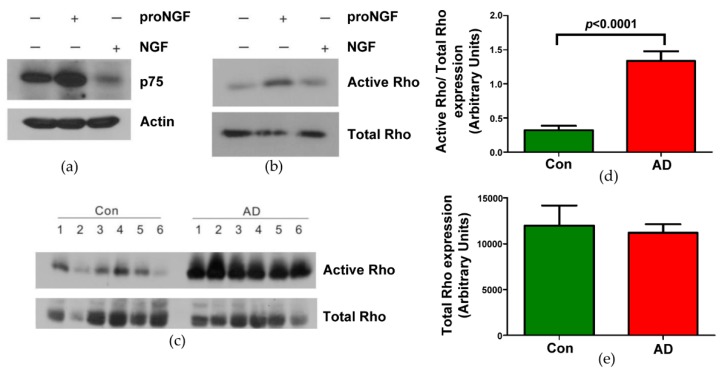
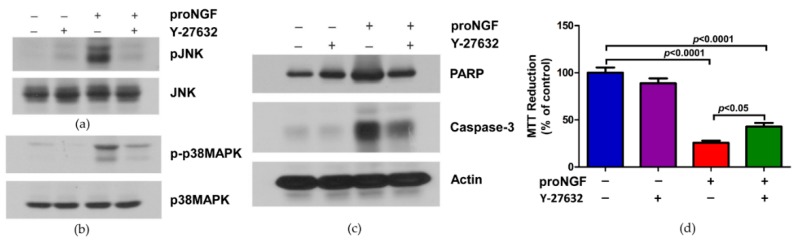
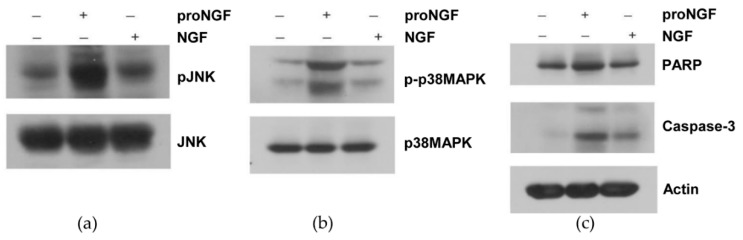
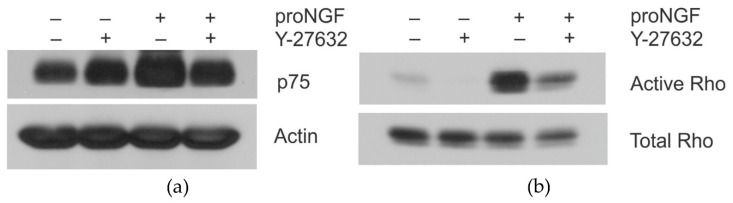
We have previously shown that the expression of pro-nerve growth factor (proNGF) was significantly increased, nerve growth factor (NGF) level was decreased, and the expression of p75 was enhanced in Alzheimer's disease (AD) hippocampal samples. NGF regulates cell survival and differentiation by binding TrkA and p75 receptors. ProNGF is the precursor form of NGF, binds to p75, and induces cell apoptosis. The objective of this study is to determine whether the increased p75 expression in AD is due to the accumulation of proNGF and Rho kinase activation. PC12 cells were stimulated with either proNGF or NGF. Pull-down assay was carried out to determine the RhoA kinase activity. We found the expression of p75 was enhanced by proNGF compared to NGF. The proNGF stimulation also increased the RhoA kinase activity leading to apoptosis. The expression of active RhoA kinase was found to be increased in human AD hippocampus compared to control. The addition of RhoA kinase inhibitor Y27632 not only blocked the RhoA kinase activity but also reduced the expression of p75 receptor and inhibited the activation of JNK and MAPK induced by proNGF. This suggests that overexpression of proNGF in AD enhances p75 expression and activation of RhoA, leading to neuronal cell death.
我们之前已经表明,在阿尔茨海默病(AD)海马样本中,前神经生长因子(proNGF)的表达显著增加,神经生长因子(NGF)水平降低,并且p75的表达增强。NGF通过结合TrkA和p75受体来调节细胞存活和分化。ProNGF是NGF的前体形式,与p75结合并诱导细胞凋亡。本研究的目的是确定AD中p75表达增加是否归因于proNGF的积累和Rho激酶激活。用proNGF或NGF刺激PC12细胞。进行下拉实验以确定RhoA激酶活性。我们发现与NGF相比,proNGF增强了p75的表达。ProNGF刺激还增加了RhoA激酶活性,导致细胞凋亡。与对照组相比,在人类AD海马中发现活性RhoA激酶的表达增加。添加RhoA激酶抑制剂Y27632不仅阻断了RhoA激酶活性,还降低了p75受体的表达,并抑制了proNGF诱导的JNK和MAPK的激活。这表明AD中proNGF的过表达增强了p75的表达和RhoA的激活,导致神经元细胞死亡。