Department of Epidemiology and Public Health, Graduate School of Medical Sciences, Kyushu University, Fukuoka, Japan.
Department of Diabetes and Molecular Genetics, Ehime University Graduate School of Medicine, Ehime, Japan.
J Diabetes Investig. 2020 Mar;11(2):482-489. doi: 10.1111/jdi.13129. Epub 2019 Sep 15.
AIMS/INTRODUCTION: Resistin is an adipocyte-derived polypeptide that leads to the progression of insulin resistance and subsequent atherosclerosis. Some studies have reported an association between self-reported intake of n-3 polyunsaturated fatty acids (PUFAs) and serum resistin levels. However, no studies have investigated the association between the ratio of serum levels of n-3 to serum n-6 PUFAs and the serum resistin concentration in the general population.
We carried out a cross-sectional study of 3,200 community-dwelling Japanese individuals aged ≥40 years in 2002-2003. The ratios of serum eicosapentaenoic acid or docosahexaenoic acid to arachidonic acid (AA) were categorized into quartiles. The associations of serum eicosapentaenoic acid/AA and docosahexaenoic acid/AA with the serum resistin concentration were assessed using linear regression models with adjustment for potential confounding factors.
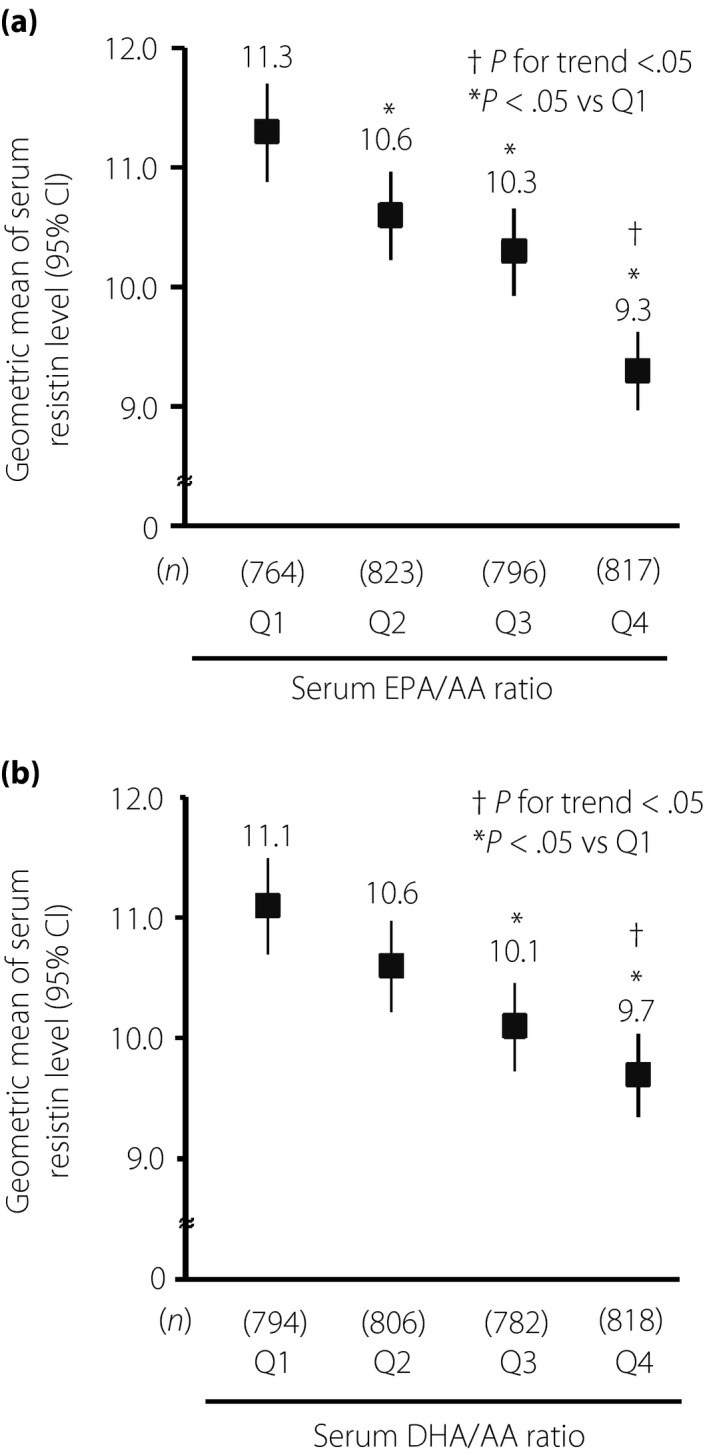
The geometric mean of serum resistin was 10.3 ng/mL. The age- and sex-adjusted geometric mean of serum resistin decreased significantly with increased levels of serum eicosapentaenoic acid/AA (quartile 1: 11.3 ng/mL; quartile 2: 10.6 ng/mL; quartile 3: 10.3 ng/mL; quartile 4: 9.3 ng/mL; P for trend <0.001). A similar association was observed for serum docosahexaenoic acid/AA (quartile 1: 11.1 ng/mL; quartile 2: 10.6 ng/mL; quartile 3: 10.1 ng/mL; quartile 4: 9.7 ng/mL; P for trend <0.001). An adjustment for potential confounding factors did not change these associations.
Higher ratios of serum n-3 to n-6 PUFAs were associated with lower serum resistin levels. Consumption of a large amount of n-3 PUFAs might have desirable effects on resistin-mediated diseases.
目的/引言:抵抗素是一种脂肪细胞衍生的多肽,可导致胰岛素抵抗和随后的动脉粥样硬化进展。一些研究报告称,自我报告的 n-3 多不饱和脂肪酸(PUFA)摄入量与血清抵抗素水平之间存在关联。然而,尚无研究调查一般人群中血清 n-3 与血清 n-6 PUFAs 比值与血清抵抗素浓度之间的关系。
我们于 2002-2003 年对 3200 名年龄≥40 岁的社区居民进行了一项横断面研究。将血清二十碳五烯酸或二十二碳六烯酸与花生四烯酸(AA)的比值分为四组。使用线性回归模型,在调整潜在混杂因素后,评估血清二十碳五烯酸/AA 和二十二碳六烯酸/AA 与血清抵抗素浓度的关系。
血清抵抗素的几何均数为 10.3ng/ml。经年龄和性别调整后,血清抵抗素的几何均数随血清二十碳五烯酸/AA 水平的升高而显著降低(第 1 四分位数:11.3ng/ml;第 2 四分位数:10.6ng/ml;第 3 四分位数:10.3ng/ml;第 4 四分位数:9.3ng/ml;趋势 P<0.001)。血清二十二碳六烯酸/AA 也观察到类似的关联(第 1 四分位数:11.1ng/ml;第 2 四分位数:10.6ng/ml;第 3 四分位数:10.1ng/ml;第 4 四分位数:9.7ng/ml;趋势 P<0.001)。调整潜在混杂因素并未改变这些关联。
血清 n-3 与 n-6 PUFAs 的比值较高与血清抵抗素水平较低相关。大量摄入 n-3 PUFAs 可能对抵抗素介导的疾病具有理想的效果。