Department of Sport Medicine and Medical Rehabilitation, Sechenov First Moscow State Medical University, 119435 Moscow, Russia.
Department of Sport Medicine and Medical Rehabilitation, Faculty of Continuing Professional Education, Sechenov First Moscow State Medical University, 119435 Moscow, Russia.
Nutrients. 2019 Aug 21;11(9):1960. doi: 10.3390/nu11091960.
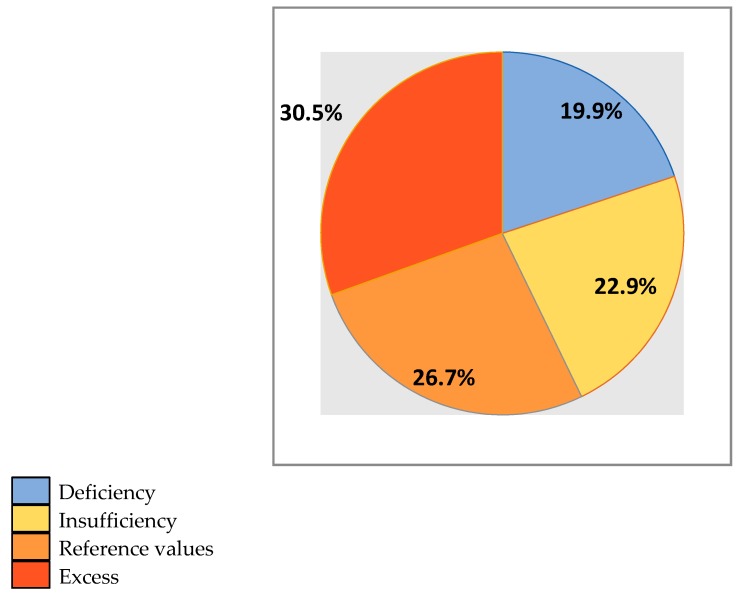
: Vitamin D insufficiency is prevalent among athletes, and it can negatively affect physical performance. At the same time, most of the available data were obtained from untrained individuals of various ages, and published studies performed in athletes led to contradictory conclusions. : This cohort prospective study examined the serum concentration of 25-hydroxycalciferol (25(OH)D) and its association with running speed and muscle power in 131 young football players (mean age 15.6 ± 2.4 years). : 25(OH)D levels were below reference in 42.8% (serum 25(OH)D <30 ng/mL) and above reference in 30.5% of the participants (serum 25(OH)D 61-130 ng/mL). A comparison of the results of 5, 15, and 30 m sprint tests and the standing long jump test found no statistically significant differences between the two groups. Athletes from the 25(OH)D-insufficient group were treated with 5000 IU cholecalciferol supplement daily for 60 days. After the treatment, the 25(OH)D concentration increased by 79.2% and was within reference in 84% of the treated athletes (serum 25(OH)D 30-60 ng/mL). Testing was repeated after the end of treatment, and a statistically significant increase in the results of the 5, 15, and 30 m sprint tests was observed (Cohen's was 0.46, 0.33, and 0.34, respectively), while the results of the standing long jump test remained unchanged. Body height, body weight, and lean body mass of the football players also increased. : These findings indicate that there is likely no correlation between serum levels of 25(OH)D, muscle power, and running speed in young professional football players, and the changes observed post-treatment might have been caused by changes in the anthropometric parameters. During the study, all the anthropometric parameters changed, but the amount of lean body mass only correlated with the results of the 5 m sprint.
: 运动员普遍存在维生素 D 不足的情况,这会对他们的身体表现产生负面影响。同时,大多数现有数据均来自于各个年龄段未经训练的个体,并且在运动员中开展的已发表研究得出了相互矛盾的结论。: 本队列前瞻性研究检查了 131 名年轻足球运动员(平均年龄 15.6 ± 2.4 岁)血清 25-羟维生素 D [25(OH)D] 的浓度及其与跑步速度和肌肉力量的关系。: 42.8%(血清 25(OH)D <30ng/ml)的参与者血清 25(OH)D 水平低于参考值,30.5%(血清 25(OH)D 61-130ng/ml)的参与者血清 25(OH)D 水平高于参考值。对 5m、15m 和 30m 冲刺测试以及立定跳远测试结果进行比较,发现两组之间无统计学显著差异。25(OH)D 不足组的运动员接受每日 5000IU 胆钙化醇补充治疗 60 天。治疗后,25(OH)D 浓度增加 79.2%,84%接受治疗的运动员 25(OH)D 浓度处于参考范围内(血清 25(OH)D 30-60ng/ml)。治疗结束后重复测试,发现 5m、15m 和 30m 冲刺测试的结果有统计学显著提高(Cohen's 分别为 0.46、0.33 和 0.34),而立定跳远测试的结果保持不变。足球运动员的身高、体重和瘦体重也增加了。: 这些发现表明,年轻职业足球运动员的血清 25(OH)D 水平、肌肉力量和跑步速度之间可能没有相关性,并且治疗后观察到的变化可能是由人体测量参数的变化引起的。在研究期间,所有人体测量参数都发生了变化,但瘦体重的量仅与 5m 冲刺的结果相关。