Department of Pediatrics, Diabetology and Endocrinology, Gdansk Medical University, 80-210 Gdansk, Poland.
Department of Health and Natural Sciences, Gdansk University of Physical Education and Sport, 80-336 Gdansk, Poland.
Nutrients. 2022 Jan 25;14(3):521. doi: 10.3390/nu14030521.
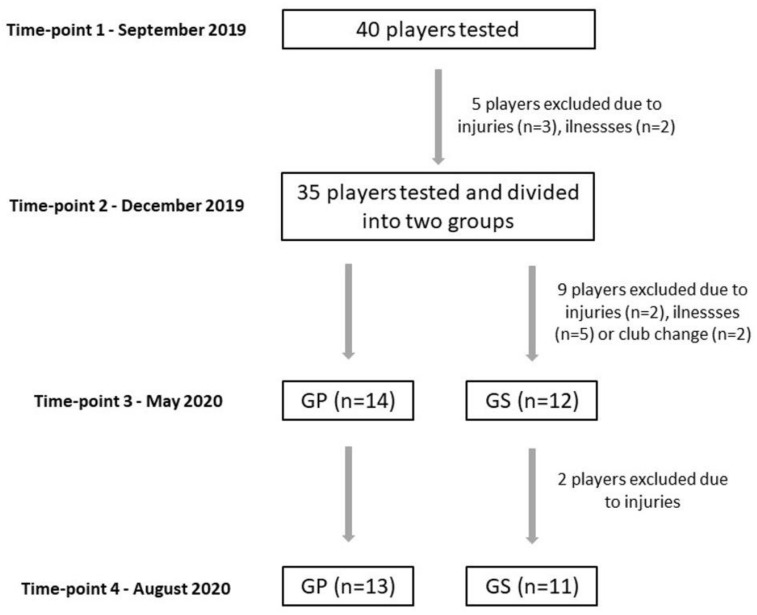
The main purpose of this research was to demonstrate the changes in 25(OH)D concentration, bone resorption markers, and physical fitness along the one-year training season in young soccer players. A total of 24 young soccer players (age: 17.2 ± 1.16 years, mass: 70.2 ± 5.84, height: 179.1 ± 4.26 cm) were tested at four different time points across one year (T1-September 2019; T2-December 2019; T3-May 2020; T4-August 2020). After T2 (during COVID-19 lockdown), players were divided into a supplemented (GS) group and a placebo group (GP). Variables such as 25(OH)D, calcium (Ca), phosphorus (P), parathyroid hormone (PTH), aerobic capacity, speed, and explosive power were measured. Analyses performed for all participants indicated significant changes in all selected blood markers and running speed. The highest values in 25(OH)D were noted during summertime in T1 and T4. After individuals were split into two groups, a two-factorial ANOVA demonstrated a significant time interaction for 25(OH)D, Ca, P, PTH, 30 m sprint, and counter-movement jump. Significant time x group effect was calculated for aerobic capacity. This study confirmed that 25(OH)D concentration varies between four seasons, with the greatest decreases in the low sunlight periods. Vitamin D supplementation did not cause a preventive and long-lasting effect of increasing the 25(OH)D concentration in the young soccer players.
本研究的主要目的是展示一年训练季节中青少年足球运动员 25(OH)D 浓度、骨吸收标志物和体能的变化。共有 24 名年轻足球运动员(年龄:17.2±1.16 岁,体重:70.2±5.84kg,身高:179.1±4.26cm)在一年中的四个不同时间点进行了测试(T1-2019 年 9 月;T2-2019 年 12 月;T3-2020 年 5 月;T4-2020 年 8 月)。在 T2 之后(COVID-19 封锁期间),运动员被分为补充组(GS)和安慰剂组(GP)。测量了 25(OH)D、钙(Ca)、磷(P)、甲状旁腺激素(PTH)、有氧能力、速度和爆发力等变量。对所有参与者进行的分析表明,所有选定的血液标志物和跑步速度都发生了显著变化。T1 和 T4 的夏季记录到了 25(OH)D 的最高值。将个体分为两组后,双因素方差分析表明 25(OH)D、Ca、P、PTH、30m 冲刺和反向纵跳的时间交互作用具有统计学意义。有氧能力的时间×组效应具有统计学意义。本研究证实,25(OH)D 浓度在四个季节之间存在差异,在光照较少的时期降幅最大。维生素 D 补充剂并未对青少年足球运动员 25(OH)D 浓度的增加产生预防和持久的作用。