Department of Sport Medicine and Medical Rehabilitation, Sechenov First Moscow State Medical University (Sechenov University), 119435 Moscow, Russia.
FC Lokomotiv, 107553 Moscow, Russia.
Nutrients. 2019 Oct 8;11(10):2405. doi: 10.3390/nu11102405.
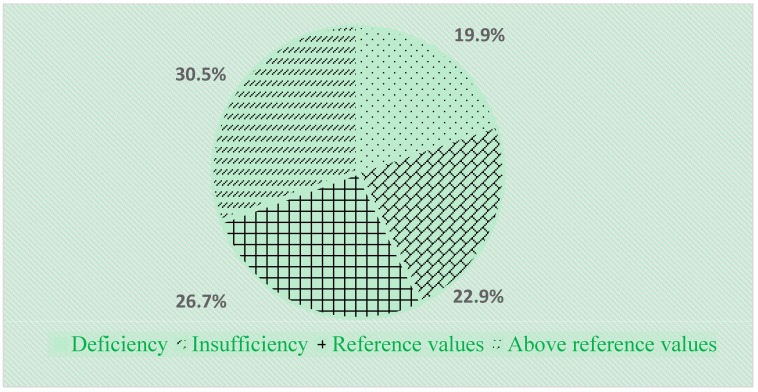
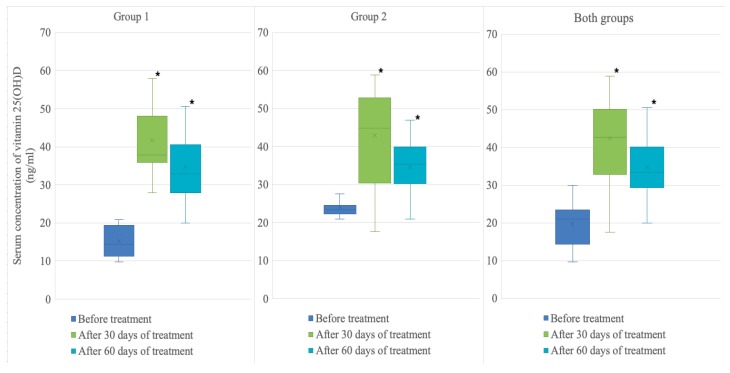
Vitamin D (25(OH)D) insufficiency and deficiency are highly prevalent in adult soccer players and can exceed 80% even in regions with high insolation; however, the treatment of this condition is often complicated. The aim of the present study was to examine the prevalence of vitamin D insufficiency and deficiency in youth Russian soccer players and the efficacy of its treatment. Participants were 131 young male football players (age 15.6 ± 2.4 years). Low vitamin D levels (below 30 ng/mL) were observed in 42.8% of the analyzed participants. These athletes were split in two groups composed of persons with vitamin D deficiency (serum vitamin D below 21 ng/mL) and insufficiency (serum vitamin D in range of 21-29 ng/mL). A dietary supplement of 5000 IU cholecalciferol per day was administered for two months. After the treatment, an average 92% increase in vitamin D concentration was observed (before treatment-19.7 ± 5.4 ng/mL, after treatment-34.7 ± 8.6 ng/mL, p<0.001) and 74% of the post-treatment values were within the reference range (30-60 ng/mL). Serum concentration of vitamin D increased by 200% ± 98% (p<0.001) during the first month of treatment with vitamin D deficiency and insufficiency being successfully treated in 83% of the football players. In summary, the prevalence of vitamin D insufficiency and deficiency was high in young Russian soccer players. Furthermore, it was indicated that the daily usage of cholecalciferol in a dose 5000 IU was an effective and well-tolerated treatment for vitamin D insufficiency. No linear dependency between the duration of treatment and increase in vitamin 25(OH)D concentration was observed.
维生素 D(25(OH)D)不足和缺乏在成年足球运动员中非常普遍,即使在高阳光地区,其发生率也可超过 80%;然而,这种情况的治疗往往很复杂。本研究旨在检查俄罗斯青年足球运动员维生素 D 不足和缺乏的发生率以及其治疗效果。参与者为 131 名年轻男性足球运动员(年龄 15.6 ± 2.4 岁)。在分析的参与者中,有 42.8%存在低维生素 D 水平(低于 30ng/ml)。这些运动员分为两组,一组是维生素 D 缺乏症患者(血清维生素 D 低于 21ng/ml),另一组是维生素 D 不足症患者(血清维生素 D 在 21-29ng/ml 范围内)。每天给予 5000IU 胆钙化醇作为膳食补充剂,连续治疗两个月。治疗后,维生素 D 浓度平均增加 92%(治疗前 19.7 ± 5.4ng/ml,治疗后 34.7 ± 8.6ng/ml,p<0.001),74%的治疗后值处于参考范围(30-60ng/ml)内。血清维生素 D 浓度增加 200%±98%(p<0.001),在第一个月的治疗中,维生素 D 缺乏症和不足症患者的治疗成功率为 83%。总之,俄罗斯年轻足球运动员中维生素 D 不足和缺乏的发生率很高。此外,每天使用 5000IU 胆钙化醇治疗维生素 D 不足是一种有效且耐受性良好的治疗方法。未观察到治疗时间与维生素 25(OH)D 浓度增加之间存在线性依赖性。