Di Nota Paula M, Huhta Juha-Matti
Department of Psychology, University of Toronto, Mississauga, ON, Canada.
Office of Applied Research & Graduate Studies, Justice Institute of British Columbia, New Westminster, BC, Canada.
Front Psychol. 2019 Aug 7;10:1797. doi: 10.3389/fpsyg.2019.01797. eCollection 2019.
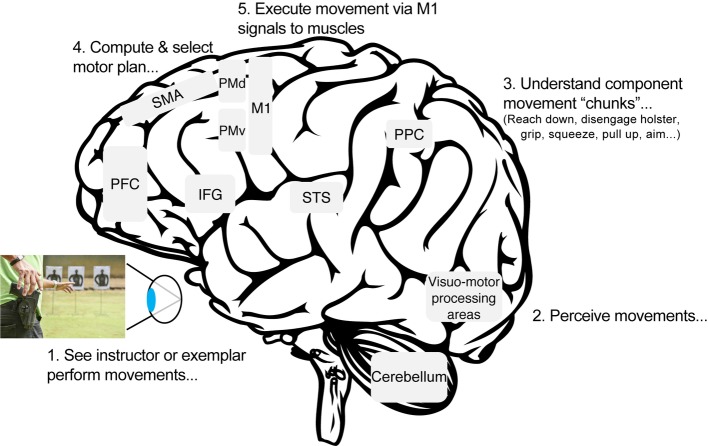
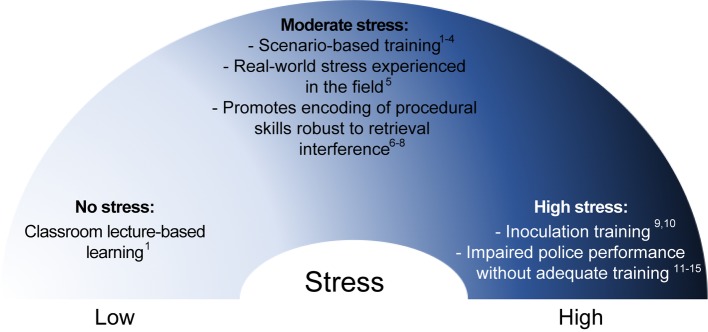
The practices surrounding police training of complex motor skills, including the use of force, varies greatly around the world, and even over the course of an officer's career. As the nature of policing changes with society and the advancement of science and technology, so should the training practices that officers undertake at both central (i.e., police academy basic recruit training) and local (i.e., individual agency or precinct) levels. The following review is intended to bridge the gap between scientific knowledge and applied practice to inform best practices for training complex motor skills that are unique and critical to law enforcement, including the use of lethal force. We begin by providing a basic understanding of the fundamental cognitive processes underlying motor learning, from novel skill acquisition to complex behaviors including situational awareness, and decision-making that precede and inform action. Motor learning, memory, and perception are then discussed within the context of occupationally relevant stress, with a review of evidence-based training practices that promote officer performance and physiological responses to stress during high-stakes encounters. A lack of applied research identifying the neurophysiological mechanisms underlying motor learning in police is inferred from a review of evidence from various clinical populations suffering from disorders of cognitive and motor systems, including Alzheimer's and Parkinson's disease and stroke. We conclude this review by identifying practical, organizational, and systemic challenges to implementing evidence-based practices in policing and provide recommendations for best practices that will promote training effectiveness and occupational safety of end-users (i.e., police trainers and officers).
世界各地围绕警察复杂运动技能训练(包括使用武力)的做法差异很大,甚至在警察职业生涯中也是如此。随着警务工作的性质随着社会以及科学技术的发展而变化,警察在中央层面(即警察学院新警基础训练)和地方层面(即个别机构或辖区)所接受的训练做法也应随之改变。以下综述旨在弥合科学知识与应用实践之间的差距,为训练对执法工作独特且关键的复杂运动技能(包括使用致命武力)提供最佳实践依据。我们首先对运动学习背后的基本认知过程进行基本介绍,从新技能的习得到包括情境意识在内的复杂行为,以及行动之前并为行动提供依据的决策。然后在与职业相关的压力背景下讨论运动学习、记忆和感知,并回顾基于证据的训练做法,这些做法可促进警察在高风险遭遇中的表现以及对压力的生理反应。从对包括阿尔茨海默病、帕金森病和中风在内的各种认知和运动系统紊乱临床人群的证据回顾中可以推断,缺乏确定警察运动学习背后神经生理机制的应用研究。我们通过确定在警务工作中实施基于证据的做法所面临的实际、组织和系统挑战来结束本综述,并为最佳实践提供建议,这些建议将提高最终用户(即警察培训人员和警察)的训练效果和职业安全性。