Sakuma Satoru, Minamino Saaya, Takase Maya, Ishiyama Yoshitaka, Hosokura Hiroyuki, Kohda Tetsuya, Ikeda Yukino, Fujimoto Yohko
Department of Physiological Chemistry, Osaka University of Pharmaceutical Sciences, 4-20-1 Nasahara, Takatsuki, Osaka 569-1094, Japan.
Heliyon. 2019 Aug 9;5(8):e02244. doi: 10.1016/j.heliyon.2019.e02244. eCollection 2019 Aug.
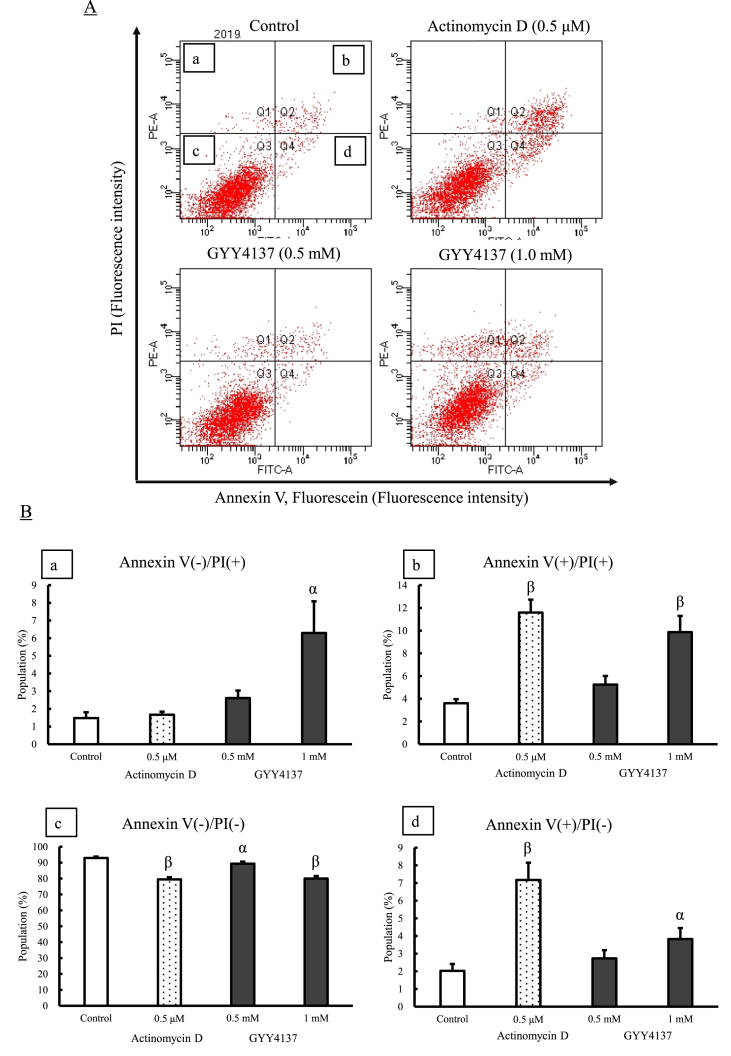
Conflicting data regarding the ability of hydrogen sulfide (HS), which reaches high levels in the large intestine owing to biosynthesis in the intestinal cells and intestinal bacteria, to promote or inhibit colorectal cancer cell proliferation have been reported recently. In the present study, the effect of HS on the proliferation of the human colorectal cancer cell line Caco-2 was examined by using the HS donor GYY4137. At concentrations of 0.5 mM and 1.0 mM, GYY4137 significantly inhibited Caco-2 cell viability. Cell cycle analysis, and apoptosis and necrosis detection revealed that the anti-proliferative effect of GYY4137 was partially attributable to the induction of S-G/M cell cycle arrest, apoptosis and necrosis. These results suggest that HS has the potential to suppress human colorectal cancer cell proliferation by influencing both cell cycle and cell death.
由于肠道细胞和肠道细菌中的生物合成作用,硫化氢(HS)在大肠中会达到较高水平,关于其促进或抑制结肠直肠癌细胞增殖能力的数据最近相互矛盾。在本研究中,使用HS供体GYY4137检测了HS对人结肠直肠癌细胞系Caco-2增殖的影响。在0.5 mM和1.0 mM浓度下,GYY4137显著抑制Caco-2细胞活力。细胞周期分析以及凋亡和坏死检测表明,GYY4137的抗增殖作用部分归因于诱导S-G/M期细胞周期停滞、凋亡和坏死。这些结果表明,HS有可能通过影响细胞周期和细胞死亡来抑制人结肠直肠癌细胞增殖。