Zheng Chen, Quan Ruida, Xia Er-Jie, Bhandari Adheesh, Zhang Xiaohua
Department of Thyroid and Breast Surgery, The First Affiliated Hospital of Wenzhou Medical University, Wenzhou, Zhejiang 325000, P.R. China.
Oncol Lett. 2019 Sep;18(3):3227-3235. doi: 10.3892/ol.2019.10632. Epub 2019 Jul 18.
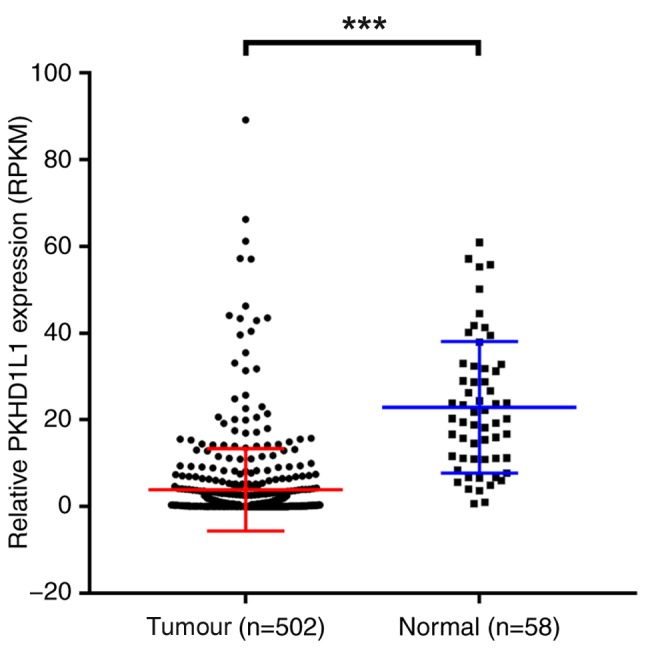
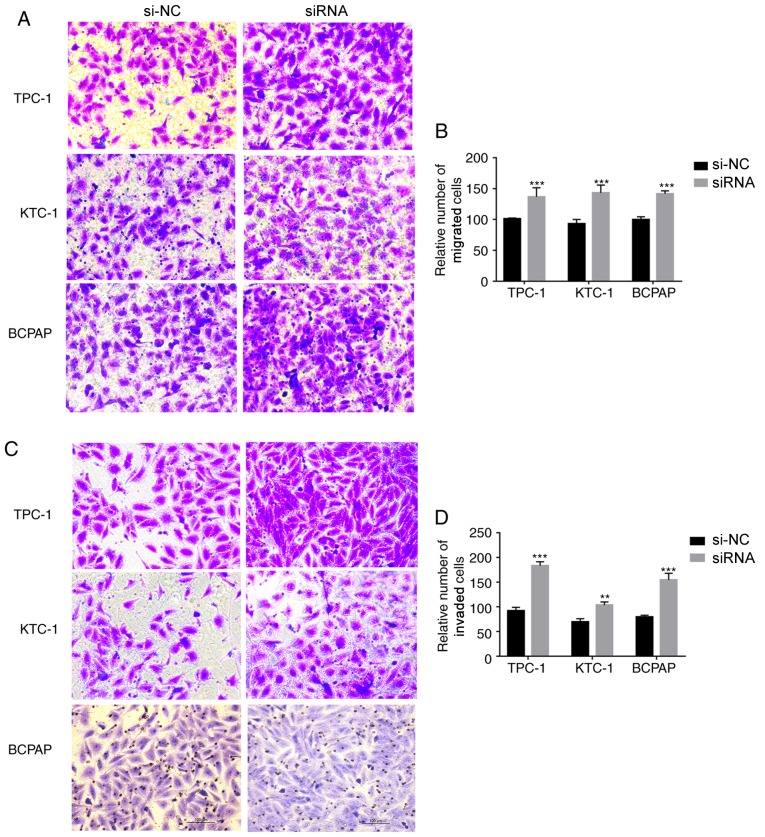
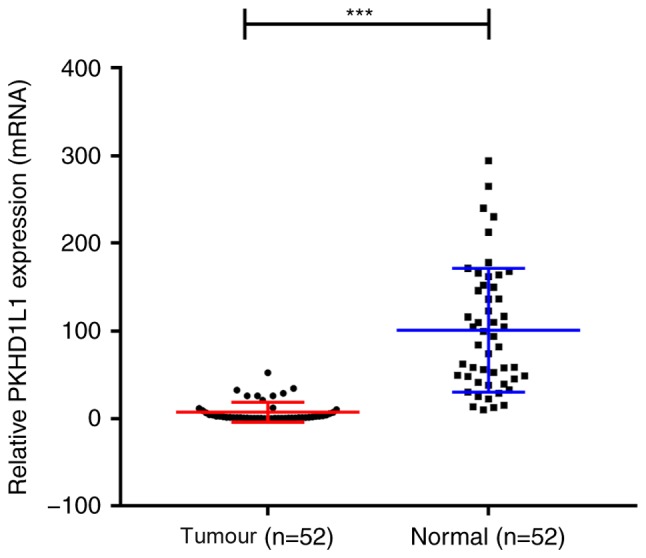
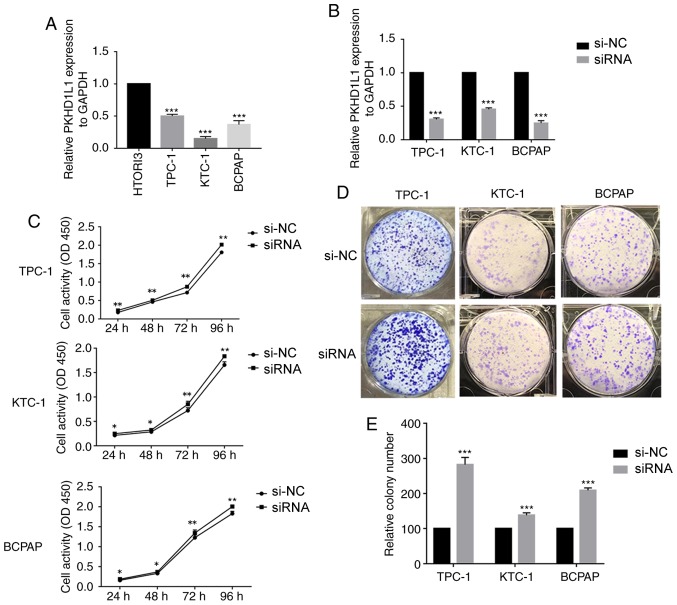
In recent decades, thyroid cancer (TC) has become one of the most common endocrine malignancies. Next-generation sequencing of paired TC and adjacent healthy thyroid tissues demonstrated that polycystic kidney and hepatic disease 1-like 1 (PKHD1L1) may serve as a tumour suppressor gene in thyroid cancer. However, the function of PKHD1L1 in thyroid cancer is still unknown. To validate the results of whole-transcriptome resequencing, the expression levels of PKHD1L1 were evaluated in 58 pairs of papillary thyroid cancer (PTC) tissue samples and three thyroid cancer cell lines. In addition, The Cancer Genome Atlas (TCGA) data were used to analyse the relationship between PKHD1L1 and patient clinicopathological features. Cell Counting Kit-8, colony formation, migration and invasion assays were performed to assess the effects of PKHD1L1 knockdown in three TC cell lines. PKHD1L1 expression was significantly lower in thyroid carcinoma compared with that in matched normal tissue, and this result was consistent with that in TCGA cohort. TCGA data demonstrated that PKHD1L1 downregulation was associated with a number of aggressive clinicopathological features, such as histological type, lymph node metastasis (LNM), distant metastasis, tumour size and clinical stage. Logistic regression analysis of data from patients with PTC revealed that PKHD1L1 expression, histological type, age and tumour size were independent high-risk factors for LNM. The PKHD1L1 biological function was investigated in the three TC cell lines: TPC-1, KTC1 and BCPAP. A loss of function experiment demonstrated that PKHD1L1 knockdown promoted cell proliferation, colony formation and cell invasion in TC cell lines. In conclusion, PKHD1L1 may be a tumour suppressor gene associated with PC, and may be a potential therapeutic target in the future.
近几十年来,甲状腺癌(TC)已成为最常见的内分泌恶性肿瘤之一。对配对的甲状腺癌组织和相邻健康甲状腺组织进行的二代测序表明,多囊肾和肝病1样1(PKHD1L1)可能作为甲状腺癌中的一种肿瘤抑制基因。然而,PKHD1L1在甲状腺癌中的功能仍不清楚。为了验证全转录组重测序的结果,在58对甲状腺乳头状癌(PTC)组织样本和三种甲状腺癌细胞系中评估了PKHD1L1的表达水平。此外,利用癌症基因组图谱(TCGA)数据来分析PKHD1L1与患者临床病理特征之间的关系。进行细胞计数试剂盒-8、集落形成、迁移和侵袭试验,以评估在三种甲状腺癌细胞系中敲低PKHD1L1的效果。与配对的正常组织相比,甲状腺癌中PKHD1L1的表达显著降低,这一结果与TCGA队列中的结果一致。TCGA数据表明,PKHD1L1下调与一些侵袭性临床病理特征相关,如组织学类型、淋巴结转移(LNM)(远处转移、肿瘤大小和临床分期。对PTC患者的数据进行逻辑回归分析显示,PKHD1L1表达、组织学类型、年龄和肿瘤大小是LNM的独立高危因素。在三种甲状腺癌细胞系TPC-1、KTC1和BCPAP中研究了PKHD1L1的生物学功能。功能丧失实验表明,敲低PKHD1L1可促进甲状腺癌细胞系中的细胞增殖、集落形成和细胞侵袭。总之,PKHD1L1可能是一种与甲状腺癌相关的肿瘤抑制基因,并且可能是未来潜在的治疗靶点。