Agha Mickey, Yanagitsuru Yuzo R, Fangue Nann A, Nowakowski A Justin, Kojima Laura V, Cech Joseph J, Riley Melissa K, Freeman Janna, Cocherell Dennis E, Todd Brian D
Department of Wildlife, Fish, and Conservation Biology, University of California, Davis, One Shields Avenue, Davis, CA, USA.
Conserv Physiol. 2019 Aug 21;7(1):coz054. doi: 10.1093/conphys/coz054. eCollection 2019.
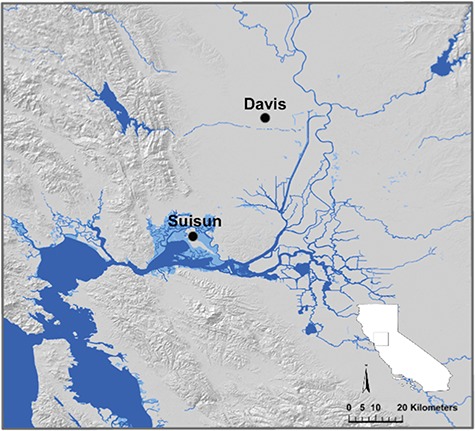
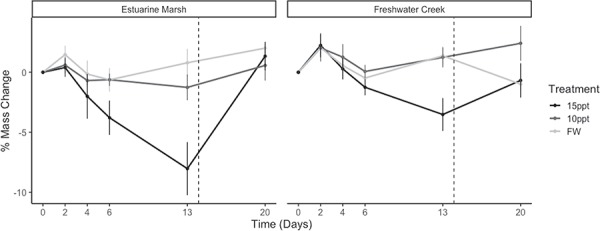
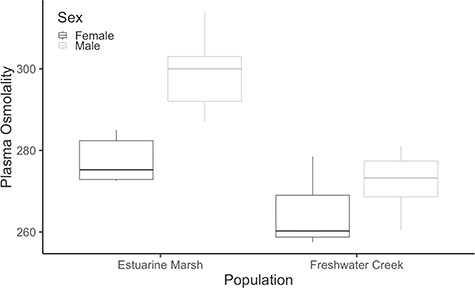
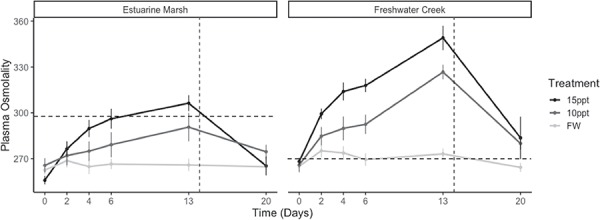
Sea-level rise, drought and water diversion can all lead to rapid salinization of freshwater habitats, especially in coastal areas. Increased water salinities can in turn alter the geographic distribution and ecology of freshwater species including turtles. The physiological consequences of salinization for freshwater turtles, however, are poorly known. Here, we compared the osmoregulatory response of two geographically separate populations of the freshwater Western Pond Turtle ()-a species declining across its range in western North America-to three constant salinities: 0.4 ppt, 10 ppt and 15 ppt over 2 weeks. We found that turtles from a coastal estuarine marsh population regulated their plasma osmolality at lower levels than their conspecifics from an inland freshwater creek population 45 km away. Plasma osmolalities were consistently lower in estuarine marsh turtles than the freshwater creek turtles over the entire 2-week exposure to 10 ppt and 15 ppt water. Furthermore, estuarine marsh turtles maintained plasma osmolalities within 1 SD of their mean field osmolalities over the 2-week exposure, whereas freshwater creek turtles exceeded their field values within the first few days after exposure to elevated salinities. However, individuals from both populations exhibited body mass loss in 15 ppt water, with significantly greater loss in estuarine turtles. We speculate that the greater ability to osmoregulate by the estuarine marsh turtles may be explained by their reduced feeding and drinking in elevated salinities that was not exhibited by the freshwater creek population. However, due to mass loss in both populations, physiological and behavioural responses exhibited by estuarine marsh turtles may only be effective adaptations for short-term exposures to elevated salinities, such as those from tides and when traversing saline habitats, and are unlikely to be effective for long-term exposure to elevated salinity as is expected under sea-level rise.
海平面上升、干旱和引水都可能导致淡水栖息地迅速盐碱化,尤其是在沿海地区。盐度增加反过来又会改变包括海龟在内的淡水物种的地理分布和生态。然而,盐碱化对淡水龟生理的影响却鲜为人知。在此,我们比较了淡水西部锦龟()两个地理隔离种群的渗透调节反应,该物种在北美洲西部的分布范围内数量正在减少,将其置于三种恒定盐度环境下:0.4ppt、10ppt和15ppt,持续两周。我们发现,来自沿海河口沼泽种群的海龟调节其血浆渗透压的水平低于距离45公里外内陆淡水溪流种群的同种海龟。在整个两周暴露于10ppt和15ppt水体的过程中,河口沼泽海龟的血浆渗透压始终低于淡水溪流海龟。此外,河口沼泽海龟在两周暴露期间将血浆渗透压维持在其平均野外渗透压的1个标准差范围内,而淡水溪流海龟在暴露于高盐度后的头几天内就超过了其野外值。然而,两个种群的个体在15ppt水体中均出现体重减轻,河口海龟的体重减轻更为显著。我们推测,河口沼泽海龟更强的渗透调节能力可能是由于它们在高盐度环境下摄食和饮水减少,而淡水溪流种群并未表现出这种情况。然而,由于两个种群都出现体重减轻,河口沼泽海龟表现出的生理和行为反应可能仅对短期暴露于高盐度环境有效,例如潮汐引起的以及穿越盐碱栖息地时的高盐度暴露,而对于海平面上升预期下的长期高盐度暴露可能无效。