Global Hepatitis Programme, World Health Organization, Geneva, Switzerland.
Department of Gastroenterology, Kanazawa University and WHO Collaborating Center for Chronic Hepatitis and Liver Cancer, Kanazawa, Ishikawa, Japan.
BMC Health Serv Res. 2019 Aug 27;19(1):600. doi: 10.1186/s12913-019-4366-9.
Reuse of injection devices to give healthcare injections decreased from 39.8 to 5.5% between 2000 and 2010, but trends since 2011 have not been described. We reviewed results of Demographic and Health Surveys (DHS) to describe injection practices worldwide from 2011 to 2015.
We searched the DHS Internet site for data published on injection practices conducted in countries from 2011 to 2015, extracted information on frequency (number of healthcare injections per person in the last 12 months) and safety (proportion of syringes and needles taken from a new, unopened package). We compared gender groups and WHO regions in terms of frequency and safety. For countries with data available, we compared injection practices 2004-2010 and 2011-2015.
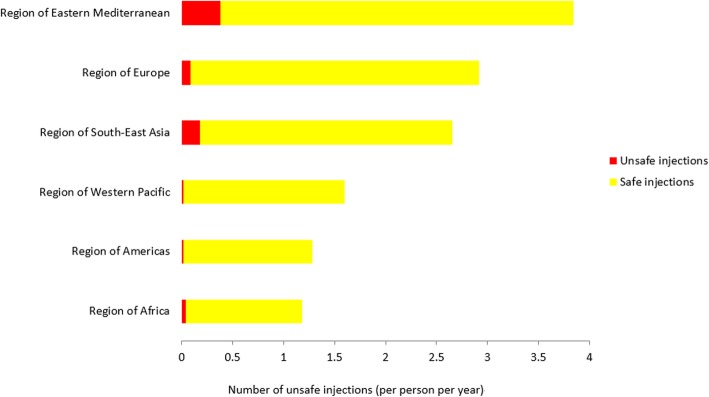
Since 2011, 40 of 92 countries (43%) that conducted DHS surveys reported on injection practices. On average, the frequency of injection was 1.64 per person per year (from 3.84 in WHO Eastern Mediterranean region to 1.18 in WHO African region). Among those, 96.1% of injections reportedly used new injection devices (from 90.2% in the WHO Eastern Mediterranean region to 98.8% in the WHO Western Pacific region). On average, women received more injections per year (1.85) than men (1.41). Among 16 (40%) countries with data in 2004-2010 and 2011-2015, 69% improved in terms of safety. The annual number of unsafe injections reduced in 81% of countries. In Pakistan, the number of unsafe injections was the highest and did not decrease between 2006 and 2012.
Injection practices have continued to improve in most countries worldwide, although the Eastern Mediterranean region in particular still faces unsafe practices that are not improving. Further efforts are needed to eliminate unsafe injection practices in health care settings, including through the use of reuse-prevention devices. Despite some limitations, DHS is an easily available method to measure progress over time.
2000 年至 2010 年间,注射装置的重复使用比例从 39.8%降至 5.5%,但自 2011 年以来的趋势尚未描述。我们查阅了人口与健康调查(DHS)的数据,以描述 2011 年至 2015 年间全球的注射实践情况。
我们在 DHS 网站上搜索了 2011 年至 2015 年在各国进行的注射实践相关数据,提取了频率(过去 12 个月内每人接受的医疗注射次数)和安全性(从新的、未开封的包装中取出的注射器和针头比例)信息。我们比较了不同性别组和世卫组织区域的频率和安全性。对于有数据的国家,我们比较了 2004-2010 年和 2011-2015 年的注射实践情况。
自 2011 年以来,在开展 DHS 调查的 92 个国家中,有 40 个(43%)报告了注射实践情况。平均而言,每年每人接受的注射次数为 1.64 次(从世卫组织东地中海区域的 3.84 次到世卫组织非洲区域的 1.18 次)。其中,据报告,96.1%的注射使用了新的注射装置(从世卫组织东地中海区域的 90.2%到世卫组织西太平洋区域的 98.8%)。平均而言,女性每年接受的注射次数(1.85 次)多于男性(1.41 次)。在 2004-2010 年和 2011-2015 年有数据的 16 个(40%)国家中,69%的国家在安全性方面有所改善。81%的国家不安全注射的数量有所减少。在巴基斯坦,不安全注射的数量最多,且在 2006 年至 2012 年间没有减少。
尽管在特定地区仍存在未得到改善的不安全注射实践,但全球大多数国家的注射实践仍在持续改善。需要进一步努力,包括通过使用防止重复使用的装置,在卫生保健环境中消除不安全的注射实践。尽管存在一些局限性,但 DHS 是一种随时可用的方法,可以衡量随着时间的推移的进展。