Diao Zhaolu, Hirte Johannes, Chen Wenwen, Spatz Joachim P
Department of Cellular Biophysics, Max Planck Institute for Medical Research, Jahnstraße 29, D-69120 Heidelberg, Germany.
Department of Biophysical Chemistry, University of Heidelberg, INF 253, D-69120 Heidelberg, Germany.
ACS Omega. 2017 Aug 28;2(8):5012-5018. doi: 10.1021/acsomega.7b01001. eCollection 2017 Aug 31.
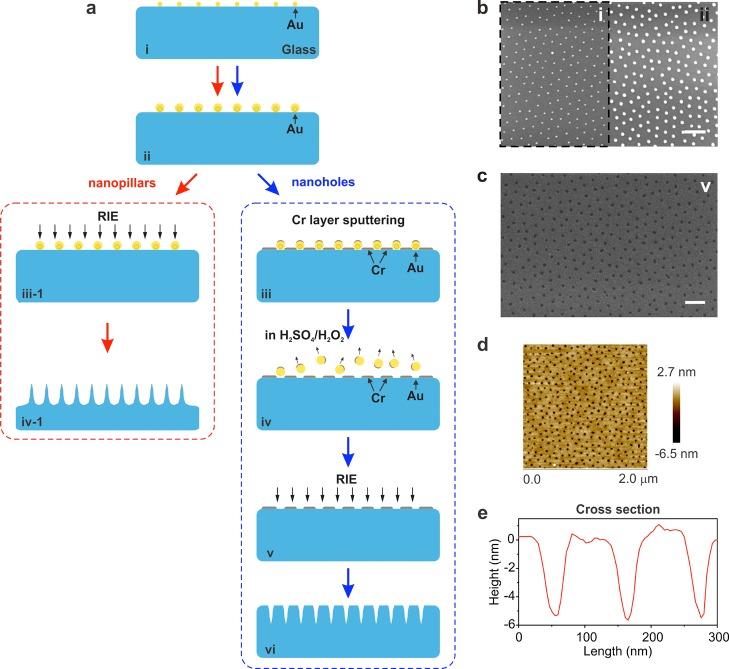
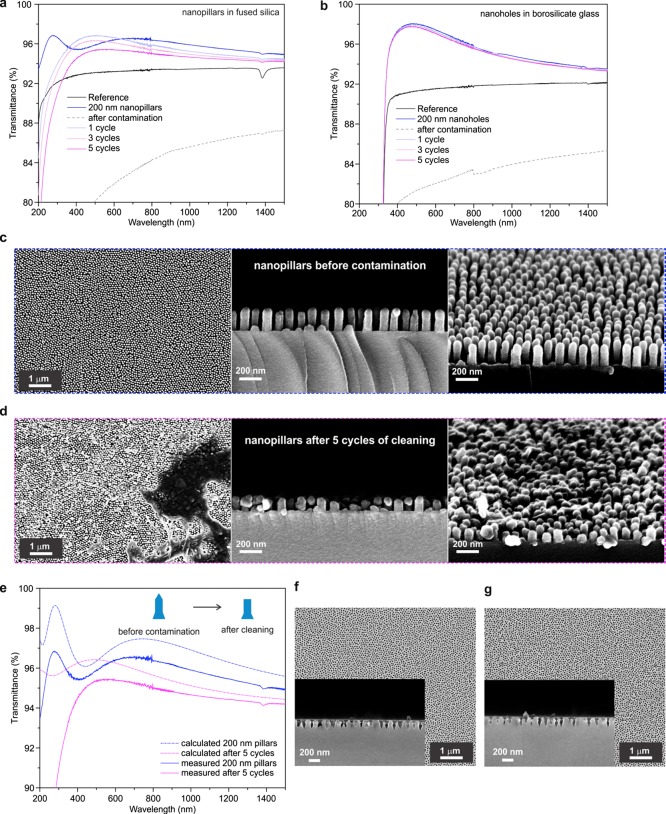
Moth-eye-inspired nanostructures are highly useful for antireflection applications. However, block copolymer micelle lithography, an effective method to prepare moth eye nanopillars, can only be used on a limited choice of substrates. Another drawback of nanopillar substrates is that contamination is easily absorbed, thereby reducing transmittance. The production of antireflective surfaces that are contamination-resistant or that can be cleaned easily without the loss of optical properties remains challenging. Here, we describe an approach for creating inverse moth eye nanostructures on other optical substrates than the most commonly used fused silica. We demonstrate its feasibility by fabricating a borosilicate substrate with inverse nanostructures on both sides. The etching of nanoholes on both sides of the substrate improves its transmittance by 8%, thereby surpassing the highest increase of transmittance yet to be obtained with nanopillars on fused silica. More importantly, the substrate with inverse moth eye nanostructures is more robust against contaminations than the substrates with nanopillars. No significant decrease in performance is observed after five cycles of repeated contamination and cleaning. Our approach is transferable to a variety of optical materials, rendering our antireflection nanostructures ideal for applications in touch devices such as touch screens and display panels.
受蛾眼启发的纳米结构在抗反射应用中非常有用。然而,嵌段共聚物胶束光刻作为制备蛾眼纳米柱的有效方法,只能用于有限的几种基板。纳米柱基板的另一个缺点是容易吸附污染物,从而降低透光率。生产抗污染或易于清洁且不损失光学性能的抗反射表面仍然具有挑战性。在此,我们描述了一种在除最常用的熔融石英之外的其他光学基板上创建反向蛾眼纳米结构的方法。我们通过在硼硅酸盐基板两侧制造具有反向纳米结构来证明其可行性。在基板两侧蚀刻纳米孔可将其透光率提高8%,从而超过了熔融石英上纳米柱迄今所能实现的最高透光率增幅。更重要的是,具有反向蛾眼纳米结构的基板比具有纳米柱的基板更抗污染。在经过五次重复污染和清洁循环后,未观察到性能有显著下降。我们的方法可转移到多种光学材料上,使我们的抗反射纳米结构非常适合用于触摸屏和显示面板等触摸设备。