Clinic of Radiotherapy and Radiation Oncology, University Hospital Basel, Petersgraben 4, 4031, Basel, Switzerland.
Radiat Oncol. 2019 Aug 28;14(1):153. doi: 10.1186/s13014-019-1364-3.
The heart and lungs are routinely exposed to incidental irradiation during adjuvant radiotherapy (RT) of breast cancer. We analyzed the impact of patient and treatment characteristics on heart and lung dose in left-sided breast RT.
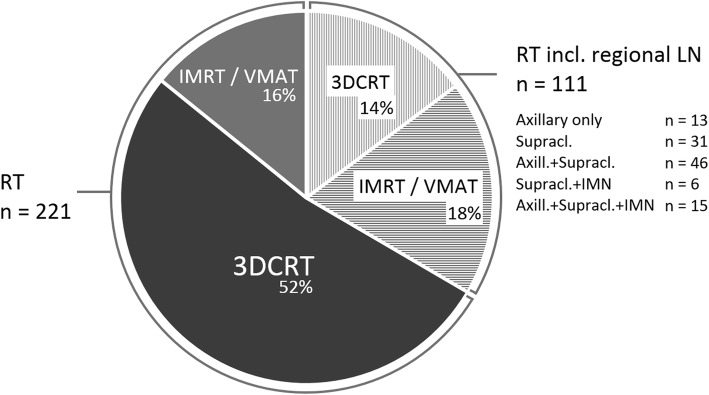
We analyzed 332 female patients treated with left-sided breast RT between 2013 and 2018. Mean heart dose (MHD), left mean lung dose (MLD) and heart / lung V were collected from treatment plans. Patients were stratified by RT technique (3D-conformal RT, 3DCRT; intensity-modulated RT, IMRT; volumetric modulated arc therapy, VMAT) and target volumes, including lymph node RT (LN-RT). Patient characteristics (body mass index (BMI), heart and lung volume) were assessed using correlation analyses.
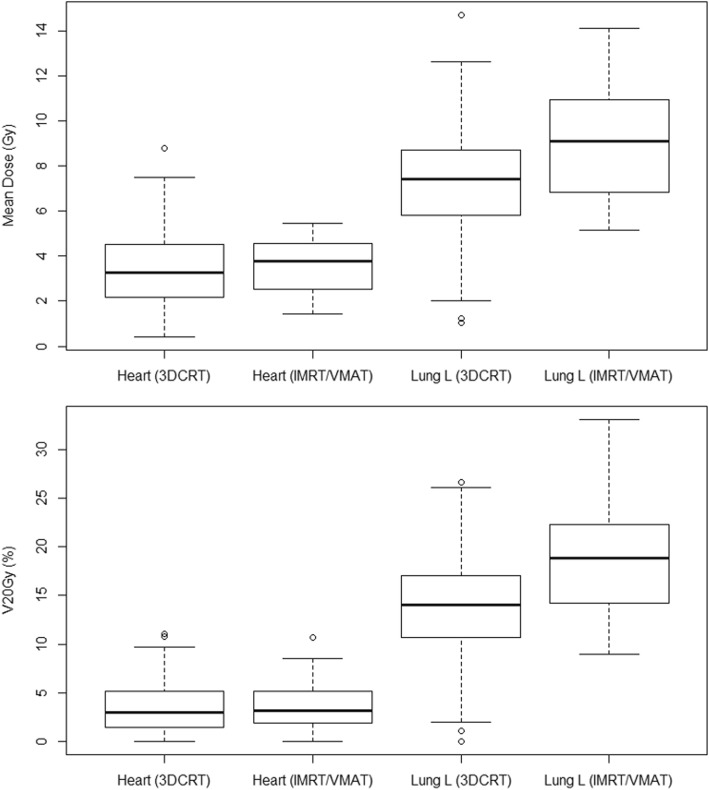
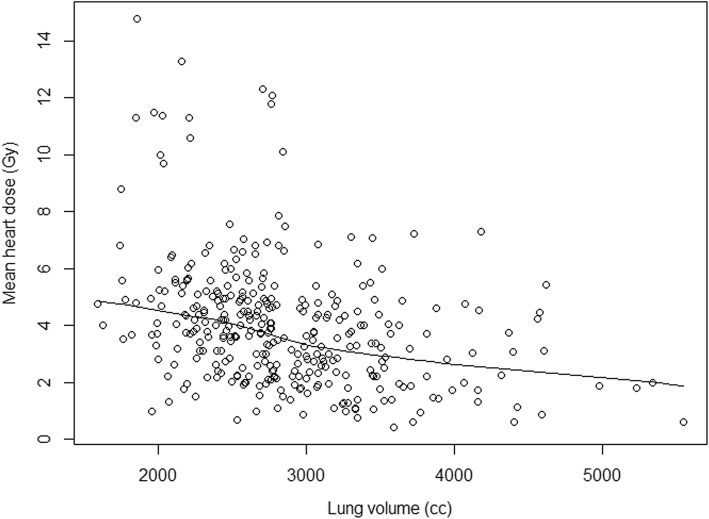
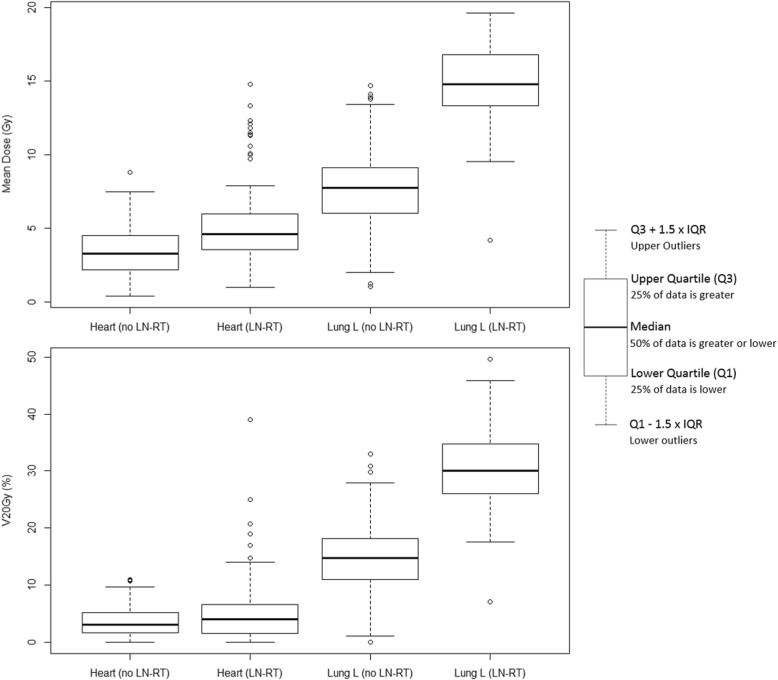
LN-RT was performed in 111 patients with increased MHD (median 4.6 vs. 3.3 Gy; p < .01), left MLD (14.8 vs. 7.7 Gy; p < .01) and left lung V (30.0% vs. 14.4%; p < .01) compared to treatment without LN-RT. Internal mammary LN-RT further increased organ doses compared to RT involving only supraclavicular +/- axillary LN (p < .01 for all values; MHD 6.9 vs. 4.2 Gy). In 221 patients treated without LN-RT, IMRT/VMAT was associated with higher left lung doses (MLD 9.1 vs. 7.4 Gy, p < .01; V 18.8% vs. 14.0%, p < .01) compared to 3DCRT. A negative correlation between total lung volume and both MHD (r = - 0.38; p < .01) and heart V (r = - 0.37; p < .01), as well as a weak positive correlation of BMI and MHD (r = 0.27; p < .01) were observed.
In adjuvant RT for left-sided breast cancer, LN-RT is associated with a marked increase in heart and lung doses, particularly with internal mammary LN-RT. Potential advantages of IMRT/VMAT for breast or chest wall RT need to be weighed against a moderately increased lung dose.
在乳腺癌辅助放疗(RT)中,心脏和肺部通常会受到偶然照射。我们分析了患者和治疗特征对左侧乳腺癌 RT 中心脏和肺部剂量的影响。
我们分析了 2013 年至 2018 年间接受左侧乳腺癌 RT 的 332 名女性患者。从治疗计划中收集平均心脏剂量(MHD)、左肺平均剂量(MLD)和心脏/肺 V。根据放疗技术(三维适形放疗、3DCRT;调强放疗、IMRT;容积旋转调强放疗、VMAT)和靶区(包括淋巴结放疗、LN-RT)对患者进行分层。使用相关性分析评估患者特征(体重指数(BMI)、心脏和肺部容积)。
111 例接受 LN-RT 的患者 MHD(中位数 4.6 比 3.3 Gy;p < 0.01)、左 MLD(14.8 比 7.7 Gy;p < 0.01)和左肺 V(30.0%比 14.4%;p < 0.01)均增加,与未行 LN-RT 的治疗相比。与仅锁骨上/腋下 LN(所有值的 p < 0.01;MHD 6.9 比 4.2 Gy)相比,内乳淋巴结 LN-RT 进一步增加了器官剂量。在 221 例未行 LN-RT 的患者中,与 3DCRT 相比,IMRT/VMAT 与更高的左肺剂量(MLD 9.1 比 7.4 Gy,p < 0.01;V 18.8%比 14.0%,p < 0.01)相关。总肺容积与 MHD(r = -0.38;p < 0.01)和心脏 V(r = -0.37;p < 0.01)呈负相关,BMI 与 MHD 呈弱正相关(r = 0.27;p < 0.01)。
在左侧乳腺癌辅助 RT 中,LN-RT 与心脏和肺部剂量显著增加有关,尤其是内乳淋巴结 LN-RT。IMRT/VMAT 治疗乳房或胸壁 RT 的潜在优势需要与适度增加的肺剂量相权衡。