Law G W, Wong Y R, Yew A K-S, Choh A C T, Koh J S B, Howe T S
Department of Orthopaedic Surgery, Singapore General Hospital, Singapore, Singapore.
Singapore General Hospital, Singapore, Singapore.
Bone Joint Res. 2019 Aug 2;8(7):313-322. doi: 10.1302/2046-3758.87.BJR-2018-0271.R1. eCollection 2019 Jul.
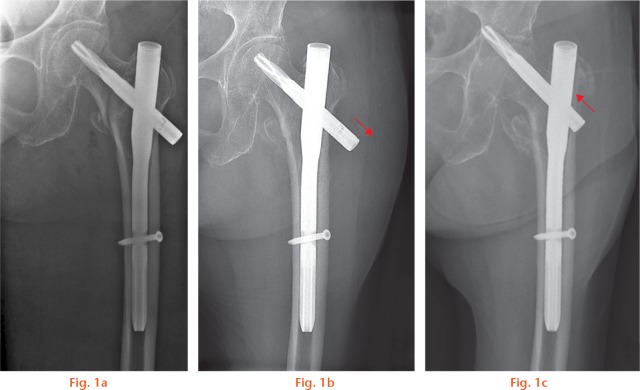
The paradoxical migration of the femoral neck element (FNE) superomedially against gravity, with respect to the intramedullary component of the cephalomedullary device, is a poorly understood phenomenon increasingly seen in the management of pertrochanteric hip fractures with the intramedullary nail. The aim of this study was to investigate the role of bidirectional loading on the medial migration phenomenon, based on unique wear patterns seen on scanning electron microscopy of retrieved implants suggestive of FNE toggling.
A total of 18 synthetic femurs (Sawbones, Vashon Island, Washington) with comminuted pertrochanteric fractures were divided into three groups (n = 6 per group). Fracture fixation was performed using the Proximal Femoral Nail Antirotation (PFNA) implant (Synthes, Oberdorf, Switzerland; n = 6). Group 1 was subjected to unidirectional compression loading (600 N), with an elastomer (70A durometer) replacing loose fracture fragments to simulate surrounding soft-tissue tensioning. Group 2 was subjected to bidirectional loading (600 N compression loading, 120 N tensile loading), also with the elastomer replacing loose fracture fragments. Group 3 was subjected to bidirectional loading (600 N compression loading, 120 N tensile loading) without the elastomer. All constructs were tested at 2 Hz for 5000 cycles or until cut-out occurred. The medial migration distance (MMD) was recorded at the end of the testing cycles.
The MMDs for Groups 1, 2, and 3 were 1.02 mm, 6.27 mm, and 5.44 mm respectively, with reliable reproduction of medial migration seen in all groups. Bidirectional loading groups showed significantly higher MMDs compared with the unidirectional loading group (p < 0.01).
Our results demonstrate significant contributions of bidirectional cyclic loading to the medial migration phenomenon in cephalomedullary nail fixation of pertrochanteric hip fractures.: G. W. Law, Y. R. Wong, A. K-S. Yew, A. C. T. Choh, J. S. B. Koh, T. S. Howe. Medial migration in cephalomedullary nail fixation of pertrochanteric hip fractures: A biomechanical analysis using a novel bidirectional cyclic loading model. 2019;8:313-322. DOI: 10.1302/2046-3758.87.BJR-2018-0271.R1.
相对于髓内钉的头髓内固定装置,股骨颈部件(FNE)逆重力向内侧的反常移位是一种尚未被充分理解的现象,在股骨转子间骨折的髓内钉治疗中越来越常见。本研究的目的是基于取出的植入物扫描电子显微镜下显示的FNE翻转独特磨损模式,研究双向加载对内侧移位现象的作用。
将18具患有粉碎性股骨转子间骨折的合成股骨(Sawbones,华盛顿州瓦胡岛)分为三组(每组n = 6)。使用股骨近端抗旋髓内钉(PFNA)植入物(Synthes,瑞士奥伯多夫;n = 6)进行骨折固定。第1组接受单向压缩加载(600 N),用弹性体(硬度70A)替代松散的骨折碎片以模拟周围软组织的张紧。第2组接受双向加载(600 N压缩加载,120 N拉伸加载),同样用弹性体替代松散的骨折碎片。第3组接受双向加载(600 N压缩加载,120 N拉伸加载)但不使用弹性体。所有构建物均在2 Hz下测试5000个循环或直至出现穿出。在测试循环结束时记录内侧移位距离(MMD)。
第1、2和3组的MMD分别为1.02 mm、6.27 mm和5.44 mm,所有组均出现了可靠的内侧移位重现。与单向加载组相比,双向加载组的MMD显著更高(p < 0.01)。
我们的结果表明,双向循环加载对股骨转子间骨折髓内钉固定中的内侧移位现象有显著影响。:G. W. 劳、Y. R. 黄、A. K-S. 叶、A. C. T. 卓、J. S. B. Koh、T. S. 豪。股骨转子间骨折髓内钉固定中的内侧移位:使用新型双向循环加载模型的生物力学分析。2019;8:313 - 322。DOI:10.1302/2046 - 3758.87.BJR - 2018 - 0271.R1。