Department of Neurology and Neurological Sciences.
Stanford Institute for Stem Cell Biology and Regenerative Medicine.
Curr Opin Oncol. 2019 Nov;31(6):522-530. doi: 10.1097/CCO.0000000000000577.
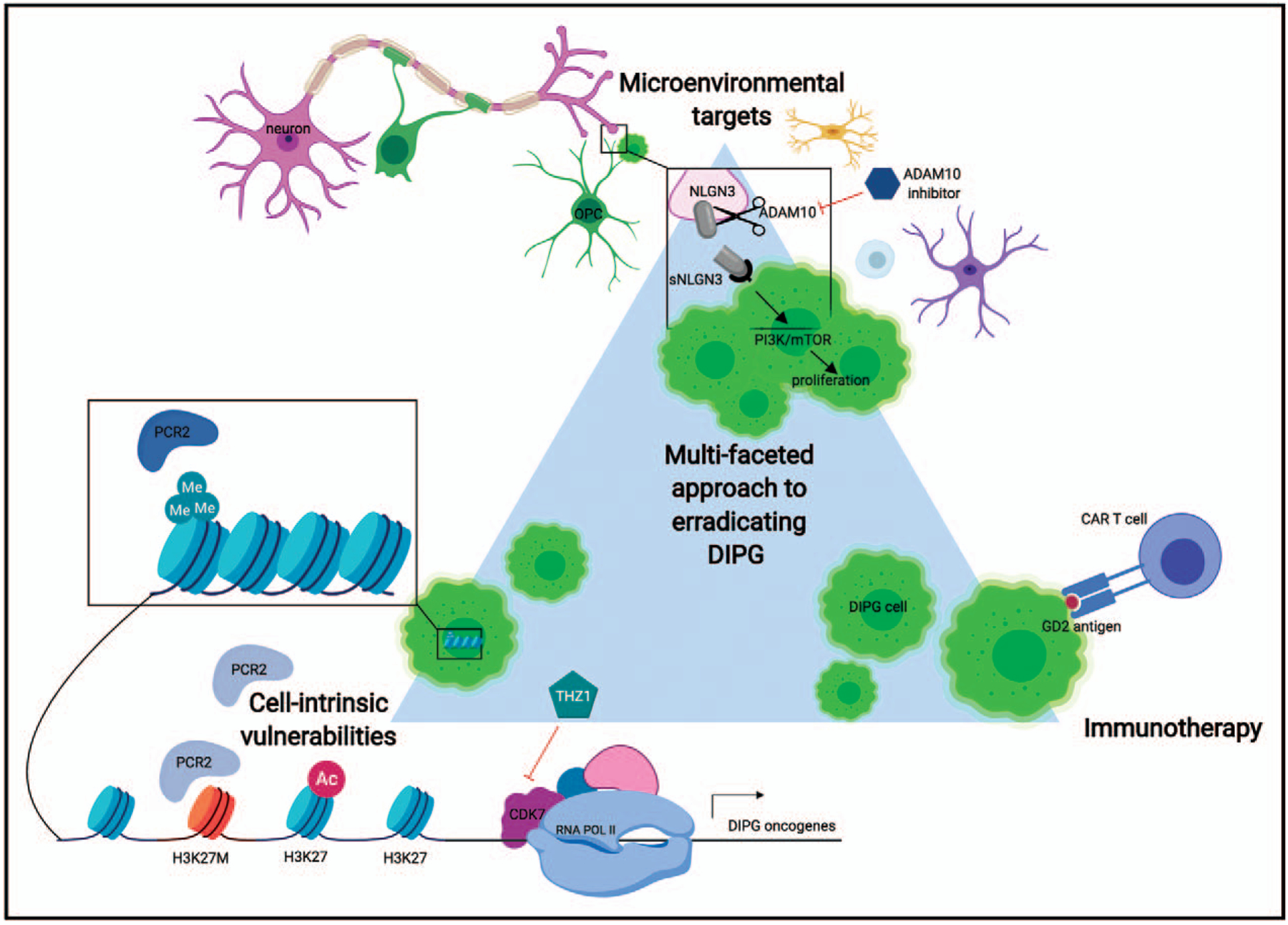
Diffuse intrinsic pontine glioma (DIPG) is a fatal childhood brainstem malignancy. Despite advances in understanding of the molecular underpinnings of the tumor in the past decade, the dismal prognosis of DIPG has thus far remained unchanged. This review seeks to highlight promising therapeutic targets within three arenas: DIPG cell-intrinsic vulnerabilities, immunotherapeutic approaches to tumor clearance, and microenvironmental dependencies that promote tumor growth.
Promising therapeutic strategies from recent studies include epigenetic modifying agents such as histone deacetylase inhibitors, bromodomain and extra-terminal motif (BET) protein inhibitors, and CDK7 inhibitors. Tumor-specific immunotherapies are emerging. Key interactions between DIPG and normal brain cells are coming to light, and targeting critical microenvironmental mechanisms driving DIPG growth in the developing childhood brain represents a new direction for therapy.
Several DIPG treatment strategies are being evaluated in early clinical trials. Ultimately, we suspect that a multifaceted therapeutic approach utilizing cell-intrinsic, microenvironmental, and immunotherapeutic targets will be necessary for eradicating DIPG.
弥漫性内在脑桥神经胶质瘤(DIPG)是一种致命的儿童脑干恶性肿瘤。尽管在过去十年中对肿瘤的分子基础有了更多的了解,但 DIPG 的预后仍然不容乐观。本综述旨在强调三个领域内有前途的治疗靶点:DIPG 细胞内在脆弱性、肿瘤清除的免疫治疗方法以及促进肿瘤生长的微环境依赖性。
最近的研究中提出了一些有希望的治疗策略,包括表观遗传修饰剂,如组蛋白去乙酰化酶抑制剂、溴结构域和末端外结构域(BET)蛋白抑制剂和 CDK7 抑制剂。肿瘤特异性免疫疗法也在不断涌现。DIPG 与正常脑细胞之间的关键相互作用逐渐显现,针对发育中儿童大脑中推动 DIPG 生长的关键微环境机制的治疗代表了一个新的治疗方向。
几种 DIPG 治疗策略正在早期临床试验中进行评估。我们最终怀疑,需要一种利用细胞内在、微环境和免疫治疗靶点的多方面治疗方法才能根除 DIPG。