Joachim Clarisse, Macni Jonathan, Drame Moustapha, Pomier Audrey, Escarmant Patrick, Veronique-Baudin Jacqueline, Vinh-Hung Vincent
CHU Martinique, UF1441 Registre des Cancers de la Martinique, Pôle de Cancérologie Hématologie Urologie, Martinique, France.
CHU Martinique, Unité de Soutien Méthodologique à la Recherche, Martinique, France.
Medicine (Baltimore). 2019 Aug;98(35):e16941. doi: 10.1097/MD.0000000000016941.
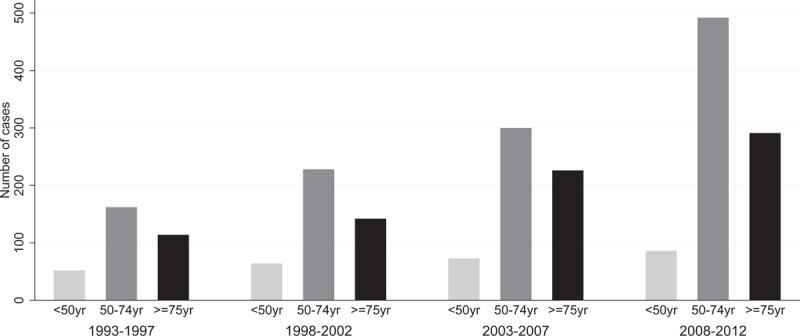
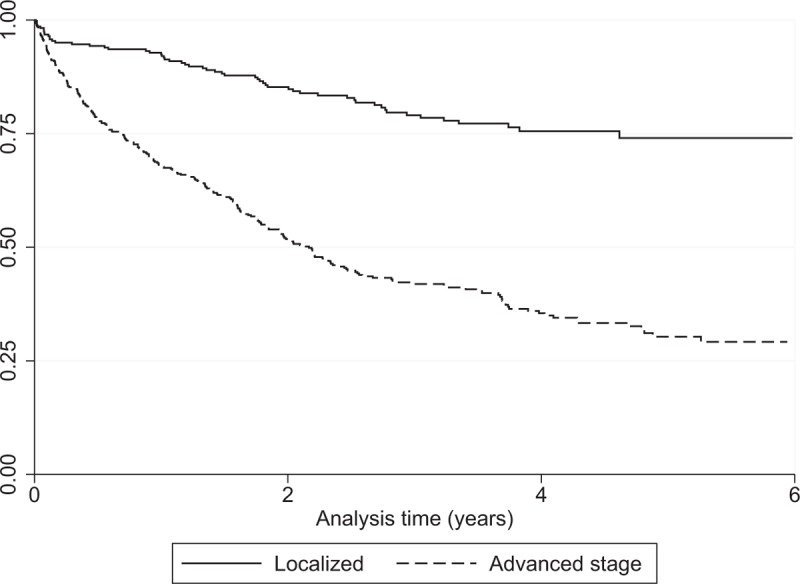
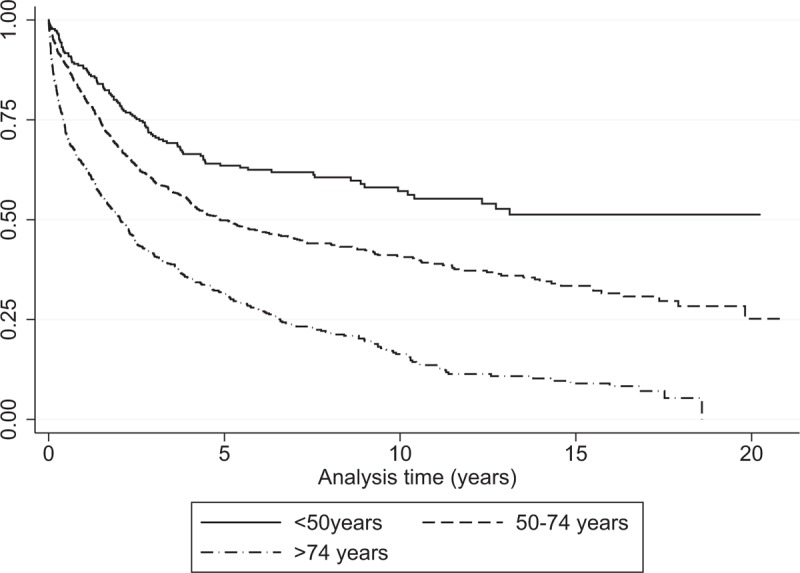
Population-based cancer registries (PBCR) participate in epidemiological surveillance and in the evaluation of cancer types by enabling analysis of incidence and survival data over time. The aim of this study was to examine overall survival (OS) in patients with colorectal cancer (CRC) by analyzing data from the Martinique population-based cancer registry between 1993 and 2012. All colorectal cancer cases diagnosed in Martinique between 1993 and 2012 were included. Characteristics of CRC patients were analyzed according to age subgroups, namely: <50 years, 50 to 74 years and over 75 years.We recorded the following socio-demographic and clinical variables: year of diagnosis, age at diagnosis, sex, histology, zone of residence, and subsite of the cancer. Incidence of malignant neoplasms of the colon and rectum (ICD-10 C18-21) was extracted from the Martinique Cancer Registry database. Stage at diagnosis (localized: stage I-II, regional: stage III and metastatic stage: stage IV) were also analyzed for the 2008 to 2012 period.A total of 2230 cases of incident invasive CRC were included during the study period (1993-2012): 1171 were women (52.5%); 1588 patients (71.2%) had colon cancer. Stage at diagnosis was evaluated in 779 patients (89.6%): 486/779 (62.4%) had stage III-IV at diagnosis, including 285 (36.6%) patients with metastases at diagnosis (stage IV). One-year, 5-year and 10-year OS for the study period 1993 to 2012 was 74.6%, 43.8% and 33.0% respectively. There was a statistical difference in overall survival according to gender (P = .0153), age at diagnosis (P < .001) and stage (P < .001).Median OS was 2.0 years (95% CI [1.4-2.1]) in the stage III-IV group during the period 2008 to 2012, whereas it was unreached in the stage I-II group. Multivariable analysis confirmed that stage III-IV at diagnosis (hazard ratio (HR) = 3.70 [2.89-4.99]; P < .0001) and colon cancer (HR = 1.30 [1.01-1.69]; P = .04) were main prognostic factors for OS. Women had a HR of 0.78 [0.62-0.96], P = .02. CRC patients in the 50 to 74 years age group had a HR of 0.63 [0.50-0.80], P = .0001.This study underlines the importance of structuring management of CRC cancer patients.
基于人群的癌症登记处(PBCR)通过对发病率和生存数据进行长期分析,参与癌症的流行病学监测和癌症类型评估。本研究旨在通过分析1993年至2012年马提尼克岛基于人群的癌症登记处的数据,研究结直肠癌(CRC)患者的总生存期(OS)。纳入了1993年至2012年在马提尼克岛诊断的所有结直肠癌病例。根据年龄亚组分析CRC患者的特征,即:<50岁、50至74岁和75岁以上。我们记录了以下社会人口学和临床变量:诊断年份、诊断时年龄、性别、组织学、居住区域和癌症的亚部位。从马提尼克岛癌症登记处数据库中提取结肠和直肠癌恶性肿瘤(ICD-10 C18-21)的发病率。还分析了2008年至2012年期间诊断时的分期(局限性:I-II期、区域性:III期和转移性:IV期)。研究期间(1993-2012年)共纳入2230例新诊断的浸润性CRC病例:1171例为女性(52.5%);1588例患者(71.2%)患有结肠癌。对779例患者(89.6%)进行了诊断时分期评估:486/779(62.4%)在诊断时为III-IV期,其中285例(36.6%)患者在诊断时已有转移(IV期)。1993年至2012年研究期间的1年、5年和10年总生存率分别为74.6%、43.8%和33.0%。总生存期根据性别(P = 0.0153)、诊断时年龄(P < 0.001)和分期(P < 0.001)存在统计学差异。2008年至2012年期间,III-IV期组的中位总生存期为2.0年(95%CI[1.4-2.1]),而I-II期组未达到。多变量分析证实,诊断时为III-IV期(风险比(HR)= 3.70[2.89-4.99];P < 0.0001)和结肠癌(HR = 1.30[1.01-1.69];P = 0.04)是总生存期的主要预后因素。女性的HR为0.78[0.62-0.96],P = 0.02。50至74岁年龄组的CRC患者HR为0.63[0.50-0.80],P = 0.0001。本研究强调了构建CRC癌症患者管理的重要性。