Icahn School of Medicine at Mount Sinai (ISMMS), Department of Neuroscience, New York, 10029, USA.
ISMMS, Department of Diagnostic, Molecular, and Interventional Radiology, New York, 10029, USA.
Sci Rep. 2019 Aug 29;9(1):12495. doi: 10.1038/s41598-019-48995-4.
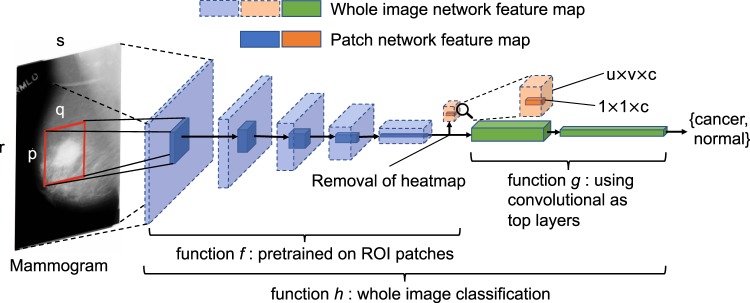
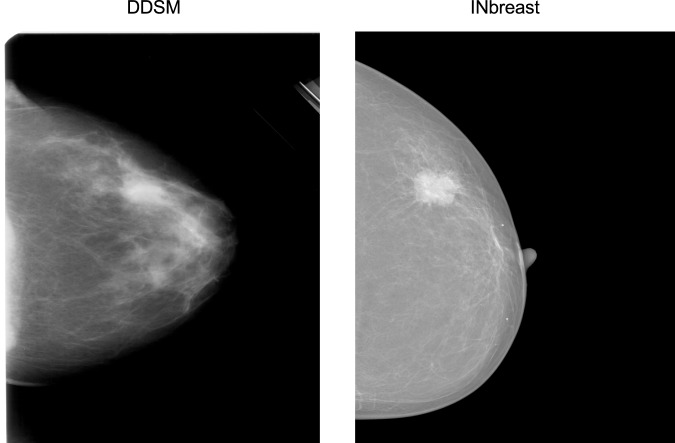
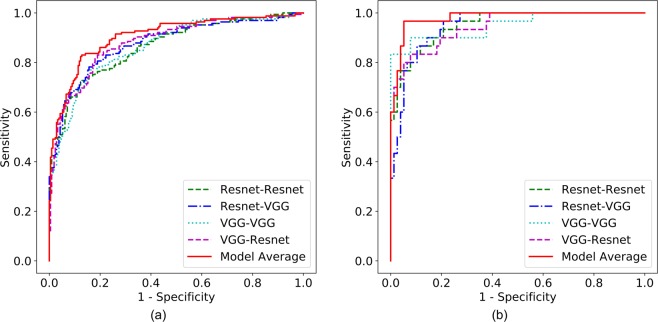
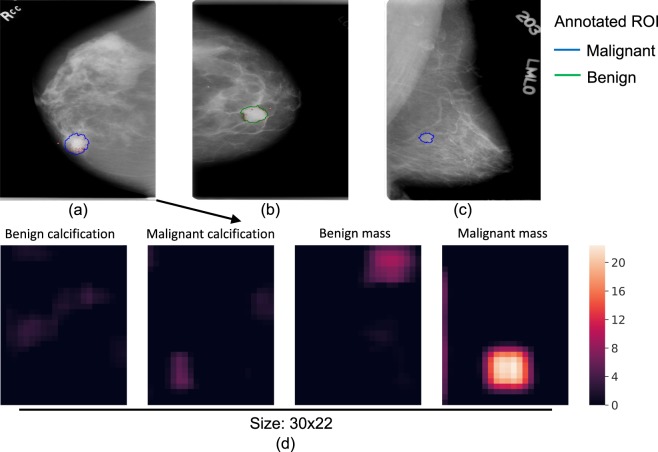
The rapid development of deep learning, a family of machine learning techniques, has spurred much interest in its application to medical imaging problems. Here, we develop a deep learning algorithm that can accurately detect breast cancer on screening mammograms using an "end-to-end" training approach that efficiently leverages training datasets with either complete clinical annotation or only the cancer status (label) of the whole image. In this approach, lesion annotations are required only in the initial training stage, and subsequent stages require only image-level labels, eliminating the reliance on rarely available lesion annotations. Our all convolutional network method for classifying screening mammograms attained excellent performance in comparison with previous methods. On an independent test set of digitized film mammograms from the Digital Database for Screening Mammography (CBIS-DDSM), the best single model achieved a per-image AUC of 0.88, and four-model averaging improved the AUC to 0.91 (sensitivity: 86.1%, specificity: 80.1%). On an independent test set of full-field digital mammography (FFDM) images from the INbreast database, the best single model achieved a per-image AUC of 0.95, and four-model averaging improved the AUC to 0.98 (sensitivity: 86.7%, specificity: 96.1%). We also demonstrate that a whole image classifier trained using our end-to-end approach on the CBIS-DDSM digitized film mammograms can be transferred to INbreast FFDM images using only a subset of the INbreast data for fine-tuning and without further reliance on the availability of lesion annotations. These findings show that automatic deep learning methods can be readily trained to attain high accuracy on heterogeneous mammography platforms, and hold tremendous promise for improving clinical tools to reduce false positive and false negative screening mammography results. Code and model available at: https://github.com/lishen/end2end-all-conv .
深度学习技术的快速发展激发了人们对其在医学成像问题中应用的极大兴趣。在这里,我们开发了一种深度学习算法,该算法可以通过使用“端到端”的训练方法,使用具有完整临床注释或仅整个图像的癌症状态(标签)的训练数据集,准确地检测乳房 X 光筛查中的乳腺癌。在这种方法中,仅在初始训练阶段需要进行病变注释,而后续阶段仅需要图像级标签,从而消除了对罕见病变注释的依赖。与以前的方法相比,我们用于分类筛查乳房 X 光片的全卷积网络方法表现出色。在来自 Digital Database for Screening Mammography(CBIS-DDSM)的数字化胶片乳房 X 光片的独立测试集中,最佳的单个模型的每幅图像 AUC 为 0.88,而四模型平均提高了 AUC 至 0.91(敏感性:86.1%,特异性:80.1%)。在来自 INbreast 数据库的全视野数字化乳腺摄影(FFDM)图像的独立测试集中,最佳的单个模型的每幅图像 AUC 为 0.95,而四模型平均提高了 AUC 至 0.98(敏感性:86.7%,特异性:96.1%)。我们还证明,使用我们的端到端方法在 CBIS-DDSM 数字化胶片乳房 X 光片上训练的整个图像分类器可以仅使用 INbreast 数据的子集进行微调,并无需进一步依赖病变注释的可用性,就可以转移到 INbreast FFDM 图像。这些发现表明,自动深度学习方法可以轻松地进行训练,以在异构乳房 X 光平台上获得高精度,并为改善临床工具以减少假阳性和假阴性的乳房 X 光筛查结果带来了巨大的希望。代码和模型可在以下网址获得:https://github.com/lishen/end2end-all-conv。