Ueno Hiroshi, Shimada Atsumi, Suemitsu Shunsuke, Murakami Shinji, Kitamura Naoya, Wani Kenta, Matsumoto Yosuke, Okamoto Motoi, Ishihara Takeshi
Department of Medical Technology, Kawasaki University of Medical Welfare, Okayama, 701-0193, Japan.
Division of Food and Nutrition, Nakamura Gakuen University Junior College, Fukuoka, 814-0198, Japan.
Evid Based Complement Alternat Med. 2019 Jul 30;2019:2745453. doi: 10.1155/2019/2745453. eCollection 2019.
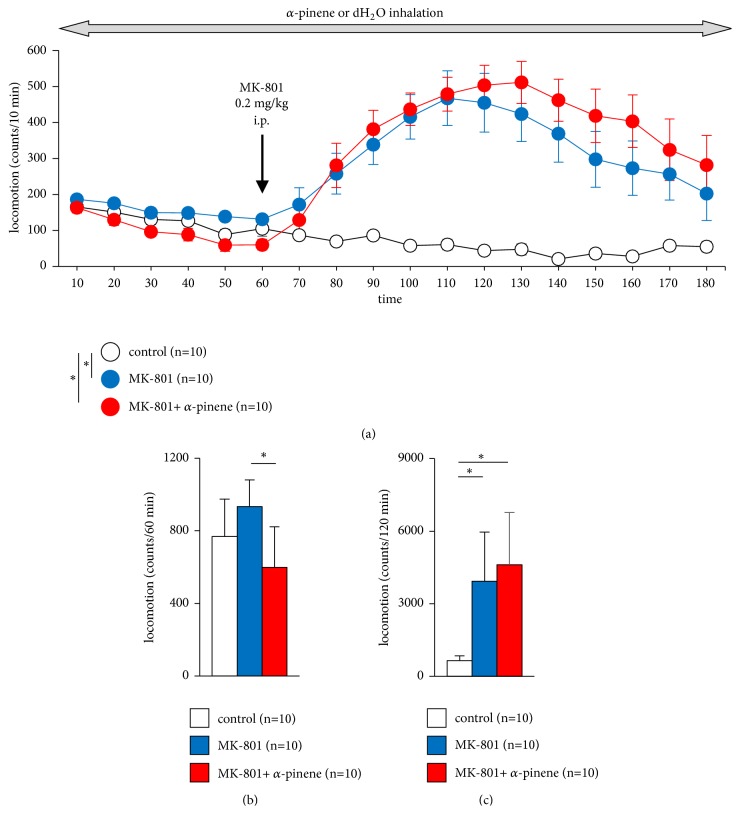
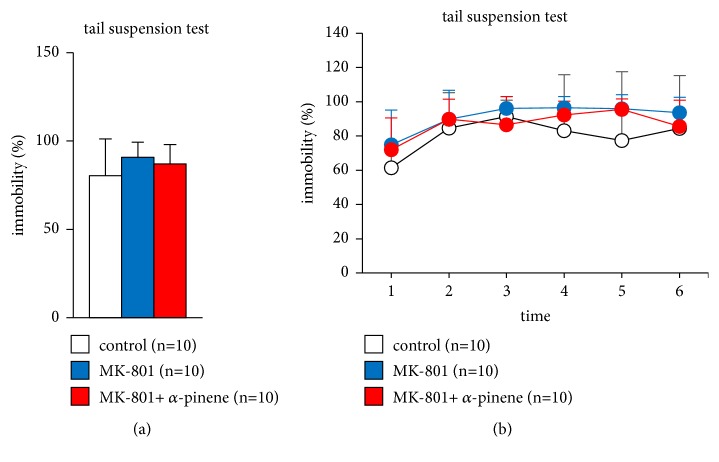
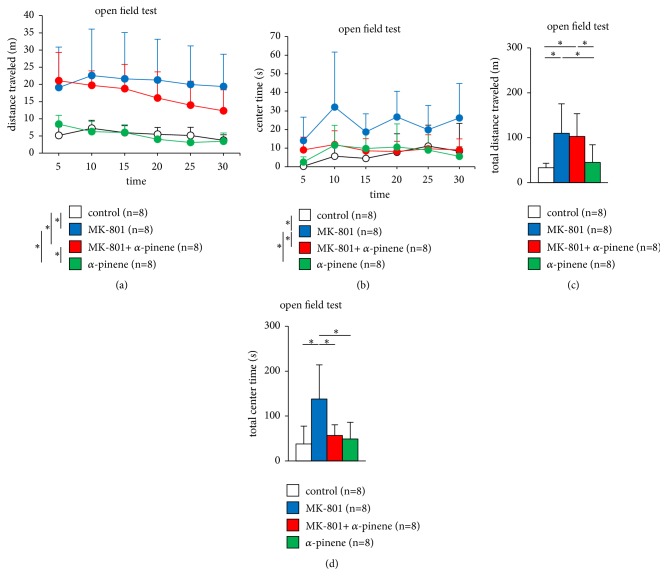
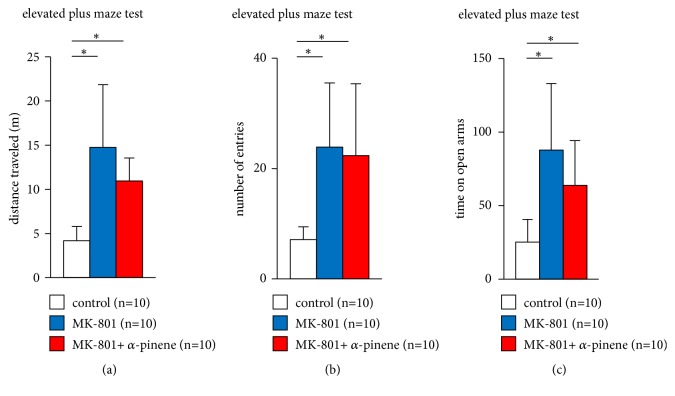
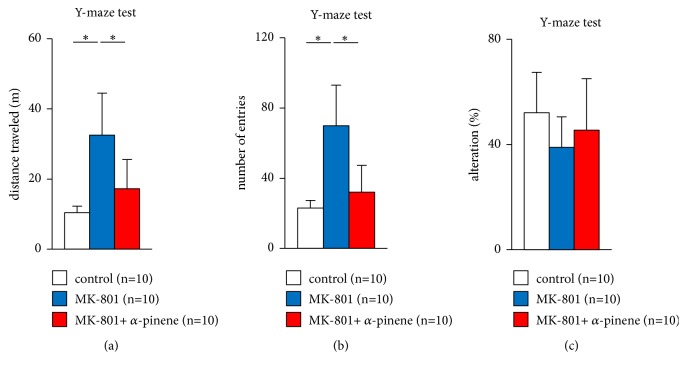
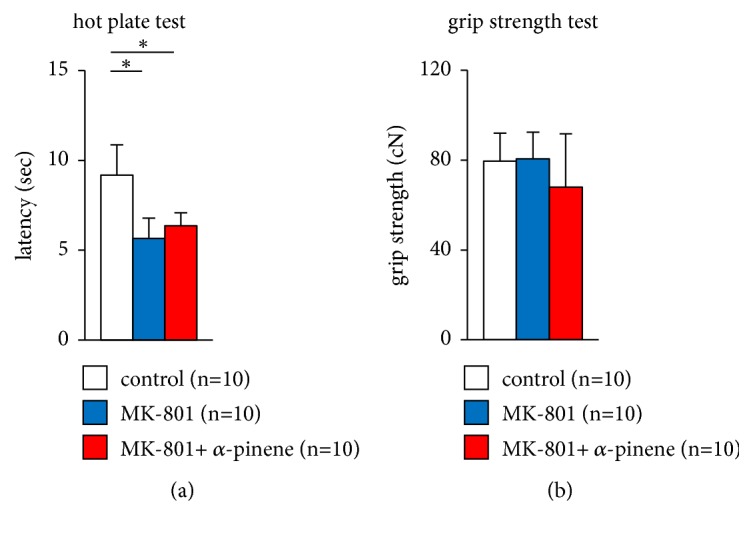
-Pinene, an organic terpene compound found in coniferous trees, is used as a safe food additive and is contained in many essential oils. Moreover, some studies have shown that -pinene suppresses neuronal activity. In this study, we investigated whether inhalation of -pinene suppresses dizocilpine (MK-801-) induced schizophrenia-like behavioural abnormalities in mice. Mice inhaled -pinene 1 h before the first MK-801 injection. Thirty minutes after MK-801 injection, the open field, spontaneous locomotor activity, elevated plus maze, Y-maze, tail suspension, hot plate, and grip strength tests were conducted as behavioural experiments. Inhalation of -pinene suppressed the activity of mice in the spontaneous locomotor activity test and although it did not suppress the MK-801-induced increased locomotor activity in the open field test, it remarkably decreased the time that the mice remained in the central area. Inhalation of -pinene suppressed the MK-801-induced increased total distance travelled in the Y-maze test, whereas it did not alter the MK-801-induced reduced threshold of antinociception in the hot plate test. In the tail suspension and grip strength tests, there was no effect on mouse behaviour by administration of MK-801 and inhalation of -pinene. These results suggest that -pinene acts to reduce MK-801-induced behavioural abnormalities resembling those seen in neuropsychiatric disorders. Therefore, both medicinal plants and essential oils containing -pinene may have potential for therapeutic treatment of schizophrenia.
蒎烯是一种存在于针叶树中的有机萜类化合物,用作安全的食品添加剂,且存在于许多香精油中。此外,一些研究表明,α-蒎烯可抑制神经元活动。在本研究中,我们调查了吸入α-蒎烯是否能抑制小鼠中由地卓西平(MK-801)诱导的精神分裂症样行为异常。小鼠在首次注射MK-801前1小时吸入α-蒎烯。在注射MK-801后30分钟,进行旷场试验、自发运动活动试验、高架十字迷宫试验、Y迷宫试验、悬尾试验、热板试验和握力试验作为行为实验。吸入α-蒎烯在自发运动活动试验中抑制了小鼠的活动,并且尽管它在旷场试验中没有抑制MK-801诱导的运动活动增加,但它显著减少了小鼠停留在中央区域的时间。吸入α-蒎烯在Y迷宫试验中抑制了MK-801诱导的总行进距离增加,而在热板试验中它没有改变MK-801诱导的抗伤害感受阈值降低。在悬尾试验和握力试验中,MK-801给药和吸入α-蒎烯对小鼠行为没有影响。这些结果表明,α-蒎烯可减轻MK-801诱导的类似于神经精神疾病中所见的行为异常。因此,含有α-蒎烯的药用植物和香精油可能具有治疗精神分裂症的潜力。