Department for General, Trauma and Reconstructive Surgery, University Hospital, LMU Munich, Munich, Germany.
Translational Medicine, Novartis Institute for Biomedical Research, Basel, Switzerland.
PLoS One. 2019 Aug 30;14(8):e0221732. doi: 10.1371/journal.pone.0221732. eCollection 2019.
Mobile accelerometry is a powerful and promising option to capture long-term changes in gait in both clinical and real-world scenarios. Increasingly, gait parameters have demonstrated their value as clinical outcome parameters, but validation of these parameters in elderly patients is still limited.
The aim of this study was to implement a validation framework appropriate for elderly patients and representative of real-world settings, and to use this framework to test and improve algorithms for mobile accelerometry data in an orthogeriatric population.
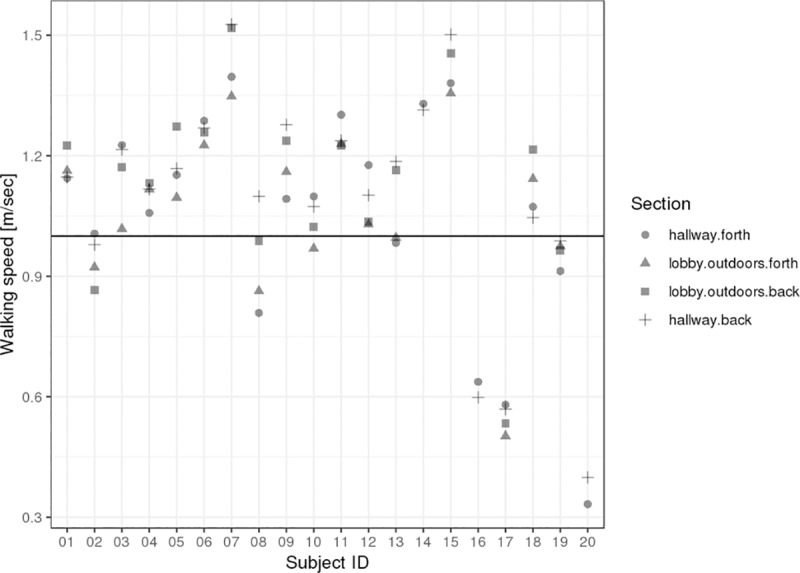
Twenty elderly subjects wearing a 3D-accelerometer completed a parcours imitating a real-world scenario. High-definition video and mobile reference speed capture served to validate different algorithms.
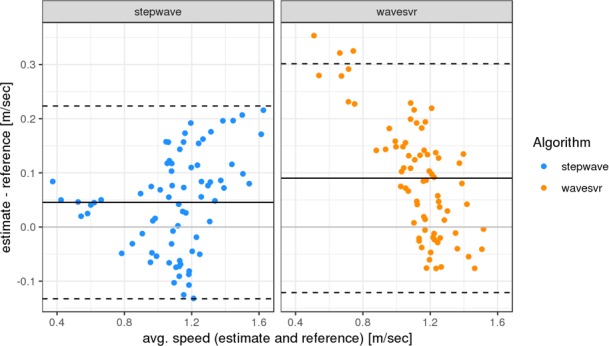
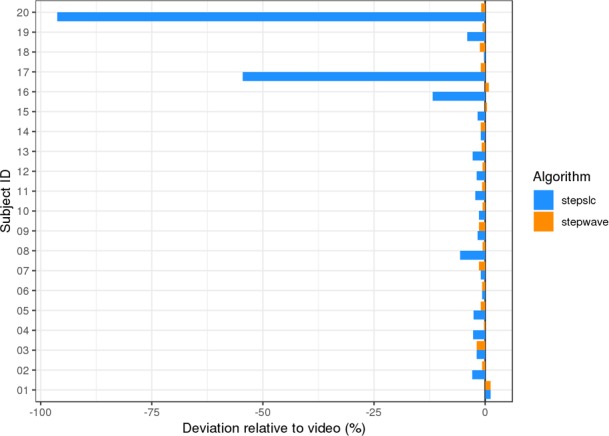
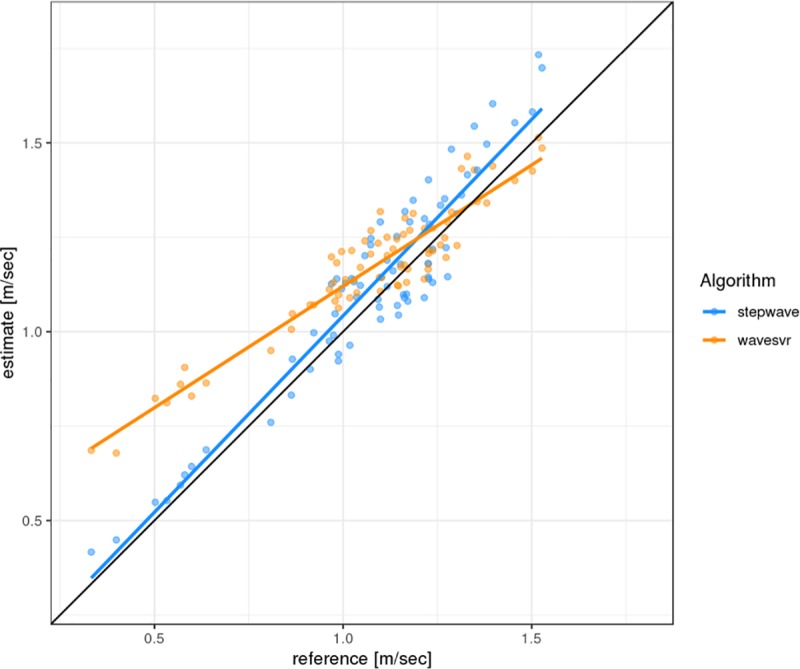
Particularly at slow gait speeds, relevant improvements in accuracy have been achieved. Compared to the reference the deviation was less than 1% in step detection and less than 0.05 m/s in gait speed measurements, even for slow walking subjects (< 0.8 m/s).
With the described setup, algorithms for step and gait speed detection have successfully been validated in an elderly population and demonstrated to have improved performance versus previously published algorithms. These results are promising that long-term and/or real-world measurements are possible with an acceptable accuracy even in elderly frail patients with slow gait speeds.
移动加速度计是一种强大且有前途的方法,可以在临床和真实场景中捕捉长期的步态变化。越来越多的步态参数已经证明了它们作为临床结果参数的价值,但在老年患者中验证这些参数仍然有限。
本研究的目的是实施一个适用于老年患者且代表真实环境的验证框架,并使用该框架来测试和改进矫形科人群中移动加速度计数据的算法。
20 名佩戴 3D 加速度计的老年受试者完成了一个模仿真实场景的路线。高清视频和移动参考速度捕获用于验证不同的算法。
特别是在较慢的步行速度下,准确性得到了显著提高。与参考值相比,即使是步行速度较慢的受试者(<0.8 m/s),步检测的偏差也小于 1%,步态速度测量的偏差也小于 0.05 m/s。
使用描述的设置,在老年人群中成功验证了用于步检测和步态速度检测的算法,与之前发表的算法相比,这些算法的性能得到了显著提高。这些结果很有希望,即使是步态速度较慢的虚弱老年患者,也可以通过可接受的准确性进行长期和/或真实世界的测量。