Department of Otorhinolaryngology, Medical University of Vienna, Vienna, Austria.
Institute of Experimental and Clinical Pharmacology and Toxicology, Friedrich-Alexander University Erlangen-Nürnberg, Erlangen, Germany.
Laryngoscope. 2020 Jul;130(7):1629-1633. doi: 10.1002/lary.28258. Epub 2019 Aug 31.
The human sense of smell constitutes the main part of flavor perception. Typically, patients with loss of olfactory function complain of diminished perception during eating and drinking. However, some patients with smell loss still report normal enjoyment of foods. The aim of the present study was to compare orthonasal and retronasal olfactory function in patients with non-sinonasal smell loss and subjectively normal flavor perception.
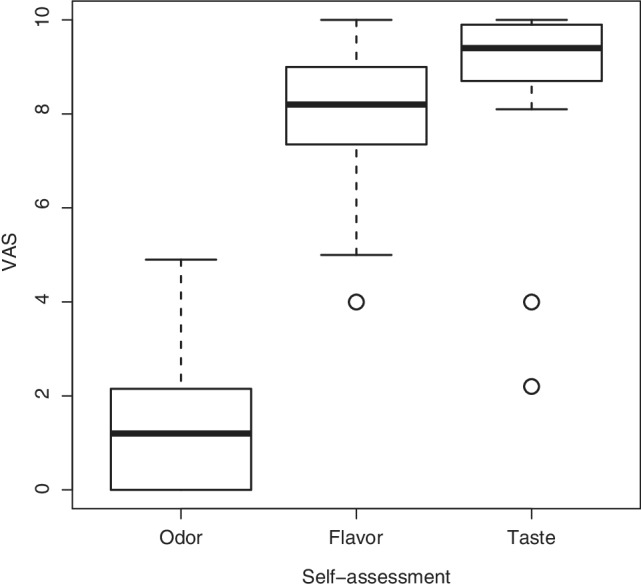
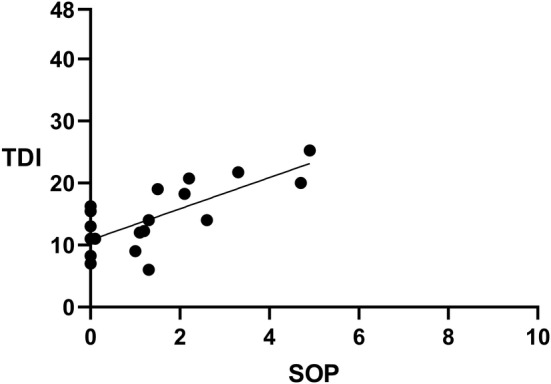
Nineteen patients (mean age [range] 52.0 [8-83 years]) with self-reported olfactory impairment but subjective normal flavor perception were included. Olfactory performance was assessed using the Sniffin' Sticks (TDI) for orthonasal and the Candy Smell Test (CST) for retronasal function. Visual analogue scales were used for self-assessment of odor (SOP), taste (STP), and flavor perception (SFP), ranging from 0 (no perception) to 10 (excellent perception).
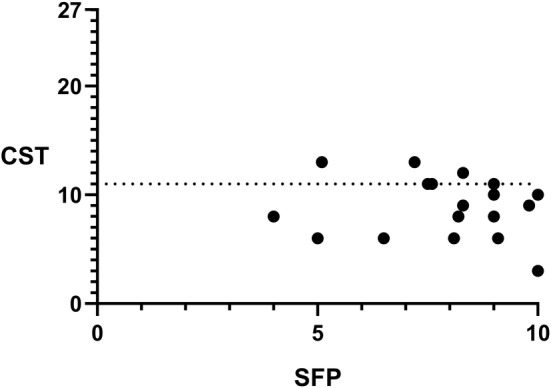
Mean (SD) SFP was 8.0 (1.8). Mean (SD) orthonasal TDI-score of all patients was 14.4 (5.3, range 6-25.3) with 11 patients classified as anosmic and eight as hyposmic. Mean/SD retronasal CST-score was 8.8 (2.7, range 3-13) within the range of anosmia/hyposmia. No correlation was found between SFP and the CST (P = .62).
The present results showed that despite claiming normal flavor perception, our patients were ortho- and retronasally dysosmic using standard tests for olfactory function. Although other explanations could be possible, we suggest that this subjective flavor perception might be due to unconscious memory recall from previously experienced cross-modal sensory interactions.
4 Laryngoscope, 130:1629-1633, 2020.
人类的嗅觉构成了味觉感知的主要部分。通常情况下,嗅觉丧失的患者在进食和饮水时会抱怨感知能力下降。然而,一些嗅觉丧失的患者仍报告正常享受食物。本研究的目的是比较非鼻-鼻窦嗅觉丧失且主观味觉正常的患者的鼻前和鼻后嗅觉功能。
纳入 19 名(平均年龄[范围]52.0[8-83 岁])自我报告嗅觉障碍但主观味觉正常的患者。使用 Sniffin' Sticks(TDI)评估鼻前嗅觉功能,使用 Candy Smell Test(CST)评估鼻后嗅觉功能。使用视觉模拟量表(VAS)评估自我感知的嗅觉(SOP)、味觉(STP)和味觉感知(SFP),范围从 0(无感知)到 10(极好感知)。
平均(SD)SFP 为 8.0(1.8)。所有患者的平均(SD)鼻前 TDI 评分为 14.4(5.3,范围 6-25.3),11 名患者为失嗅,8 名患者为嗅觉减退。平均/SD 鼻后 CST 评分为 8.8(2.7,范围 3-13),处于失嗅/嗅觉减退的范围内。SFP 与 CST 之间无相关性(P =.62)。
尽管患者自我报告味觉正常,但本研究使用嗅觉功能的标准测试发现他们的鼻前和鼻后嗅觉均异常。尽管可能有其他解释,但我们建议这种主观味觉感知可能是由于无意识地从先前经历的跨模态感觉相互作用中回忆记忆所致。
4 Laryngoscope, 130:1629-1633, 2020.