Division of Cancer Sciences, Faculty of Biology, Medicine and Health, School of Medical Sciences, Manchester Cancer Research Centre, University of Manchester, Wilmslow Road, Manchester, M20 4GJ, UK.
Wythenshawe Hospital, Manchester University NHS Foundation Trust, Manchester Academic Health Science Centre, Southmoor Road, Wythenshawe, Manchester, M23 9LT, UK.
Clin Transl Oncol. 2020 Jun;22(6):870-877. doi: 10.1007/s12094-019-02197-6. Epub 2019 Aug 31.
Circulating tumour cells (CTCs) are a marker of poor prognosis and are associated with increased risk of venous thromboembolism in metastatic breast cancer (MBC). We aimed to determine if the presence of CTCs and plasma markers of hypercoagulability [thrombin-antithrombin III (TAT), fibrinogen and D-dimer] are biomarkers of survival in MBC.
METHODS/PATIENTS: In a prospective study of MBC patients, CTC (CellSearch) enumeration and plasma TAT, fibrinogen and D-dimer measured prior to commencement of treatment for disease progression were correlated to overall survival.
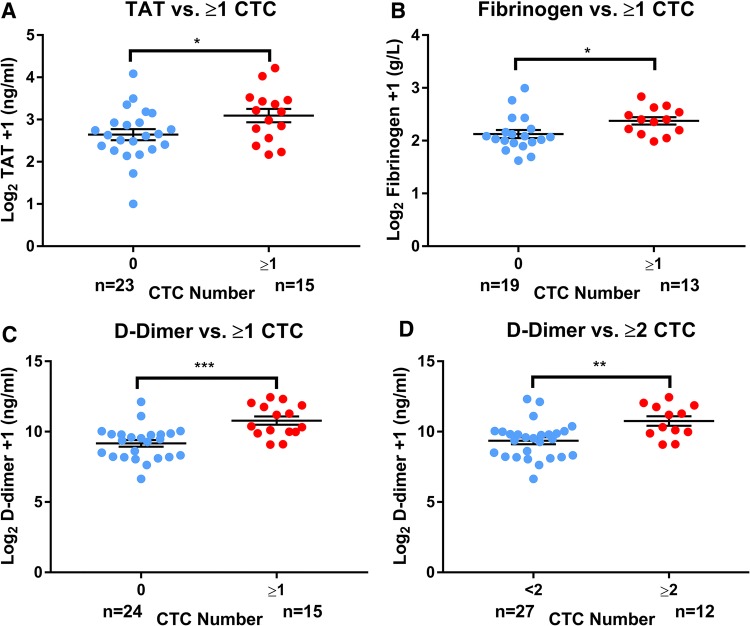
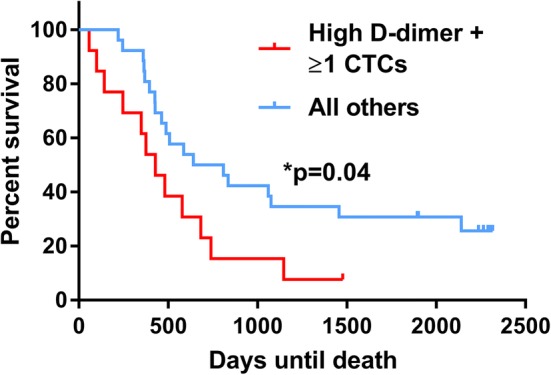
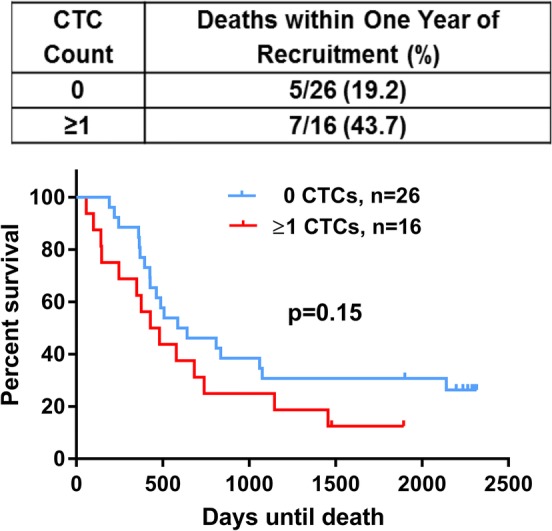
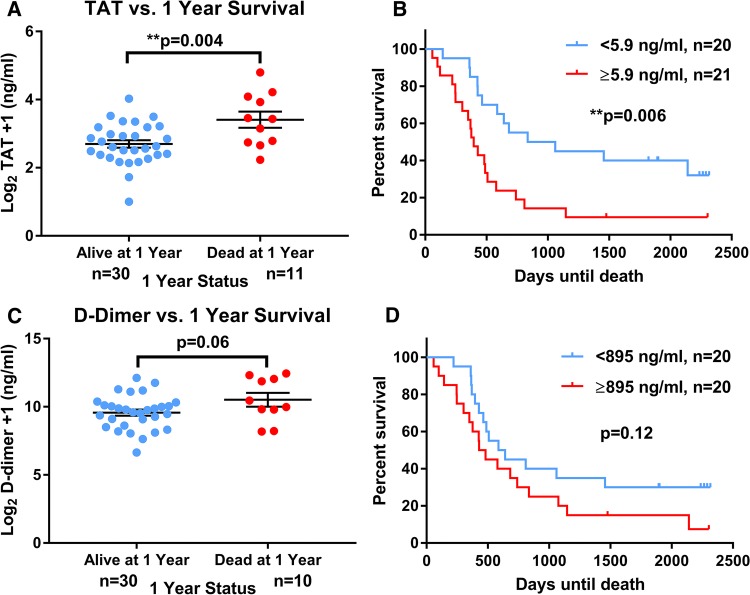
At study completion, of 50 MBC patients recruited (median age 59 years, range 36-82), 40 patients had died (median survival 417 days, range 58-2141). CTCs (≥ 1/7.5 ml) were identified in 16 patients (median number of cells per 7.5 ml, 3 (range 1-31) and were associated with systemic hypercoagulability (medians TAT: 8.1 vs. 5.2 ng/ml, p = 0.03; fibrinogen: 4.3 vs. 3.1 g/l, p = 0.03; D-dimer: 1327 vs. 683 ng/ml, p = 0.0001). At 1 year, of 16 patients with ≥ 1 CTC, 7 had died (44%), compared to 5 of 26 (19%) patients in the no-CTC group. The presence of ≥ 1 CTC was associated with a trend for reduced overall survival (median 455 days vs. 614 days, p = 0.15). Plasma TAT inversely correlated with survival and was significantly higher in patients dying within 1 year (median 9.8 vs. 5.2 ng/ml, p = 0.004) whilst D-dimer showed a trend for reduced 1-year survival (median 1211 vs. 817 ng/ml, p = 0.06). MBC patients with combined high D-dimer (≥ 895 ng/ml) and CTC positivity (≥ 1/7.5 ml whole peripheral blood) had significantly reduced survival (p = 0.04).
The correlation between CTCs, hypercoagulability and reduced survival in MBC suggests the coagulation system supports tumour cell metastasis and is, therefore, a potential therapeutic target.
循环肿瘤细胞(CTCs)是预后不良的标志物,与转移性乳腺癌(MBC)中的静脉血栓栓塞风险增加相关。我们旨在确定 CTC 与血浆高凝标志物(凝血酶-抗凝血酶 III(TAT)、纤维蛋白原和 D-二聚体)是否是 MBC 患者生存的生物标志物。
方法/患者:在 MBC 患者的前瞻性研究中,在疾病进展开始治疗前测量 CTC(CellSearch)计数和血浆 TAT、纤维蛋白原和 D-二聚体,并将其与总生存期相关联。
在研究完成时,50 名 MBC 患者入组(中位年龄 59 岁,范围 36-82 岁),40 名患者死亡(中位生存期 417 天,范围 58-2141 天)。16 名患者(中位每 7.5ml 细胞数为 3(范围 1-31))中检测到 CTCs(≥1/7.5ml),并且与全身性高凝状态相关(中位数 TAT:8.1 与 5.2ng/ml,p=0.03;纤维蛋白原:4.3 与 3.1g/l,p=0.03;D-二聚体:1327 与 683ng/ml,p=0.0001)。在 16 名≥1 CTC 的患者中,1 年内有 7 人死亡(44%),而在无 CTC 组的 26 名患者中,有 5 人死亡(19%)。存在≥1 CTC 与总生存期降低呈趋势相关(中位 455 天与 614 天,p=0.15)。血浆 TAT 与生存呈负相关,并且在 1 年内死亡的患者中显着更高(中位数 9.8 与 5.2ng/ml,p=0.004),而 D-二聚体显示 1 年生存率降低的趋势(中位数 1211 与 817ng/ml,p=0.06)。同时具有高 D-二聚体(≥895ng/ml)和 CTC 阳性(≥1/7.5ml 全血)的 MBC 患者的生存率明显降低(p=0.04)。
在 MBC 中 CTC、高凝状态和降低的生存率之间的相关性表明凝血系统支持肿瘤细胞转移,因此是潜在的治疗靶点。