
法比奥——粮食和农业生物质投入产出模型的构建。
FABIO-The Construction of the Food and Agriculture Biomass Input-Output Model.
机构信息
Institute for Ecological Economics , Vienna University of Economics and Business , 1020 Vienna , Austria.
Industrial Ecology Programme , NTNU Trondheim , 7491 Trondheim , Norway.
出版信息
Environ Sci Technol. 2019 Oct 1;53(19):11302-11312. doi: 10.1021/acs.est.9b03554. Epub 2019 Sep 11.
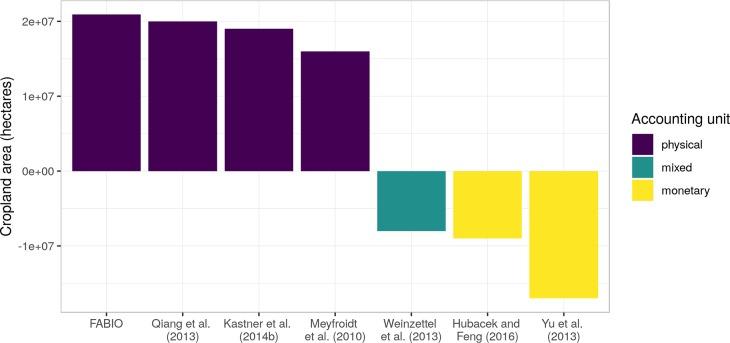
Harvested biomass is linked to final consumption by networks of processes and actors that convert and distribute food and nonfood goods. Achieving a sustainable resource metabolism of the economy is an overarching challenge which manifests itself in a number of the UN Sustainable Development Goals. Modeling the physical dimensions of biomass conversion and distribution networks is essential to understanding the characteristics, drivers, and dynamics of the socio-economic biomass metabolism. In this paper, we present the Food and Agriculture Biomass Input-Output model (FABIO), a set of multiregional supply, use and input-output tables in physical units, that document the complex flows of agricultural and food products in the global economy. The model assembles FAOSTAT statistics reporting crop production, trade, and utilization in physical units, supplemented by data on technical and metabolic conversion efficiencies, into a consistent, balanced, input-output framework. FABIO covers 191 countries and 130 agriculture, food and forestry products from 1986 to 2013. The physical supply use tables offered by FABIO provide a comprehensive, transparent, and flexible structure for organizing data representing flows of materials within metabolic networks. They allow tracing of biomass flows and embodied environmental pressures along global supply chains at an unprecedented level of product and country detail and can help to answer a range of questions regarding environment, agriculture, and trade. Here we apply FABIO to the case of cropland footprints and show the evolution of consumption-based cropland demand in China, the E.U., and the U.S.A. for plant-based and livestock-based food and nonfood products.
收获的生物质与通过将食物和非食物商品转化和分配的过程和行为者网络的最终消费有关。实现经济的可持续资源代谢是一个总体挑战,它体现在联合国可持续发展目标的许多目标中。对生物质转化和分配网络的物理维度进行建模对于理解社会经济生物质代谢的特征、驱动因素和动态至关重要。在本文中,我们提出了粮食和农业生物质投入产出模型(FABIO),这是一组多区域供应、使用和投入产出表,以实物单位记录全球经济中农业和食品产品的复杂流动。该模型将 FAOSTAT 报告的以实物单位表示的作物生产、贸易和利用统计数据与技术和代谢转化效率数据结合起来,纳入一个一致、平衡的投入产出框架。FABIO 涵盖了 191 个国家和 130 种农业、食品和林业产品,时间范围为 1986 年至 2013 年。FABIO 提供的实物供应使用表为组织代表代谢网络内物质流动的数据提供了一个全面、透明和灵活的结构。它们允许在前所未有的产品和国家详细程度上追踪全球供应链中的生物质流动和体现的环境压力,并有助于回答有关环境、农业和贸易的一系列问题。在这里,我们将 FABIO 应用于耕地足迹案例,并展示了中国、欧盟和美国对基于植物和基于动物的食物和非食物产品的消费型耕地需求的演变。


 Zotero 插件