Chung Jae-Hee, Hong Seon-Hui, Seo Nari, Kim Tae-Shin, An Hyun Joo, Lee Pedro, Shin Eui-Cheol, Kim Ho Min
Department of Biological Sciences, Korea Advanced Institute of Science and Technology (KAIST), 291 Daehak-ro, Yuseong-gu, Daejeon 34141, Republic of Korea.
Biomedical Science and Engineering Interdisciplinary Program, Korea Advanced Institute of Science and Technology (KAIST), 291 Daehak-ro, Yuseong-gu, Daejeon 34141, Republic of Korea.
Cytokine. 2020 Jan;125:154833. doi: 10.1016/j.cyto.2019.154833. Epub 2019 Aug 31.
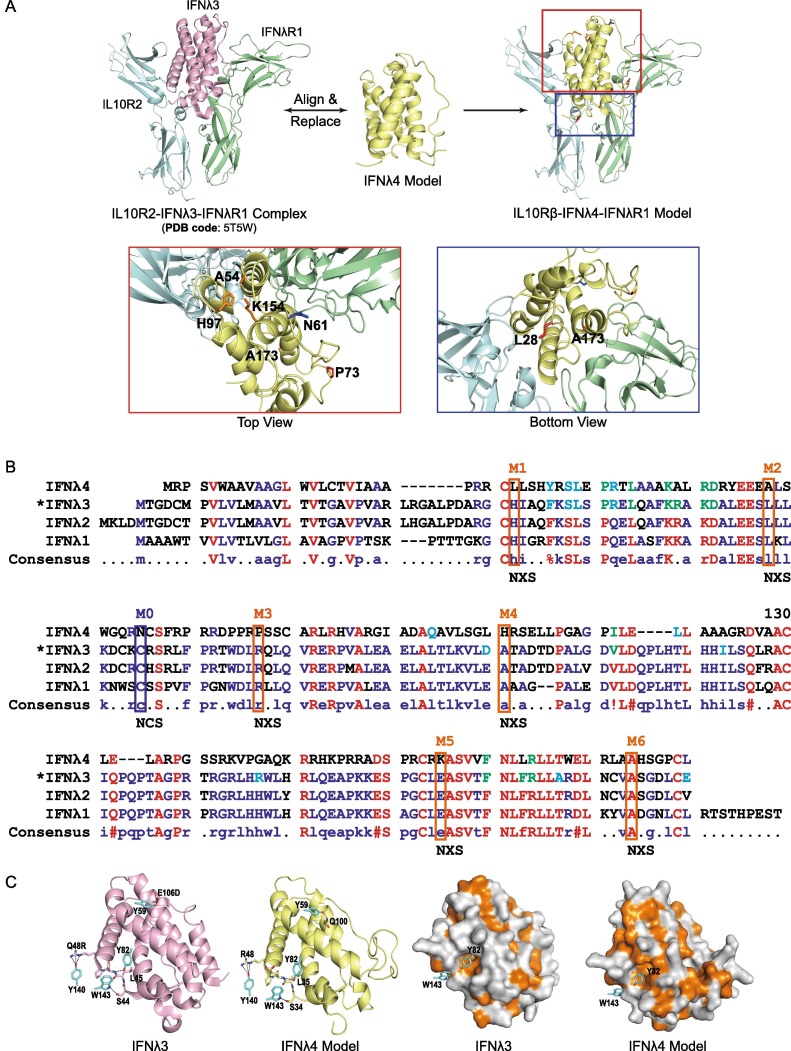
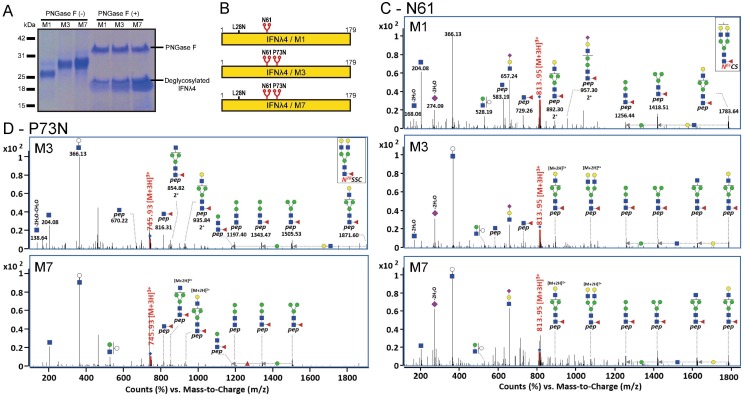
Interferon lambda 4 (IFNλ4) has been recently known and studied for its role in hepatitis C virus (HCV) infection, but its clinical potential is significantly hampered due to its poor expression in vitro. Our study reports the successful production of IFNλ4 from a mammalian cell line through a glycoengineering and structure-based approach. We introduced de novo N-glycosylation of IFNλ4, guided by structural analysis, and produced IFNλ4 variants in Expi293F that displayed improved expression and potency. To preserve the structure and functionality of IFNλ4, the model structure of the IFNλ4 signaling complex was analyzed and the N-glycosylation candidate sites were selected. The receptor binding activity of engineered IFNλ4 variants and their receptor-mediated signaling pathway were similar to the E. coli version of IFNλ4 (eIFNλ4), while the antiviral activity and induction levels of interferon-stimulated gene (ISG) were all more robust in our variants. Our engineered IFNλ4 variants may be further developed for clinical applications and utilized in basic research to decipher the immunological roles of IFNλ4.
干扰素λ4(IFNλ4)最近因其在丙型肝炎病毒(HCV)感染中的作用而被人们所了解和研究,但其临床应用潜力因在体外表达不佳而受到显著阻碍。我们的研究报告了通过糖基工程和基于结构的方法成功地从哺乳动物细胞系中生产出IFNλ4。我们在结构分析的指导下引入了IFNλ4的从头N-糖基化,并在Expi293F细胞中生产出表达和效力均有所提高的IFNλ4变体。为了保持IFNλ4的结构和功能,我们分析了IFNλ4信号复合物的模型结构并选择了N-糖基化候选位点。工程化的IFNλ4变体的受体结合活性及其受体介导的信号通路与大肠杆菌来源的IFNλ4(eIFNλ4)相似,而我们的变体的抗病毒活性和干扰素刺激基因(ISG)的诱导水平均更强。我们工程化的IFNλ4变体可能会进一步开发用于临床应用,并用于基础研究以阐明IFNλ4的免疫作用。