Ph.D. Program in Health Policy, Harvard University, Cambridge, Massachusetts, USA
BMJ Open. 2019 Sep 3;9(9):e030342. doi: 10.1136/bmjopen-2019-030342.
To measure the frequency of adequate methods, inadequate methods and poor reporting in published randomised controlled trials (RCTs) and test potential factors associated with adequacy of methods and reporting.
Retrospective analysis of RCTs included in Cochrane reviews. Time series describes the proportion of RCTs using adequate methods, inadequate methods and poor reporting. A multinomial logit model tests potential factors associated with methods and reporting, including funding source, first author affiliation, clinical trial registration status, study novelty, team characteristics, technology and geography.
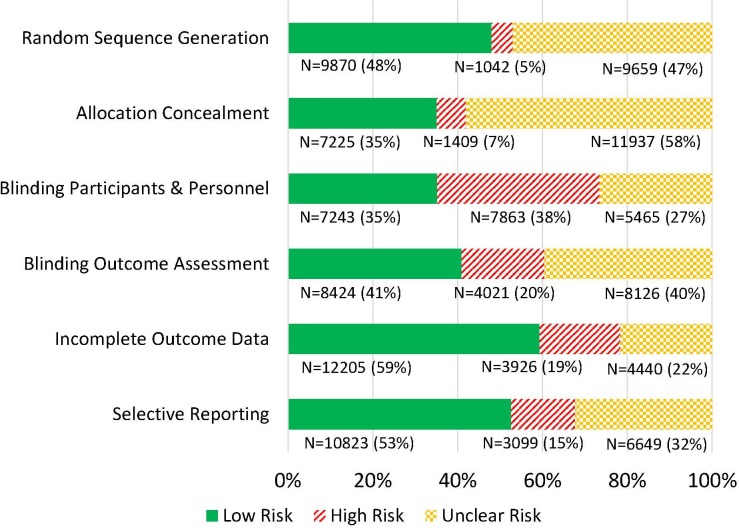
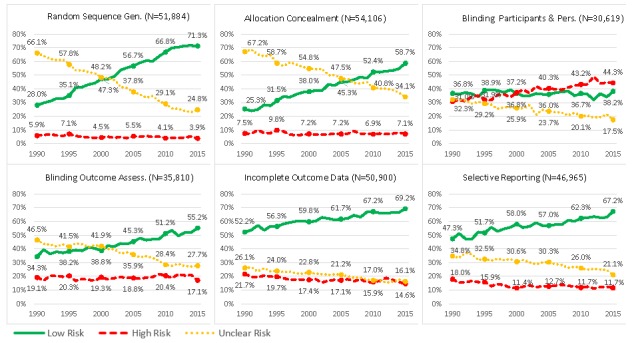
Risk of bias assessments for random sequence generation, allocation concealment, blinding of participants and personnel, blinding of outcome assessment, incomplete outcome data and selective reporting, for each RCT, were mapped to bibliometric and funding data.
Risk of bias on six methodological dimensions and RCT-level overall assessment of adequate methods, inadequate methods or poor reporting.
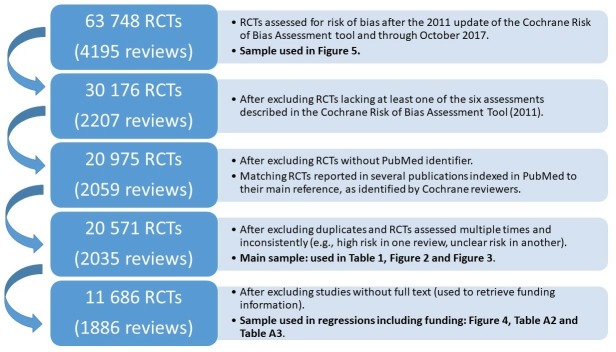
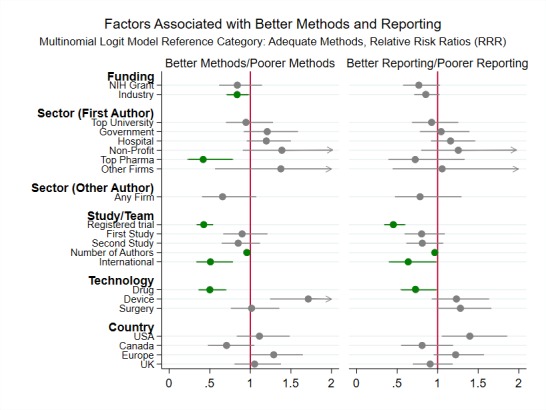
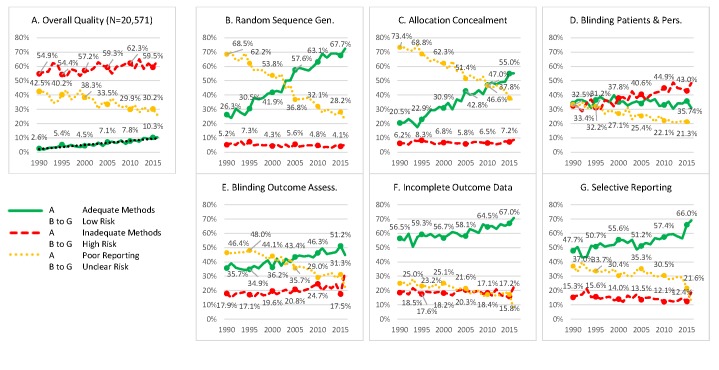
This study analysed 20 571 RCTs. 5.7% of RCTs used adequate methods (N=1173). 59.3% used inadequate methods (N=12 190) and 35.0% were poorly reported (N=7208). The proportion of poorly reported RCTs decreased from 42.5% in 1990 to 30.2% in 2015. The proportion of RCTs using adequate methods increased from 2.6% in 1990 to 10.3% in 2015. The proportion of RCTs using inadequate methods increased from 54.9% in 1990 to 59.5% in 2015. Industry funding, top pharmaceutical company affiliation, trial registration, larger authorship teams, international teams and drug trials were associated with a greater likelihood of using adequate methods. National Institutes of Health funding and university prestige were not.
Even though reporting has improved since 1990, the proportion of RCTs using inadequate methods is high (59.3%) and increasing, potentially slowing progress and contributing to the reproducibility crisis. Stronger incentives for the use of adequate methods are needed.
衡量已发表的随机对照试验(RCT)中充分方法、不充分方法和不良报告的频率,并检验与方法和报告充分性相关的潜在因素。
对 Cochrane 综述中包含的 RCT 进行回顾性分析。时间序列描述了使用充分方法、不充分方法和不良报告的 RCT 的比例。多项逻辑回归模型检验了与方法和报告相关的潜在因素,包括资金来源、第一作者所属单位、临床试验注册状态、研究新颖性、团队特征、技术和地理位置。
对每个 RCT 的随机序列生成、分配隐匿、参与者和人员的盲法、结局评估的盲法、不完整结局数据和选择性报告的偏倚风险进行评估,并将其映射到文献计量学和资金数据上。
这项研究分析了 20571 项 RCT。5.7%的 RCT 采用了充分方法(N=1173)。59.3%的 RCT 采用了不充分方法(N=12190),35.0%的 RCT 报告不良(N=7208)。报告不良的 RCT 比例从 1990 年的 42.5%下降到 2015 年的 30.2%。采用充分方法的 RCT 比例从 1990 年的 2.6%上升到 2015 年的 10.3%。采用不充分方法的 RCT 比例从 1990 年的 54.9%上升到 2015 年的 59.5%。工业资金、顶级制药公司隶属关系、试验注册、更大的作者团队、国际团队和药物试验与采用充分方法的可能性更大相关。美国国立卫生研究院的资金和大学声誉则没有。
尽管自 1990 年以来报告有所改善,但采用不充分方法的 RCT 比例仍然很高(59.3%)且呈上升趋势,这可能会减缓进展并导致可重复性危机。需要更强有力的激励措施来促进充分方法的应用。