Sadhasivam Sudharsan, Shapiro Orr H, Ziv Carmit, Barda Omer, Zakin Varda, Sionov Edward
Department of Food Quality and Safety, Institute for Postharvest and Food Sciences, Agricultural Research Organization, The Volcani Center, Rishon LeZion, Israel.
Department of Postharvest Science, Institute for Postharvest and Food Sciences, Agricultural Research Organization, The Volcani Center, Rishon LeZion, Israel.
Front Microbiol. 2019 Aug 20;10:1919. doi: 10.3389/fmicb.2019.01919. eCollection 2019.
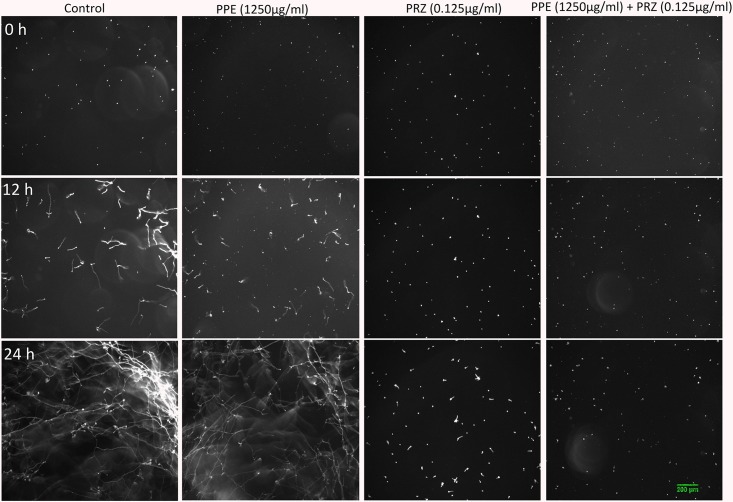
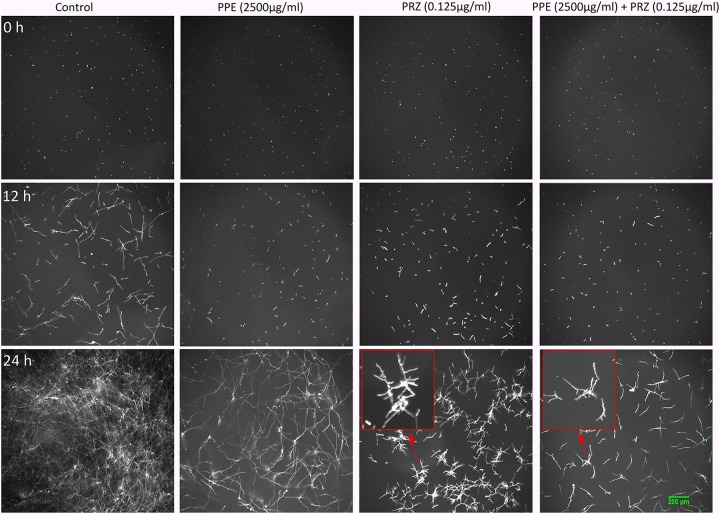
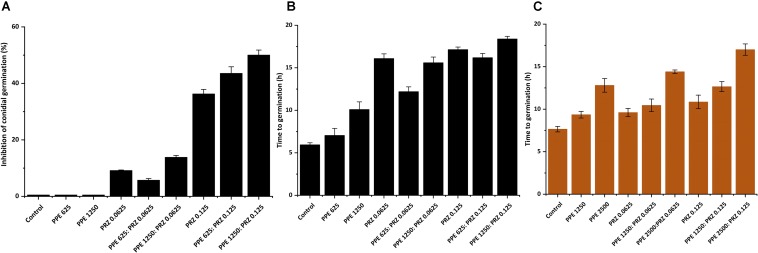
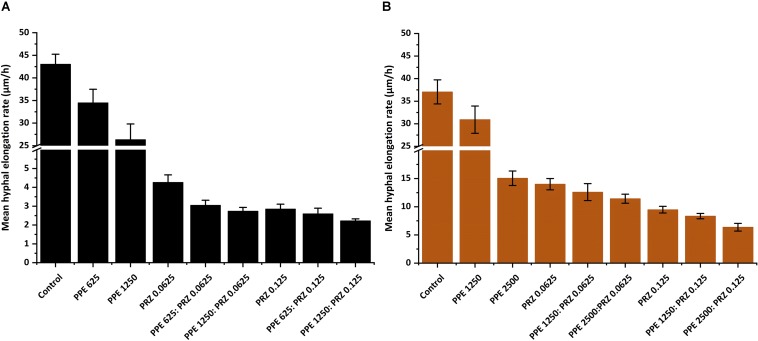
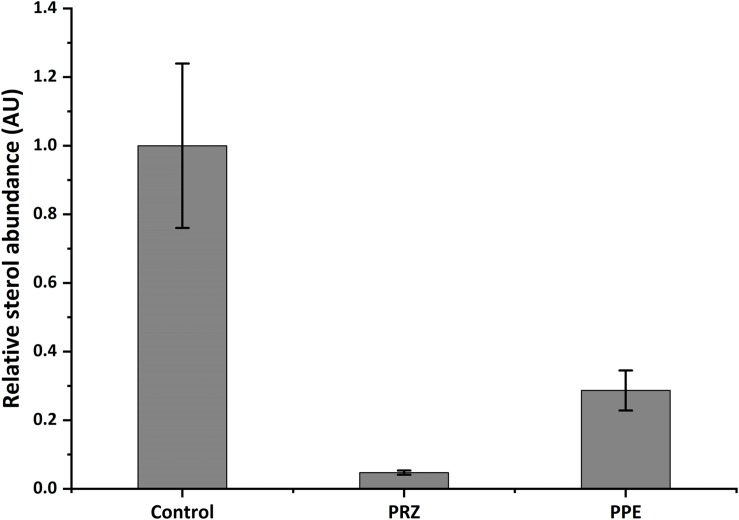
Fungal plant pathogens cause considerable losses in yield and quality of field crops worldwide. In addition, under specific environmental conditions, many fungi, including such as some and spp., are further able to produce mycotoxins while colonizing their host, which accumulate in human and animal tissues, posing a serious threat to consumer health. Extensive use of azole fungicides in crop protection stimulated the emergence of acquired azole resistance in some plant and human fungal pathogens. Combination treatments, which become popular in clinical practice, offer an alternative strategy for managing potentially resistant toxigenic fungi and reducing the required dosage of specific drugs. In the current study we tested the effect of pomegranate peel extract (PPE) on the growth and toxin production of the mycotoxigenic fungi and , both alone and in combination with the azole fungicide prochloraz (PRZ). Using time-lapse microscopy and quantitative image analysis we demonstrate significant delay of conidial germination and hyphal elongation rate in both fungi following PPE treatment in combination with PRZ. Moreover, PPE treatment reduced aflatoxin production by up to 97%, while a combined treatment with sub-inhibitory doses of PPE and PRZ resulted in complete inhibition of toxin production over a 72 h treatment. These findings were supported by qRT-PCR analysis, showing down-regulation of key genes involved in the aflatoxin biosynthetic pathway under combined PPE/PRZ treatment al low concentrations. Our results provide first evidence for synergistic effects between the commercial drug PRZ and natural compound PPE. Future application of these findings may allow to reduce the required dosage of PRZ, and possibly additional azole drugs, to inhibit mycotoxigenic fungi, ultimately reducing potential concerns over exposure to high doses of these potentially harmful fungicides.
真菌性植物病原体在全球范围内导致田间作物的产量和质量遭受巨大损失。此外,在特定环境条件下,许多真菌,包括某些曲霉属和青霉属物种,在侵染宿主时还能够产生霉菌毒素,这些毒素会在人类和动物组织中蓄积,对消费者健康构成严重威胁。在作物保护中广泛使用唑类杀菌剂促使一些植物和人类真菌病原体产生了获得性唑抗性。联合治疗在临床实践中变得流行起来,为管理潜在耐药的产毒真菌和减少特定药物的所需剂量提供了一种替代策略。在本研究中,我们测试了石榴皮提取物(PPE)单独以及与唑类杀菌剂咪鲜胺(PRZ)联合使用时,对产毒真菌黄曲霉和寄生曲霉的生长及毒素产生的影响。通过延时显微镜和定量图像分析,我们证明在PPE与PRZ联合处理后,两种真菌的分生孢子萌发和菌丝伸长速率均显著延迟。此外,PPE处理使黄曲霉毒素产量降低了高达97%,而亚抑制剂量的PPE与PRZ联合处理在72小时的处理过程中导致毒素产生完全受到抑制。qRT-PCR分析支持了这些发现,表明在低浓度PPE/PRZ联合处理下,黄曲霉毒素生物合成途径中关键基因的表达下调。我们的结果首次证明了商业药物PRZ与天然化合物PPE之间的协同作用。这些发现的未来应用可能会减少抑制产毒真菌所需的PRZ剂量,甚至可能减少其他唑类药物的剂量,最终减少对高剂量这些潜在有害杀菌剂暴露的潜在担忧。