Director, Sunlight, Nutrition, and Health Research Center, P.O. Box 641603, San Francisco, CA 94164-1603, USA.
Department of Biochemistry and Molecular Medicine, College of Medicine, Alfaisal University, P.O. Box 50927, Riyadh 11533, Saudi Arabia.
Nutrients. 2019 Sep 3;11(9):2065. doi: 10.3390/nu11092065.
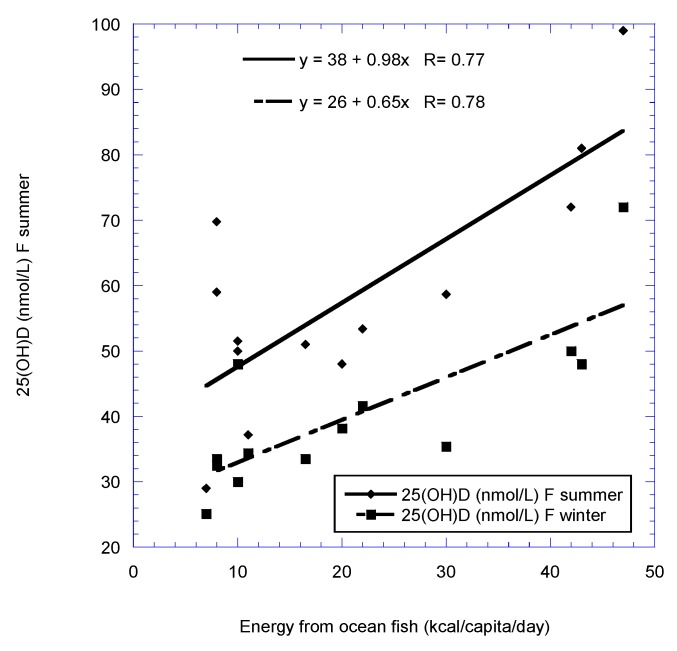
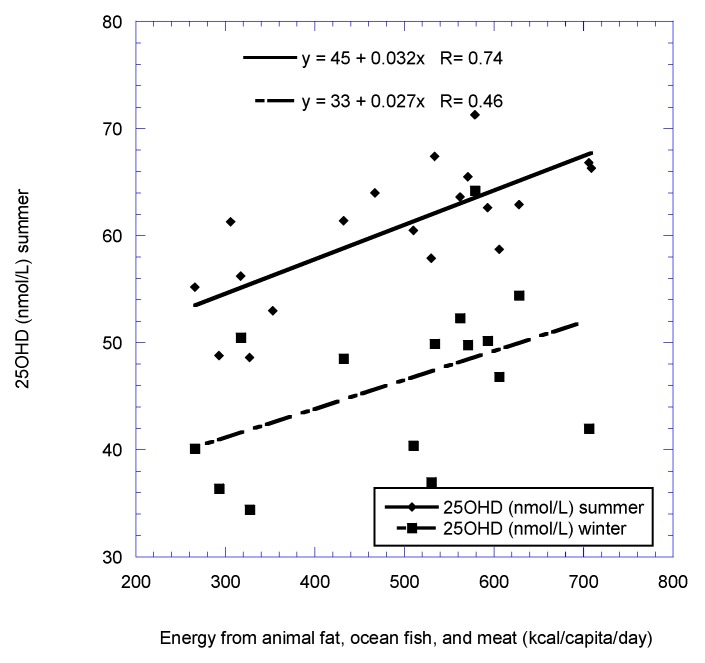
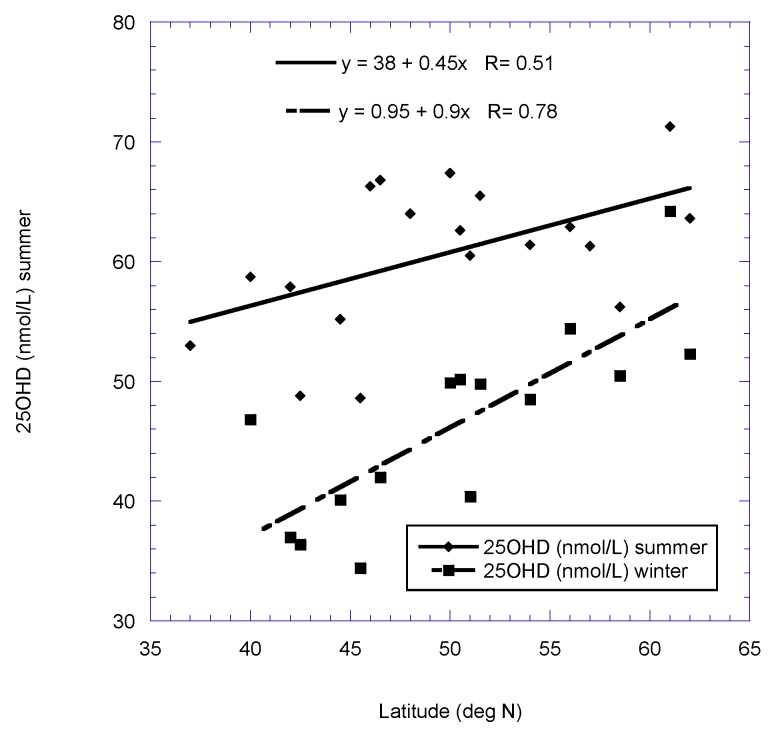
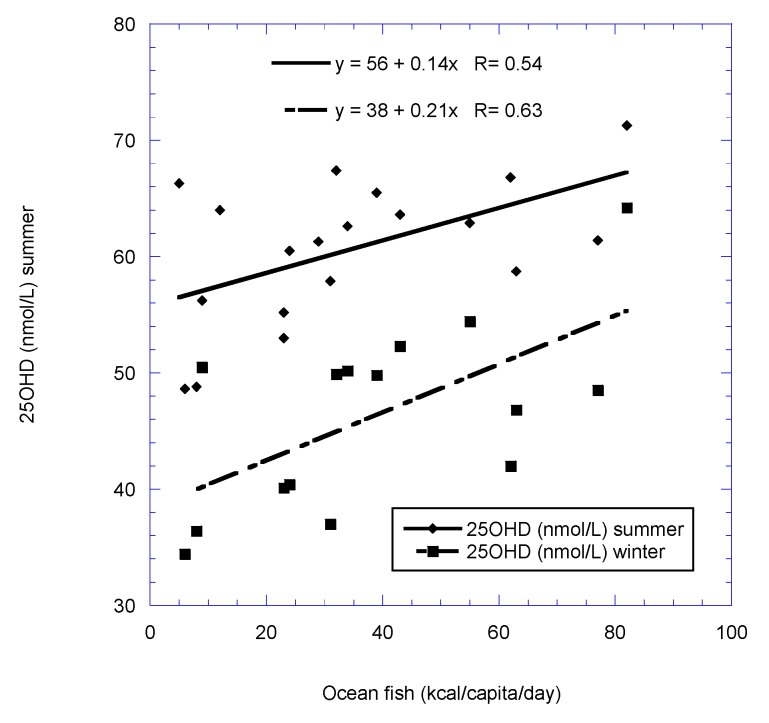
Serum 25-hydroxyvitamin D (25(OH)D) has been largely associated with latitude and sunshine exposure across several regions. According to previous results, 25(OH)D concentrations are, on average, relatively low in countries with abundant sunshine, including those of the Middle East and North Africa region, as well as lower-latitude Europe. The standard explanation for this phenomenon is that people wear concealing clothing because of cultural and religious practices and that high temperatures in summer limit direct sun exposure. However, the role of diet in the development of profound hypovitaminosis D has not been adequately explored in those countries. To examine how diet affects vitamin D status in the Middle Eastern and European countries, a search was conducted for papers from that region reporting 25(OH)D concentrations. Papers were sought that reported summertime and wintertime 25(OH)D concentrations for healthy nonpregnant adults representative of the entire population. Data from 15 Middle Eastern and European countries were found through this search. Data for postmenopausal women from 19 European countries were also obtained. Dietary supply data for animal products containing vitamin D (animal fat, eggs, ocean fish, animal meat, and milk) were obtained from the Food and Agriculture Organization of the United Nations. Latitude and a solar UVB dose index also were obtained for each country. For the 15-country study, energy from dietary factors was highly correlated with latitude, making it difficult to separate the effects of UVB exposure and dietary factors. However, for the 19-country study, dietary factors were only weakly correlated with latitude. In that study, ocean fish was the most important single dietary factor affecting serum 25(OH)D concentration for postmenopausal women in various European countries, but animal fat and meat also contributed. Because this is an ecological study, further research is encouraged to evaluate and extend the findings.
血清 25-羟维生素 D(25(OH)D)与多个地区的纬度和阳光暴露量密切相关。根据以往的结果,在阳光充足的国家,25(OH)D 浓度平均相对较低,包括中东和北非地区以及低纬度的欧洲国家。对于这种现象的标准解释是,由于文化和宗教习俗,人们会穿着遮盖性衣物,并且夏季高温会限制直接暴露在阳光下。然而,在这些国家,饮食在维生素 D 严重缺乏症的发展中的作用尚未得到充分探讨。为了研究饮食如何影响中东和欧洲国家的维生素 D 状况,我们对该地区报告 25(OH)D 浓度的论文进行了检索。我们寻找报告了代表整个人群的健康非孕妇女性在夏季和冬季的 25(OH)D 浓度的论文。通过此次搜索,我们找到了 15 个中东和欧洲国家的数据。还获得了来自 19 个欧洲国家的绝经后妇女的数据。从联合国粮食及农业组织获得了含有维生素 D 的动物产品(动物脂肪、鸡蛋、海洋鱼类、动物肉和牛奶)的饮食供应数据。还为每个国家获取了纬度和太阳 UVB 剂量指数。对于 15 国研究,饮食因素提供的能量与纬度高度相关,使得难以将紫外线 B 暴露和饮食因素的影响分开。但是,对于 19 国研究,饮食因素与纬度的相关性很弱。在该研究中,海洋鱼类是影响各种欧洲国家绝经后妇女血清 25(OH)D 浓度的最重要的单一饮食因素,但动物脂肪和肉类也有贡献。由于这是一项生态学研究,鼓励进一步研究以评估和扩展研究结果。