de Oliveira Camila Maciel, Pavani Jessica, Krieger José Eduardo, de Oliveira Alvim Rafael, Mourão-Junior Carlos Alberto, da Costa Pereira Alexandre
1Laboratory of Genetics and Molecular Cardiology, Heart Institute (InCor), University of São Paulo Medical School, São Paulo, Brazil.
2Department of Integrative Medicine, Federal University of Paraná, Curitiba, Brazil.
Diabetol Metab Syndr. 2019 Aug 29;11:76. doi: 10.1186/s13098-019-0467-1. eCollection 2019.
The association between diabetes and obesity is very well established. Faced with this, several anthropometric indices of adiposity are often involved in studies on diabetes. Our main goal in this paper is to evaluate the association between body adiposity index (BAI) and type 2 diabetes mellitus (T2DM) in a sample of the Brazilian population after 5-year follow-up.
The data used come from the Baependi Heart Study cohort, which consists of two periods: cycle 1 (2005-2006) and cycle 2 (2010-2013). Individuals of both sexes (n = 1121) were selected by excluding participants with type 2 diabetes mellitus at baseline or those that were lost to follow-up.
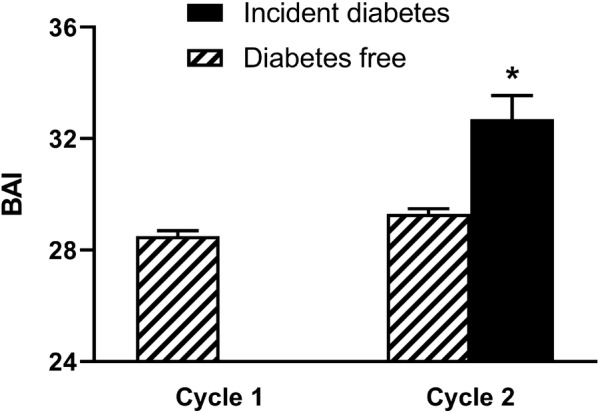
The diabetic subjects showed higher systolic blood pressure, BAI, body mass index, waist circumference and fasting glucose levels. In addition, using mixed-effects logistic regression, we found that the elevation of a single unit of BAI represented an increase of 8.4% in the risk of a patient developing T2DM (OR = 1.084 [95% CI 1.045-1.124]).
Obesity is recognised as one of the most important risk factors for T2DM and BAI has proven to be a useful tool in estimating the risk of a patient developing T2DM in a Brazilian population.
糖尿病与肥胖之间的关联已得到充分证实。面对这种情况,肥胖的几种人体测量指标经常被用于糖尿病研究。本文的主要目的是在对巴西人群进行5年随访后,评估身体肥胖指数(BAI)与2型糖尿病(T2DM)之间的关联。
所使用的数据来自Baependi心脏研究队列,该队列包括两个阶段:第1周期(2005 - 2006年)和第2周期(2010 - 2013年)。通过排除基线时患有2型糖尿病的参与者或失访者,选取了两性个体(n = 1121)。
糖尿病患者的收缩压、BAI、体重指数、腰围和空腹血糖水平较高。此外,使用混合效应逻辑回归分析,我们发现BAI每升高一个单位,患者患T2DM的风险增加8.4%(OR = 1.084 [95% CI 1.045 - 1.124])。
肥胖被认为是T2DM最重要的危险因素之一,并且BAI已被证明是评估巴西人群中患者患T2DM风险的有用工具。