Department of Neurology and Neuroscience Center, First Hospital of Jilin University, Xinmin Street No. 71, Changchun 130000, China.
Oxid Med Cell Longev. 2019 Aug 14;2019:4578462. doi: 10.1155/2019/4578462. eCollection 2019.
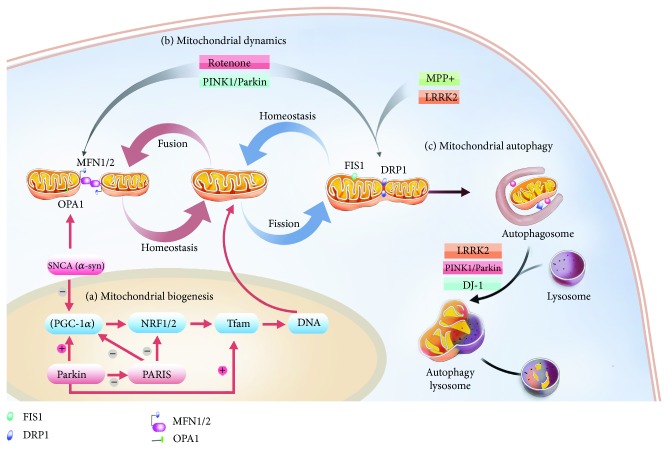
Parkinson's disease (PD), clinically characterized by motor and nonmotor symptoms, is a common progressive and multisystem neurodegenerative disorder, which is caused by both genetic and environmental risk factors. The main pathological features of PD are the loss of dopaminergic (DA) neurons and the accumulation of alpha-synuclein (-syn) in the residual DA neurons in the substantia nigra pars compacta (SNpc). In recent years, substantial progress has been made in discovering the genetic factors of PD. In particular, a total of 19 PD-causing genes have been unraveled, among which some members have been regarded to be related to mitochondrial dysfunction. Mitochondria are key regulators of cellular metabolic activity and are critical for many important cellular processes including energy metabolism and even cell death. Their normal function is basically maintained by the mitochondrial quality control (MQC) mechanism. Accordingly, 1-methyl-4-phenyl-1,2,3,6-tetrahydropyridine (MPTP), a kind of neurotoxin, exerts its neurotoxic effects at least partially by producing its toxic metabolite, namely, 1-methyl-4-phenylpyridine (MPP+), which in turn causes mitochondrial dysfunction by inhibiting complex I and mimicking the key features of PD pathogenesis. This review focused on three main aspects of the MQC signaling pathways, that is, mitochondrial biogenesis, mitochondrial dynamics, and mitochondrial autophagy; hence, it demonstrates in detail how genetic and environmental factors result in PD pathogenesis by interfering with MQC pathways, thereby hopefully contributing to the discovery of novel potential therapeutic targets for PD.
帕金森病(PD),临床上以运动和非运动症状为特征,是一种常见的进行性和多系统神经退行性疾病,由遗传和环境风险因素共同引起。PD 的主要病理特征是黑质致密部(SNpc)残留多巴胺能(DA)神经元中多巴胺能神经元的丧失和α-突触核蛋白(-syn)的积累。近年来,在发现 PD 的遗传因素方面取得了实质性进展。特别是,已经揭示了总共 19 个导致 PD 的基因,其中一些成员被认为与线粒体功能障碍有关。线粒体是细胞代谢活动的关键调节因子,对许多重要的细胞过程都至关重要,包括能量代谢甚至细胞死亡。它们的正常功能基本上由线粒体质量控制(MQC)机制维持。因此,神经毒素 1-甲基-4-苯基-1,2,3,6-四氢吡啶(MPTP)至少部分通过产生其毒性代谢物 1-甲基-4-苯基吡啶(MPP+)发挥其神经毒性作用,MPP+ 通过抑制复合物 I 并模拟 PD 发病机制的关键特征,进而导致线粒体功能障碍。本综述重点关注 MQC 信号通路的三个主要方面,即线粒体生物发生、线粒体动力学和线粒体自噬;因此,它详细说明了遗传和环境因素如何通过干扰 MQC 通路导致 PD 发病机制,从而有望为 PD 发现新的潜在治疗靶点做出贡献。