Kumari Shweta, Garg Neelima, Kumar Amod, Guru Pawas Kumar Indra, Ansari Sharafat, Anwar Shadab, Singh Krishn Pratap, Kumari Priti, Mishra Prashant Kumar, Gupta Birendra Kumar, Nehar Shamshun, Sharma Ajay Kumar, Raziuddin Mohammad, Sohail Mohammad
Research Laboratory, University Department of Zoology, Vinoba Bhave University, Hazaribag, Jharkhand, India.
Centre for Tribal Health and Biotechnology Foundation, New Delhi, India.
One Health. 2019 Aug 19;8:100098. doi: 10.1016/j.onehlt.2019.100098. eCollection 2019 Dec.
Haemoglobin content is the well accepted indicator for anaemia assessment. The high prevalence of anaemia, maternal health care issues and adverse delivery outcome in Jharkhand, we investigated whether delivering women with anaemia would present a modifiable risk of preterm (PTB) and low birth weight (LBW).
A facility-based cross-sectional study involving pregnant women, with screening for pregnancy endpoints and haemoglobin assay, were conducted. Anaemia was classified according to World Health Organization's definition of anaemia in pregnancy. Confounding variables were adjusted in a logistic model. The adjusted odds ratios (AORs) with 95% confidence intervals (CIs) were used for analyzing the association among maternal anaemia, PTB and LBW.
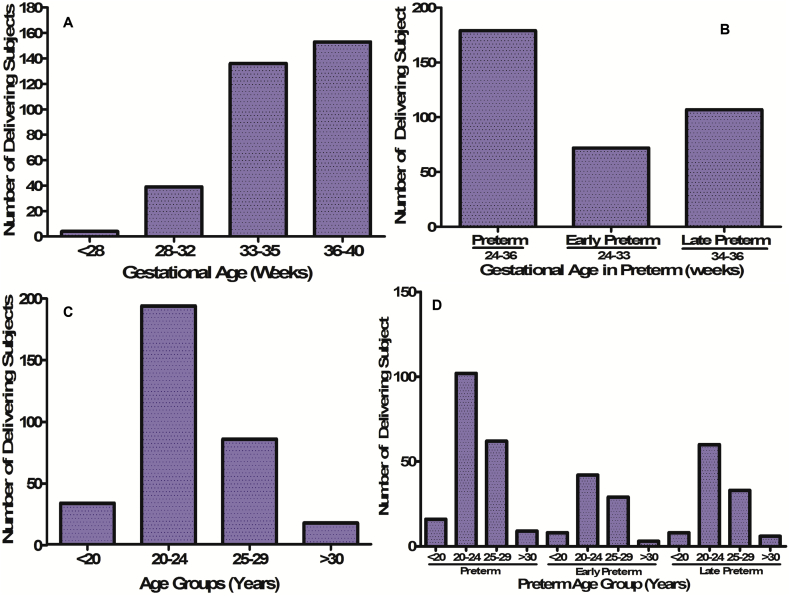
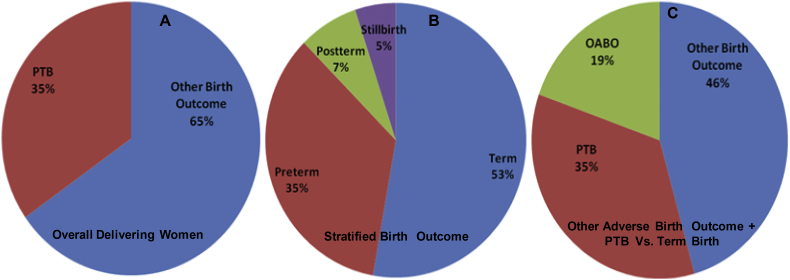
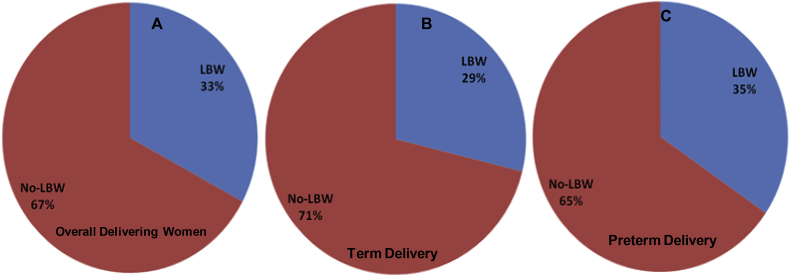
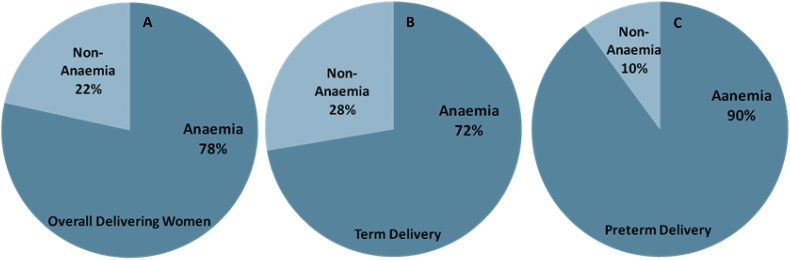
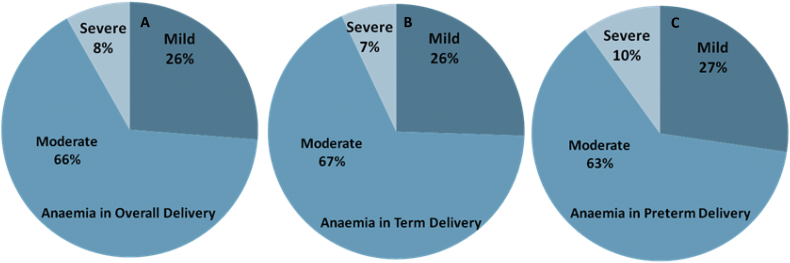
We observed a high prevalence of anaemia (78.45%) in delivering women, whereas high prevalence of preterm birth (34.75%) and LBW (32.81%) in delivering women overall. In the adjusted analysis, overall anaemia in pregnancy was strongly associated with preterm birth (OR, 3.42; 95% CI, 1.98-5.88; ) as compared to LBW (OR, 1.12; 95% CI, 0.65-1.61; ). The risk of PTB and LBW were dependent on the stratification of the anaemia group, as the strongest association was observed in severe (OR, 4.86) followed by mild (OR, 3.66) and moderate (OR, 3.18) anaemia in PTB; whereas risk of LBW was found in severe (OR, 2.5) followed by moderate (OR, 1.11) and mild (OR, 0.57) anaemia. The risk of PTB and LBW across six pregnancy haemoglobin groups were compared, haemoglobin of 10-10.9 g/dl (OR, 1.25) and ≤ 8 g/dl (OR, 1.03) have shown association with PTB and LBW, respectively. However, high haemoglobin concentration was not associated with either PTB or LBW.
Anaemia in delivering women was associated with an elevated risk of PTB and LBW and the risk increased with the severity of anaemia in pregnant women.
血红蛋白含量是评估贫血的公认指标。鉴于恰尔肯德邦贫血患病率高、孕产妇保健问题及不良分娩结局,我们调查了贫血的分娩女性是否存在早产(PTB)和低出生体重(LBW)的可改变风险。
开展了一项基于机构的横断面研究,纳入孕妇,进行妊娠结局筛查和血红蛋白检测。根据世界卫生组织对妊娠期贫血的定义对贫血进行分类。在逻辑模型中对混杂变量进行了调整。采用调整后的比值比(AOR)及95%置信区间(CI)分析孕产妇贫血、PTB和LBW之间的关联。
我们观察到分娩女性贫血患病率高(78.45%),而总体分娩女性早产(34.75%)和低出生体重(32.81%)患病率也高。在调整分析中,与低出生体重相比(比值比,1.12;95%置信区间,0.65 - 1.61),妊娠期总体贫血与早产密切相关(比值比,3.42;95%置信区间,1.98 - 5.88)。PTB和LBW的风险取决于贫血组的分层,在PTB方面,重度贫血(比值比,4.86)关联最强,其次是轻度(比值比,3.66)和中度(比值比,3.18)贫血;而在低出生体重方面,重度贫血(比值比,2.5)风险最高,其次是中度(比值比,1.11)和轻度(比值比,0.57)贫血。比较了六个妊娠血红蛋白组的PTB和LBW风险,血红蛋白10 - 10.9 g/dl(比值比,1.25)和≤8 g/dl(比值比,1.03)分别与PTB和LBW相关。然而,高血红蛋白浓度与PTB或LBW均无关联。
分娩女性贫血与PTB和LBW风险升高相关,且风险随孕妇贫血严重程度增加而升高。