Mwaka Amos Deogratius, Tusabe Gersave, Garimoi Christopher Orach, Vohra Sunita, Ibingira Charles
Department of Internal Medicine, Makerere University College of Health Sciences, Kampala, Uganda
Department of Philosophy, Makerere University College of Humanities and Social Sciences, Kampala, Uganda.
BMJ Open. 2019 Sep 4;9(9):e030316. doi: 10.1136/bmjopen-2019-030316.
To describe the disposition and sociodemographic characteristics of medical students associated with inclusion of traditional and complementary medicine in medical school curricula in Uganda.
A cross-sectional study conducted during May 2017. A pretested questionnaire was used to collect data. Disposition to include principles of traditional and complementary medicine into medical school curricula was determined as proportion and associated factors determined through multivariate logistic regression.
Medical students in their second to fifth years at the College of Health Sciences, Makerere University, Uganda. Makerere University is the oldest public university in the East African region.
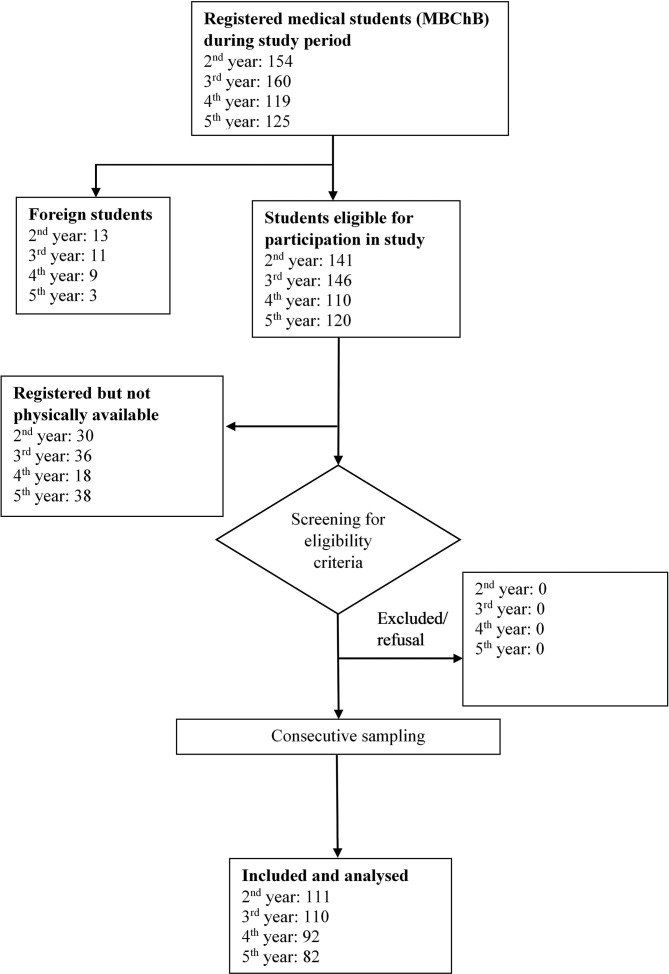
393 of 395 participants responded. About 60% (192/325) of participants recommended inclusion of traditional and complementary medicine principles into medical school curricula in Uganda. The disposition to include traditional and complementary medicine into medical school curricula was not associated with sex, age group or region of origin of the students. However, compared with the second year students, the third (OR 0.34; 95% CI 0.17 to 0.66) and fifth (OR 0.39; 95% CI 0.16 to 0.93) year students were significantly less likely to recommend inclusion of traditional and complementary medicine into the medical school curricula. Participants who hold positive attributes and believe in effectiveness of traditional and complementary medicine were statistically significantly more likely to recommend inclusion into the medical school curricula in Uganda.
Inclusion of principles of traditional and complementary medicine into medical school curricula to increase knowledge, inform practice and research, and moderate attitudes of physicians towards traditional medicine practice is acceptable by medical students at Makerere University. These findings can inform review of medical schools' curricula in Uganda.
描述乌干达医学院校课程中纳入传统医学和补充医学的医学生的态度及社会人口学特征。
2017年5月进行的一项横断面研究。使用预先测试的问卷收集数据。将传统医学和补充医学原则纳入医学院校课程的态度以比例确定,并通过多变量逻辑回归确定相关因素。
乌干达马凯雷雷大学健康科学学院二至五年级的医学生。马凯雷雷大学是东非地区最古老的公立大学。
395名参与者中有393人做出回应。约60%(192/325)的参与者建议将传统医学和补充医学原则纳入乌干达医学院校课程。将传统医学和补充医学纳入医学院校课程的态度与学生的性别、年龄组或原籍地区无关。然而,与二年级学生相比,三年级(OR 0.34;95%CI 0.17至0.66)和五年级(OR 0.39;95%CI 0.16至0.93)学生推荐将传统医学和补充医学纳入医学院校课程的可能性显著降低。对传统医学和补充医学持积极态度并相信其有效性的参与者在统计学上更有可能推荐将其纳入乌干达医学院校课程。
马凯雷雷大学的医学生认可将传统医学和补充医学原则纳入医学院校课程,以增加知识、指导实践和研究,并缓和医生对传统医学实践的态度。这些研究结果可为乌干达医学院校课程的审查提供参考。