Michael Tanja, Schanz Christian G, Mattheus Hannah K, Issler Tobias, Frommberger Ulrich, Köllner Volker, Equit Monika
Division of Clinical Psychology and Psychotherapy, Department of Psychology, Saarland University, Saarbrücken, Germany.
Department of Child and Adolescent Psychiatry, Saarland University Medical Center, Homburg, Germany.
Eur J Psychotraumatol. 2019 Jul 24;10(1):1634938. doi: 10.1080/20008198.2019.1634938. eCollection 2019.
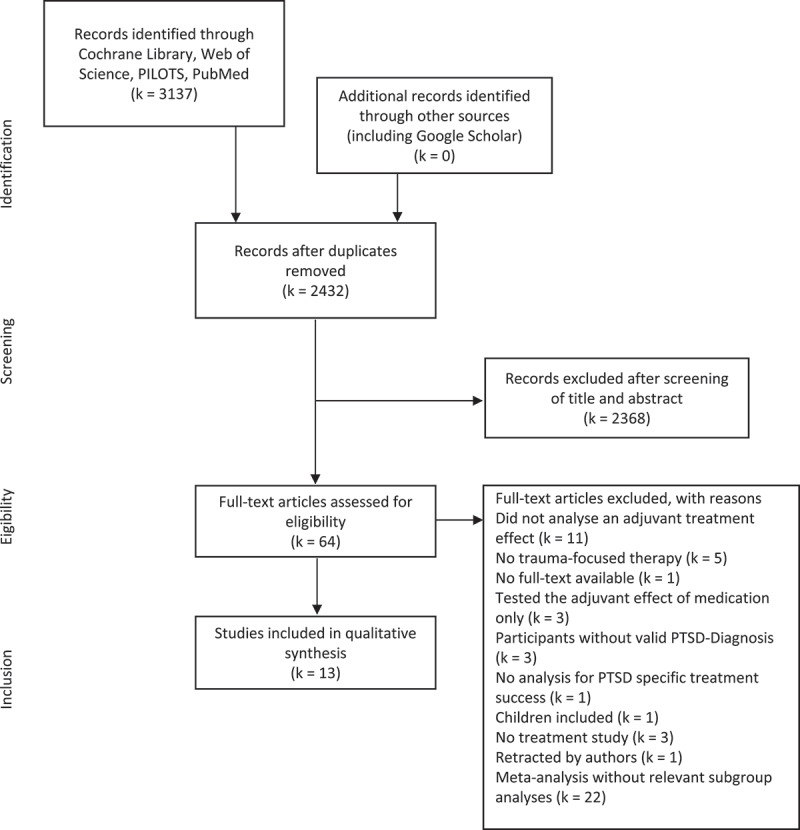
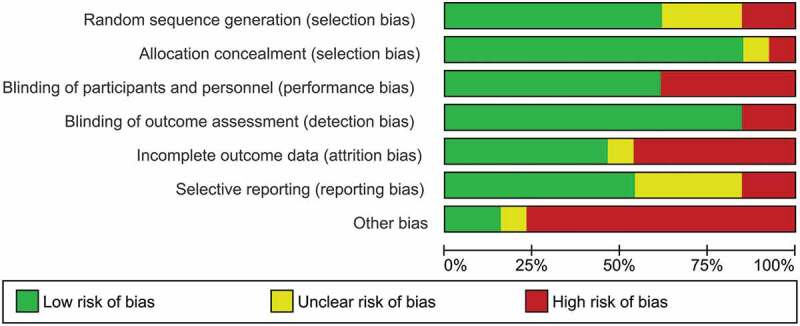
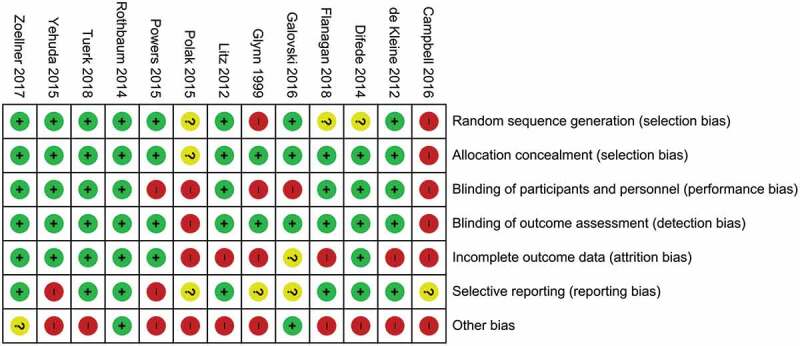
: According to clinical guidelines, trauma-focused psychotherapies (TF-PT) such as trauma-focused cognitive behavioural therapy (TF-CBT) and eye movement desensitization and reprocessing (EMDR) are recommended as first-line treatments for posttraumatic stress disorder (PTSD). TF-CBT and EMDR are equally effective and have large effect sizes. However, many patients fail to respond or have comorbid symptoms or disorders that only partially decline with TF-PT. Thus, there is growing interest in augmenting TF-PT through adjuvant interventions. : The current systematic review aims to assess whether adjuvant interventions improve outcome among adult PTSD patients receiving TF-PT. : We searched the databases PubMed, PILOTS, Web of Science and the Cochrane Library for controlled clinical trials examining whether adjuvant interventions lead to more symptom reduction in adult PTSD patients receiving TF-PT. Thirteen randomized controlled trials fitted the inclusion criteria. These were evaluated for internal risk of bias using the Cochrane Handbook for Systematic Review of Interventions. : Most studies have a substantial risk for internal bias, mainly due to small sample sizes. Thus, no strong conclusion can be drawn from the current empirical evidence. Preliminary evidence suggests that exercise and cortisol administration may have an adjuvant effect on PTSD symptom reduction. Breathing biofeedback showed a trend for an adjuvant effect and an effect for accelerated symptom reduction. : Currently, it is not possible to formulate evidence-based clinical recommendations regarding adjuvants interventions. While several adjuvant interventions hold the potential to boost the effectiveness of TF-PT, the realization of sufficiently powered studies is crucial to separate plausible ideas from interventions proven to work in practice.
根据临床指南,创伤聚焦心理治疗(TF-PT),如创伤聚焦认知行为疗法(TF-CBT)和眼动脱敏再处理疗法(EMDR),被推荐作为创伤后应激障碍(PTSD)的一线治疗方法。TF-CBT和EMDR同样有效,且效应量较大。然而,许多患者对治疗无反应,或存在共病症状或障碍,这些症状或障碍在接受TF-PT治疗后仅部分减轻。因此,通过辅助干预来增强TF-PT治疗效果的兴趣日益浓厚。
当前的系统评价旨在评估辅助干预是否能改善接受TF-PT治疗的成年PTSD患者的治疗效果。
我们检索了PubMed、PILOTS、科学网和Cochrane图书馆等数据库,以查找对照临床试验,这些试验旨在研究辅助干预是否能使接受TF-PT治疗的成年PTSD患者症状减轻更多。13项随机对照试验符合纳入标准。使用《Cochrane干预措施系统评价手册》对这些试验的内部偏倚风险进行了评估。
大多数研究存在较大的内部偏倚风险,主要原因是样本量小。因此,无法从当前的实证证据中得出有力结论。初步证据表明,运动和给予皮质醇可能对减轻PTSD症状有辅助作用。呼吸生物反馈显示出有辅助作用的趋势以及加速症状减轻的作用。
目前,无法就辅助干预制定基于证据的临床建议。虽然几种辅助干预有可能提高TF-PT的有效性,但开展有足够效力的研究对于区分合理的想法与经实践证明有效的干预措施至关重要。