Lorenzi Maria, Arndorfer Stella, Aguiar-Ibañez Raquel, Scherrer Emilie, Liu Frank Xiaoqing, Krepler Clemens
Precision Xtract, Oakland, CA, USA.
Merck & Co., Inc, Kenilworth, NJ, USA.
J Drug Assess. 2019 Jul 26;8(1):135-145. doi: 10.1080/21556660.2019.1649266. eCollection 2019.
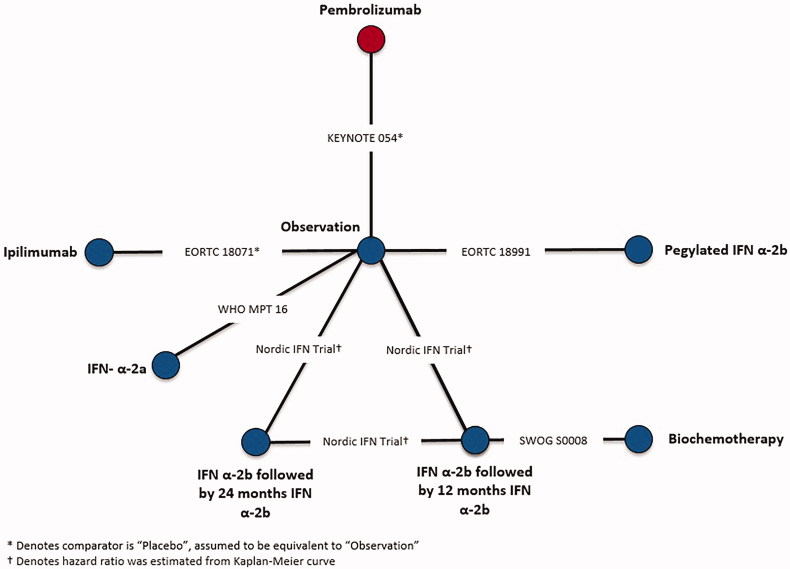
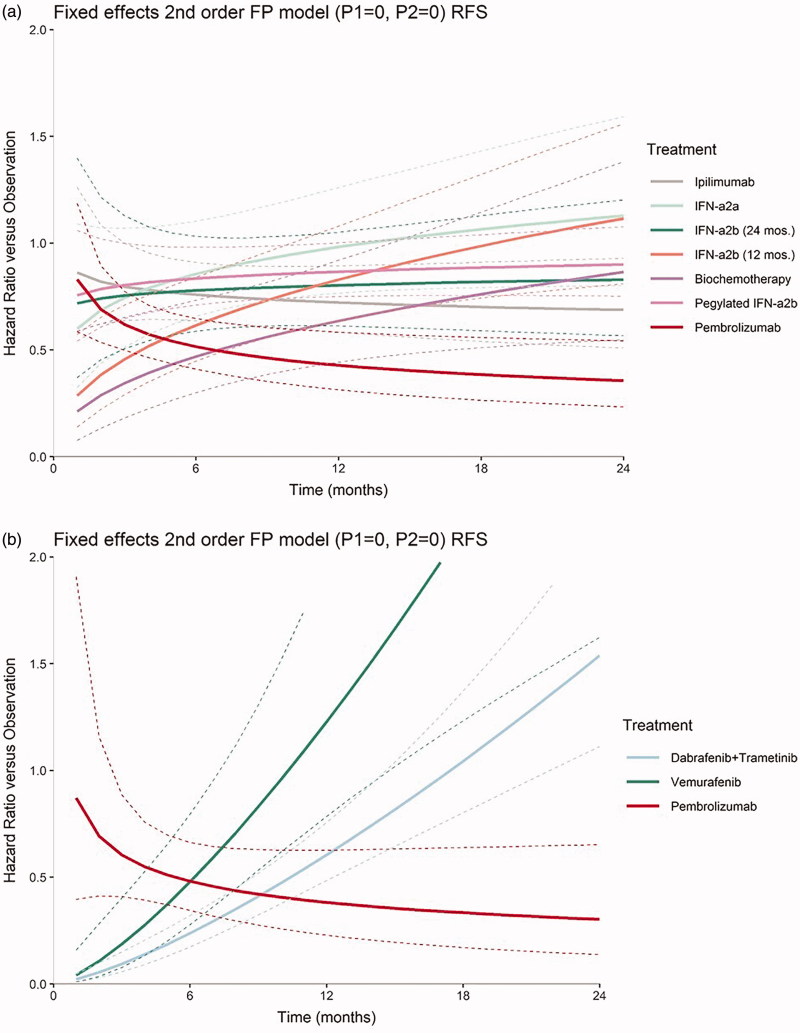
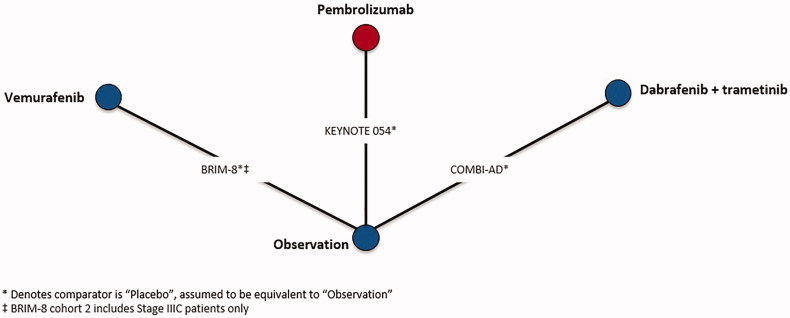
To determine the efficacy of pembrolizumab relative to other treatments used in stage III melanoma by conducting a systematic literature review (SLR) and network meta-analysis (NMA). A SLR was conducted to identify randomized clinical trials (RCTs) evaluating approved adjuvant treatments including interferon-containing regimens, BRAF-inhibitors, and PD-L1 inhibitors in stage III melanoma patients. Relative treatment effects for recurrence-free survival (RFS) were synthesized with Bayesian NMA models that allowed for hazard ratios (HRs) to vary over time. Included studies formed a connected network of evidence composed of eight trials. In high-risk stage III patients, the HR for pembrolizumab vs observation decreased significantly over time with the superiority of pembrolizumab over observation becoming statistically meaningful before 3 months. By 9 months, the HR for pembrolizumab vs observation was statistically significantly lower than the HR for most other treatments vs observation, with the exception of ipilimumab and biochemotherapy due to overlapping 95% credible intervals. In BRAF + patients, pembrolizumab was statistically significantly better than observation after 3 months. The HR for both BRAF-inhibitors vs observation increased significantly over time and pembrolizumab was statistically superior to both BRAF-inhibitors after 15 months. Pembrolizumab results in statistically significantly improved RFS compared to all competing regimens after 9 months, except ipilimumab and biochemotherapy, for the adjuvant treatment of stage III melanoma. However, point estimate HRs vs observation for pembrolizumab are much lower than those for ipilimumab. In BRAF + patients, the advantage of pembrolizumab versus competing interventions increases over time with respect to RFS.
通过进行系统文献综述(SLR)和网络荟萃分析(NMA)来确定帕博利珠单抗相对于用于III期黑色素瘤的其他治疗方法的疗效。进行了一项SLR,以识别评估III期黑色素瘤患者中包括含干扰素方案、BRAF抑制剂和PD-L1抑制剂在内的已批准辅助治疗的随机临床试验(RCT)。使用贝叶斯NMA模型综合无复发生存期(RFS)的相对治疗效果,该模型允许风险比(HRs)随时间变化。纳入的研究形成了一个由八项试验组成的连通证据网络。在高危III期患者中,帕博利珠单抗与观察相比的HR随时间显著降低,帕博利珠单抗优于观察在3个月前变得具有统计学意义。到9个月时,帕博利珠单抗与观察相比的HR在统计学上显著低于大多数其他治疗与观察相比的HR,但因95%可信区间重叠的伊匹木单抗和生物化疗除外。在BRAF+患者中,帕博利珠单抗在3个月后在统计学上显著优于观察。BRAF抑制剂与观察相比的HR均随时间显著增加,帕博利珠单抗在15个月后在统计学上优于两种BRAF抑制剂。对于III期黑色素瘤的辅助治疗,帕博利珠单抗在9个月后与所有竞争方案相比,在统计学上显著改善了RFS,但伊匹木单抗和生物化疗除外。然而,帕博利珠单抗与观察相比的点估计HR远低于伊匹木单抗。在BRAF+患者中,帕博利珠单抗相对于竞争干预措施在RFS方面的优势随时间增加。