Keosaian Julia, Venkatesh Thuppil, D'Amico Salvatore, Gardiner Paula, Saper Robert
Department of Family Medicine, Boston Medical Center, Boston, Massachusetts.
Department of Health Law, Policy, and Management, Boston University School of Public Health, Boston, Massachusetts.
Glob Adv Health Med. 2019 Aug 22;8:2164956119870988. doi: 10.1177/2164956119870988. eCollection 2019.
Traditional Indian cosmetics and Ayurvedic medicines may contain lead. Previous studies have shown a relationship between eye cosmetic use (kohl) in children and elevated blood lead levels (BLLs) > 10 µg/dL. However, an association between Ayurvedic use and elevated BLLs in children is unknown and understudied.
We assessed the feasibility of collecting BLLs in children attending Ayurvedic outpatient settings in India. Our pilot study took place over 3 days in the summer of 2010 at a large public Ayurveda hospital and a small pediatric clinic in southern India. Using a trained interpreter, we administered a standardized questionnaire in Malayalam, assessing sociodemographics, Ayurvedic medicine use, kohl use, and other potential risk factors for lead exposure, to parents of pediatric outpatients. We also analyzed BLLs using a portable lead analyzer.
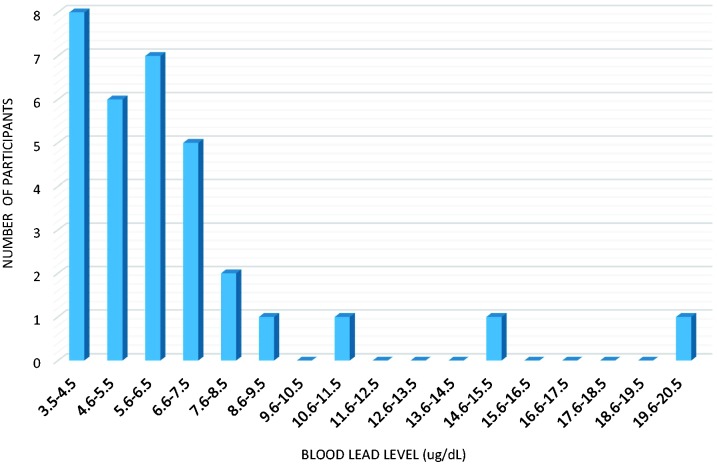
The study enrolled 29 children (mean age, 3.8 years). The mean BLL was 6.7 µg/dL (SD = 3.5; range, 3.5-20.2). Seventy-two percent of the children used Ayurvedic medicine in the past 2 years and 55% reported kohl use. Mean BLL of Ayurvedic users and nonusers was 6.2 µg/dL and 8.5 µg/dL, respectively ( = .08). Kohl users had a statistically significant higher BLL than nonusers (8.0 µg/dL vs 5.3 µg/dL, = .03).
It is feasible to collect BLLs in pediatric Ayurvedic outpatient clinics in southern India. Collaborative relationships with community members and hospital staff were essential. Further research is needed to investigate Ayurveda and kohl use as risk factors for elevated lead burden among Indian children.
传统印度化妆品和阿育吠陀药物可能含铅。先前研究表明儿童使用眼部化妆品(眼影膏)与血铅水平升高(>10μg/dL)之间存在关联。然而,阿育吠陀药物的使用与儿童血铅水平升高之间的关联尚不清楚且研究不足。
我们评估了在印度阿育吠陀门诊就诊的儿童中收集血铅水平的可行性。我们的试点研究于2010年夏季在印度南部一家大型公立阿育吠陀医院和一家小型儿科诊所进行,为期3天。我们通过一名经过培训的口译员,用马拉雅拉姆语向儿科门诊患者的家长发放一份标准化问卷,评估社会人口统计学、阿育吠陀药物使用情况、眼影膏使用情况以及其他潜在的铅暴露风险因素。我们还使用便携式铅分析仪分析血铅水平。
该研究纳入了29名儿童(平均年龄3.8岁)。平均血铅水平为6.7μg/dL(标准差=3.5;范围3.5 - 20.2)。72%的儿童在过去2年中使用过阿育吠陀药物,55%的儿童报告使用过眼影膏。使用阿育吠陀药物的儿童和未使用的儿童平均血铅水平分别为6.2μg/dL和8.5μg/dL(P = 0.08)。使用眼影膏的儿童血铅水平在统计学上显著高于未使用者(8.0μg/dL对5.3μg/dL,P = 0.03)。
在印度南部儿科阿育吠陀门诊诊所收集血铅水平是可行的。与社区成员和医院工作人员的合作关系至关重要。需要进一步研究调查阿育吠陀药物和眼影膏的使用作为印度儿童铅负担升高的风险因素。