Aaltonen Mari S, Forma Leena P, Pulkki Jutta M, Raitanen Jani A, Rissanen Pekka, Jylhä Marja K
Faculty of Social Sciences and Gerontology Research Center, Tampere University, Finland.
The University of British Columbia, Vancouver, Canada.
Gerontol Geriatr Med. 2019 Aug 21;5:2333721419870629. doi: 10.1177/2333721419870629. eCollection 2019 Jan-Dec.
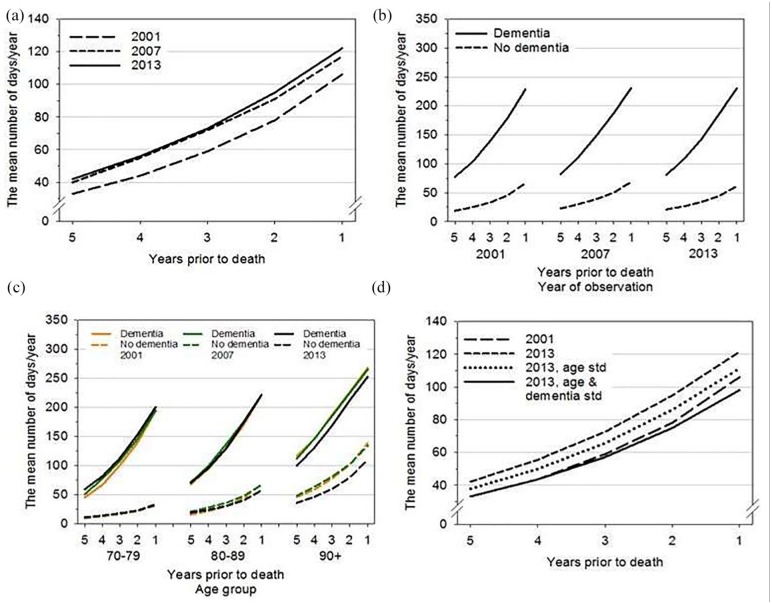
Welfare states increasingly rely on aging in place policies and have cut back on institutional long-term care (LTC) provision. Simultaneously, the major determinants of LTC use, that is, dementia and living to very old age, are increasing. We investigated how increasing longevity and concomitant dementia were associated with changes in round-the-clock LTC use in the last 5 years of life between 1996 and 2013. Retrospective data drawn from national registers included all those who died aged 70+ in 2007 and 2013, plus a 40% random sample from 2001 ( = 86,554). A generalized estimating equations (GEE) were used to estimate the association of dementia and age with LTC use during three study periods 1996-2001, 2002-2007, and 2008-2013. Between the study periods, the total number of days spent in LTC increased by around 2 months. Higher ages at death and the increased number of persons with dementia contributed to this increase. The group of the most frequent LTC users, that is, people aged 90+ with or without dementia, grew the most in size, yet their LTC use decreased. The implications of very old age and concomitant dementia for care needs must be acknowledged to guarantee an adequate quantity and quality of care.
福利国家越来越依赖居家养老政策,并减少了机构长期护理(LTC)服务的提供。与此同时,长期护理使用的主要决定因素,即痴呆症和高龄化,却在增加。我们调查了1996年至2013年期间,寿命延长和随之而来的痴呆症与生命最后5年全天候长期护理使用变化之间的关联。从国家登记册中提取的回顾性数据包括2007年和2013年所有70岁及以上死亡者,以及2001年40%的随机样本(=86,554)。使用广义估计方程(GEE)来估计1996 - 2001年、2002 - 2007年和2008 - 2013年三个研究期间痴呆症和年龄与长期护理使用之间的关联。在各研究期间,长期护理花费的总天数增加了约2个月。死亡年龄的提高和痴呆症患者数量的增加导致了这一增长。最频繁使用长期护理的群体,即90岁及以上患有或未患有痴呆症的人群,规模增长最大,但他们的长期护理使用却有所减少。必须认识到高龄和伴随的痴呆症对护理需求的影响,以确保提供足够数量和质量的护理。