Daruwalla Nayreen, Jaswal Surinder, Fernandes Prakash, Pinto Preethi, Hate Ketaki, Ambavkar Gauri, Kakad Bhaskar, Gram Lu, Osrin David
Program on Prevention of Violence Against Women and Children, SNEHA, Mumbai, Maharashtra, 400017, India.
School of Research Methodology, Centre for Health and Mental Health, School of Social Work, Tata Institute of Social Sciences, Mumbai, Maharashtra, 400088, India.
Wellcome Open Res. 2019 Aug 21;4:54. doi: 10.12688/wellcomeopenres.15128.2. eCollection 2019.
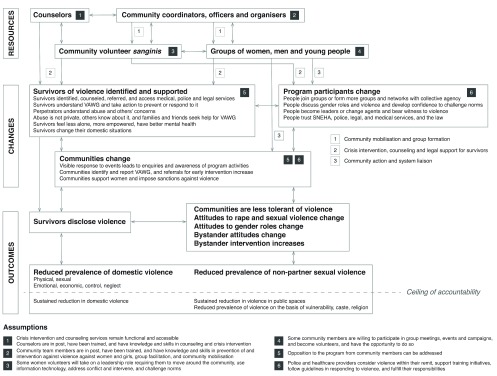
We describe the development of a theory of change for community mobilisation activities to prevent violence against women and girls. These activities are part of a broader program in urban India that works toward primary, secondary, and tertiary prevention of violence and includes crisis response and counselling and medical, police, and legal assistance. The theory of change was developed in five phases, via expert workshops, use of primary data, recurrent team meetings, adjustment at further meetings and workshops, and a review of published theories. The theory summarises inputs for primary and secondary prevention, consequent changes (positive and negative), and outcomes. It is fully adapted to the program context, was designed through an extended consultative process, emphasises secondary prevention as a pathway to primary prevention, and integrates community activism with referral and counselling interventions. The theory specifies testable causal pathways to impact and will be evaluated in a controlled trial.
我们阐述了一种社区动员活动变革理论的发展情况,这些活动旨在预防针对妇女和女童的暴力行为。这些活动是印度城市一项更广泛计划的一部分,该计划致力于暴力行为的一级、二级和三级预防,包括危机应对、咨询以及医疗、警察和法律援助。变革理论分五个阶段形成,通过专家研讨会、使用原始数据、定期团队会议、在后续会议和研讨会上进行调整以及对已发表理论的回顾。该理论总结了一级和二级预防的投入、随之产生的变化(积极和消极)以及成果。它完全适应项目背景,通过广泛的协商过程设计而成,强调二级预防是一级预防的途径,并将社区行动主义与转介和咨询干预相结合。该理论明确了可检验的影响因果途径,并将在一项对照试验中进行评估。