Department of Neurology, Mayo Clinic, Rochester, Minnesota.
Department of Physiology and Biomedical Engineering, Mayo Clinic, Rochester, Minnesota.
Ann Clin Transl Neurol. 2019 Sep;6(9):1807-1814. doi: 10.1002/acn3.50885. Epub 2019 Sep 6.
To rigorously compare automated atlas-based and manual tracing hippocampal segmentation for accuracy, repeatability, and clinical acceptability given a relevant range of imaging abnormalities in clinical epilepsy.
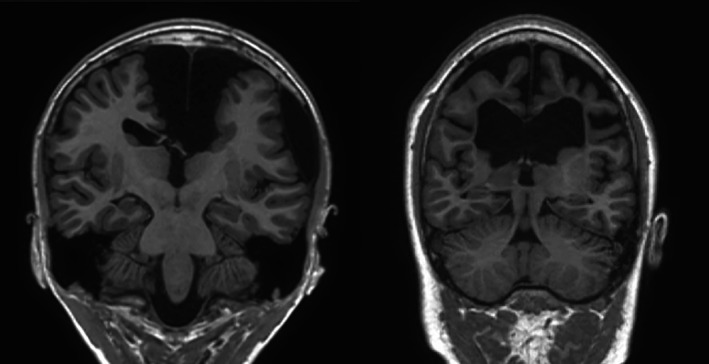
Forty-nine patients with hippocampal asymmetry were identified from our institutional radiology database, including two patients with significant anatomic deformations. Manual hippocampal tracing was performed by experienced technologists on 3T MPRAGE images, measuring hippocampal volume up to the tectal plate, excluding the hippocampal tail. The same images were processed using NeuroQuant and FreeSurfer software. Ten subjects underwent repeated manual hippocampal tracings by two additional technologists blinded to previous results to evaluate consistency. Ten patients with two clinical MRI studies had volume measurements repeated using NeuroQuant and FreeSurfer.
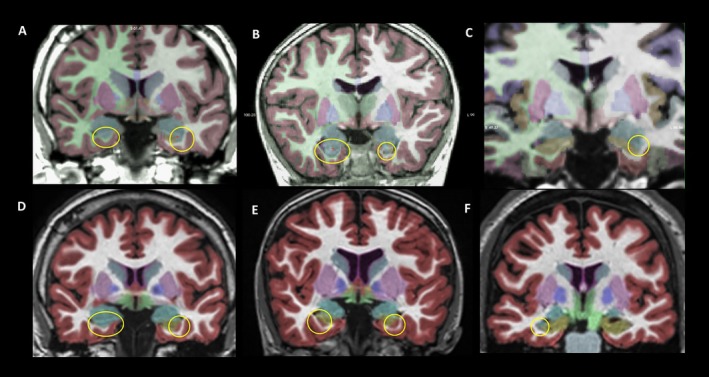
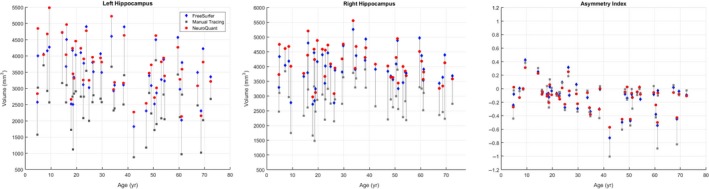
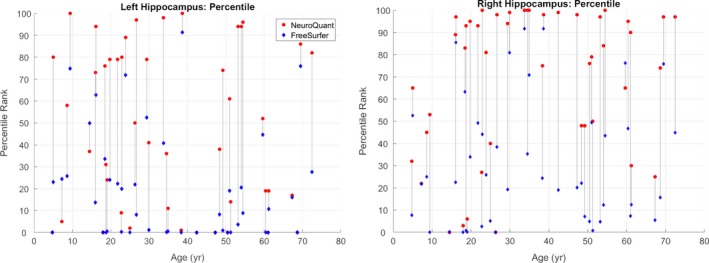
FreeSurfer raw volumes were significantly lower than NeuroQuant (P < 0.001, right and left), and hippocampal asymmetry estimates were lower for both automatic methods than manual tracing (P < 0.0001). Differences remained significant after scaling volumes to age, gender, and scanner matched normative percentiles. Volume reproducibility was fair (0.4-0.59) for manual tracing, and excellent (>0.75) for both automated methods. Asymmetry index reproducibility was excellent (>0.75) for manual tracing and FreeSurfer segmentation and fair (0.4-0.59) for NeuroQuant segmentation. Both automatic segmentation methods failed on the two cases with anatomic deformations. Segmentation errors were visually identified in 25 NeuroQuant and 27 FreeSurfer segmentations, and nine (18%) NeuroQuant and six (12%) FreeSurfer errors were judged clinically significant.
Automated hippocampal volumes are more reproducible than hand-traced hippocampal volumes. However, these methods fail in some cases, and significant segmentation errors can occur.
鉴于临床癫痫患者存在多种相关的影像学异常,本研究旨在严格比较自动图谱基和手动追踪海马体分割的准确性、可重复性和临床可接受性。
从我们的机构放射学数据库中确定了 49 例海马体不对称的患者,其中包括 2 例存在明显解剖畸形的患者。经验丰富的技术人员在 3T MPRAGE 图像上进行手动海马体追踪,测量至脑桥板的海马体体积,不包括海马体尾部。相同的图像使用 NeuroQuant 和 FreeSurfer 软件进行处理。另外 10 名受试者由 2 名额外的技术人员进行了重复的手动海马体追踪,这些技术人员对先前的结果不知情,以评估一致性。10 例患者的两次临床 MRI 研究使用 NeuroQuant 和 FreeSurfer 重复了体积测量。
FreeSurfer 原始体积明显低于 NeuroQuant(P<0.001,左右侧),并且两种自动方法的海马体不对称估计值均低于手动追踪(P<0.0001)。在将体积按年龄、性别和匹配的扫描仪正态百分比进行缩放后,差异仍然显著。手动追踪的体积可重复性为中等(0.4-0.59),两种自动方法的可重复性均为极好(>0.75)。手动追踪和 FreeSurfer 分割的不对称指数可重复性极好(>0.75),NeuroQuant 分割的可重复性为中等(0.4-0.59)。两种自动分割方法均在两个解剖畸形的病例中失败。在 25 个 NeuroQuant 和 27 个 FreeSurfer 分割中观察到分割错误,9(18%)个 NeuroQuant 和 6(12%)个 FreeSurfer 错误被认为具有临床意义。
自动海马体体积比手动追踪的海马体体积更具可重复性。然而,这些方法在某些情况下会失败,并且可能会出现显著的分割错误。