Department of Population Health and Disease Prevention, Program in Public Health; Irvine, CA 92697, USA.
School of Social Ecology; University of California, Irvine, CA 92697, USA.
Int J Environ Res Public Health. 2019 Sep 5;16(18):3254. doi: 10.3390/ijerph16183254.
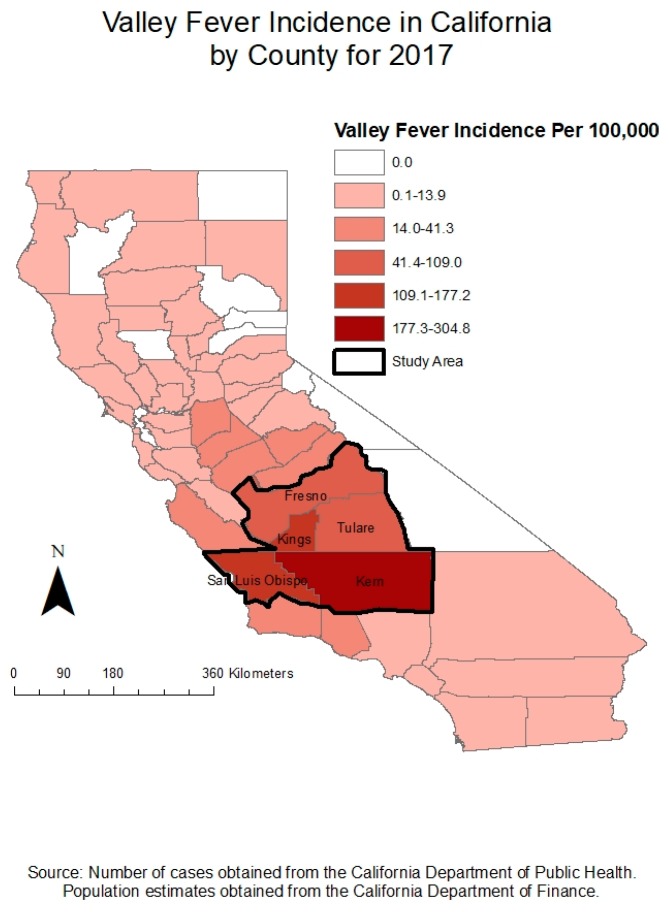
Valley Fever, or Coccidioidomycosis, a fungal respiratory disease, is prevalent with increasing incidence in the Southwestern United States, especially in the central region of California. Public health agencies in the region do not have a consistent strategy for communication and health promotion targeting vulnerable communities about this climate-sensitive disease. We used the behavior adaptation communication model to design and conduct semi-structured interviews with representatives of public health agencies in five California counties: Fresno, Kern, Kings, San Luis Obispo, and Tulare County. While none of the agencies currently include climate change information into their Valley Fever risk messaging, the agencies discuss future communication methods similar to other health risk factors such as poor air quality days and influenza virus season. For political reasons, some public health agencies deliberately avoided the use of climate change language in communicating health risk factors to farmers who are particularly vulnerable to soil and dust-borne fungal spores. The effectiveness of health communication activities of the public health agencies has not been measured in reducing the prevalence of Valley Fever in impacted communities. Given the transboundary nature of climate influence on Valley Fever risk, a concerted and consistent health communication strategy is expected to be more effective than current practices.
谷热,又称球孢子菌病,是一种真菌性呼吸道疾病,在美国西南部地区越来越普遍,尤其是在加利福尼亚州中部地区。该地区的公共卫生机构没有针对脆弱社区制定一致的传播和健康促进策略,以宣传这种对气候敏感的疾病。我们使用行为适应传播模型,对加利福尼亚州五个县(弗雷斯诺县、克恩县、金斯县、圣路易斯奥比斯波县和图莱里县)的公共卫生机构代表进行了半结构化访谈。虽然目前没有任何一个机构将气候变化信息纳入其谷热风险信息传递中,但这些机构讨论了未来类似其他健康风险因素(如空气质量差的日子和流感病毒季节)的传播方法。出于政治原因,一些公共卫生机构在向特别容易受到土壤和尘埃传播真菌孢子影响的农民传达健康风险因素时,故意避免使用气候变化方面的语言。公共卫生机构的健康传播活动在降低受影响社区谷热发病率方面的效果尚未得到评估。鉴于气候对谷热风险的跨界影响,协调一致的健康传播策略预计将比目前的做法更有效。