Tan Xiaona, Li Kaixia, Wang Zheng, Zhu Keming, Tan Xiaoli, Cao Jun
Institute of Life Sciences, Jiangsu University, Zhenjiang 212013, China.
Plants (Basel). 2019 Sep 5;8(9):327. doi: 10.3390/plants8090327.
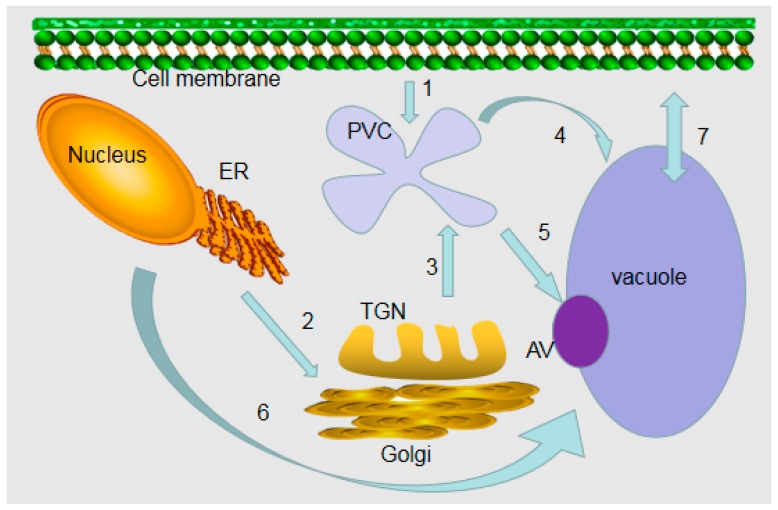
Vacuoles, cellular membrane-bound organelles, are the largest compartments of cells, occupying up to 90% of the volume of plant cells. Vacuoles are formed by the biosynthetic and endocytotic pathways. In plants, the vacuole is crucial for growth and development and has a variety of functions, including storage and transport, intracellular environmental stability, and response to injury. Depending on the cell type and growth conditions, the size of vacuoles is highly dynamic. Different types of cell vacuoles store different substances, such as alkaloids, protein enzymes, inorganic salts, sugars, etc., and play important roles in multiple signaling pathways. Here, we summarize vacuole formation, types, vacuole-located proteins, and functions.
液泡是细胞内有膜包裹的细胞器,是细胞中最大的区室,在植物细胞中所占体积可达90%。液泡由生物合成途径和内吞途径形成。在植物中,液泡对生长和发育至关重要,具有多种功能,包括储存和运输、细胞内环境稳定以及对损伤的响应。根据细胞类型和生长条件,液泡的大小具有高度动态性。不同类型的细胞液泡储存不同的物质,如生物碱、蛋白质酶、无机盐、糖类等,并在多种信号通路中发挥重要作用。在此,我们总结液泡的形成、类型、液泡定位蛋白及其功能。