Center for Tobacco Products, United States Food and Drug Administration, Silver Spring, MD, USA.
Clin Toxicol (Phila). 2020 Jun;58(6):488-494. doi: 10.1080/15563650.2019.1661426. Epub 2019 Sep 9.
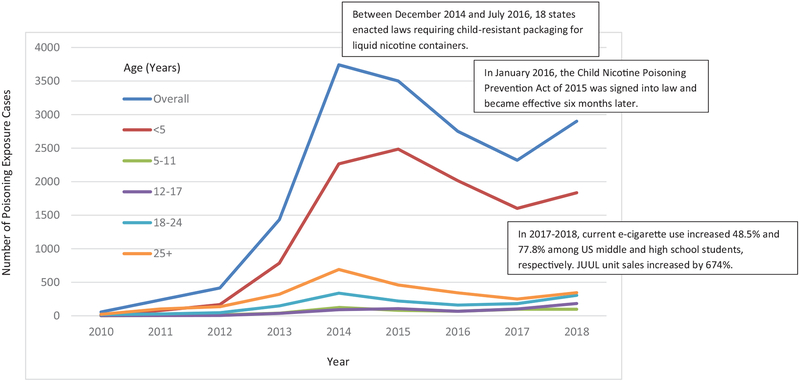
Poisoning exposure cases involving e-cigarettes have increased since 2010, coinciding with increasing rates of e-cigarette use in the United States (US). Given the increasing prevalence of e-cigarette use and ever-changing product designs, particularly the development of new products with high nicotine levels, it is important to conduct ongoing surveillance of poisoning exposure cases involving e-cigarettes. The objective of this study is to describe trends and characteristics of poisoning exposure cases involving e-cigarettes and e-liquids reported to poison control centers in the US. We analyzed e-cigarette exposure cases from the National Poison Data System (NPDS) during 2010-2018 by year and other characteristics. The annual number of e-cigarette exposure cases increased greatly between 2010 and 2014, reaching a peak of 3742 in 2014, and then decreasing each year between 2015 and 2017. Between 2017 and 2018, the overall number of e-cigarette exposure cases increased by 25.0% (from 2320 to 2901). Approximately two-thirds (64.8%) of all cases were in children under age five, and 14.7% were in children aged 5-17 years or young adults aged 18-24 years. A small proportion of cases developed life-threatening symptoms (0.1%); and cases with more serious medical outcomes tended to be exposed to a higher e-liquid or nicotine quantity. Annual declines in e-cigarette exposure cases between 2015 and 2017 did not continue in 2018. The rapid changes in the occurrence of poisoning exposure cases involving e-cigarettes coupled with the development of new tobacco products and ever-evolving tobacco use landscape underscore the importance of continued surveillance of these poisoning exposure cases. Continuous monitoring of these poisoning exposure cases may inform efforts aimed at preventing e-cigarette poisoning exposures.
自 2010 年以来,涉及电子烟的中毒暴露病例有所增加,这与美国电子烟使用率的上升相吻合。鉴于电子烟使用的日益普及和产品设计的不断变化,特别是具有高尼古丁水平的新产品的开发,对涉及电子烟的中毒暴露病例进行持续监测非常重要。本研究的目的是描述美国中毒控制中心报告的涉及电子烟和电子烟液的中毒暴露病例的趋势和特征。我们分析了 2010-2018 年国家毒物数据系统(NPDS)中的电子烟暴露病例,按年份和其他特征进行了分析。2010 年至 2014 年,电子烟暴露病例的年度数量大幅增加,2014 年达到 3742 例的峰值,然后在 2015 年至 2017 年期间每年减少。2017 年至 2018 年,电子烟暴露病例的总数增加了 25.0%(从 2320 例增加到 2901 例)。所有病例中约有三分之二(64.8%)发生在五岁以下儿童中,14.7%发生在 5-17 岁儿童或 18-24 岁年轻成年人中。一小部分病例出现危及生命的症状(0.1%);出现更严重医疗后果的病例往往接触了更高的电子烟液或尼古丁量。2015 年至 2017 年电子烟暴露病例的年度下降趋势在 2018 年并未持续。电子烟中毒暴露病例的发生迅速变化,加上新烟草产品的开发和不断变化的烟草使用环境,突显了对这些中毒暴露病例进行持续监测的重要性。对这些中毒暴露病例的持续监测可能有助于防止电子烟中毒暴露的努力。