Glassberg Mrudula B, Ghosh Sudip, Clymer Jeffrey W, Qadeer Rana A, Ferko Nicole C, Sadeghirad Behnam, Wright George Wj, Amaral Joseph F
Health Economics and Market Access, Ethicon Inc, Somerville, NJ, USA.
Health Economics and Market Access, Ethicon Inc, Cincinnati, OH, USA.
Onco Targets Ther. 2019 Aug 13;12:6407-6438. doi: 10.2147/OTT.S204340. eCollection 2019.
Percutaneous ablation techniques, including microwave ablation (MWA) and radiofrequency ablation (RFA), have become important minimally invasive treatment options for liver cancer. This systematic review compared MWA with RFA for treatment of liver cancer.
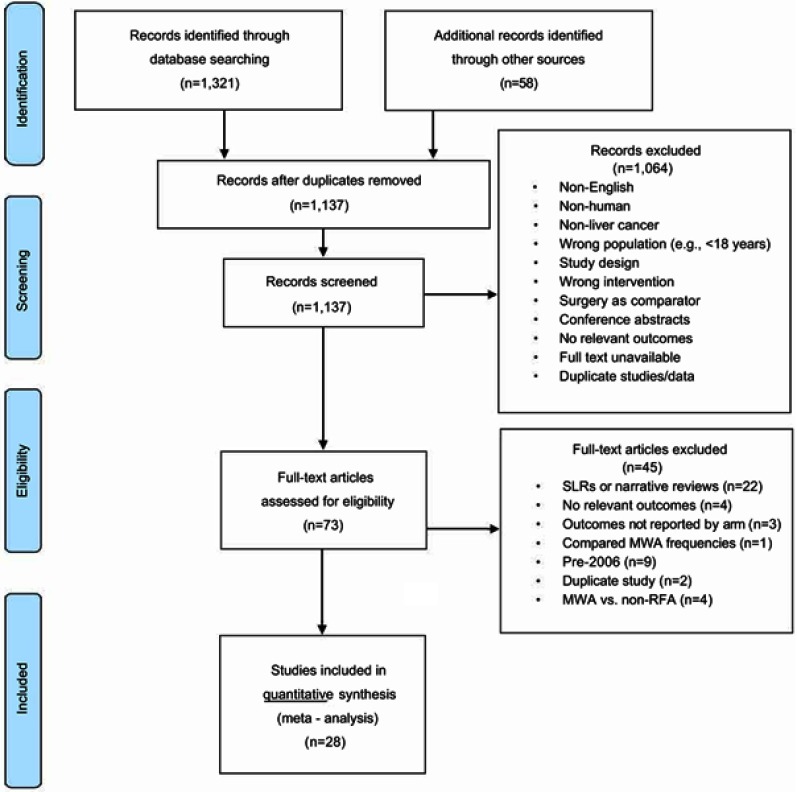
The systematic review and meta-analysis followed the Preferred Reporting Items for Systematic Reviews and Meta-Analyses (PRISMA) guidelines. A systematic search of MEDLINE, EMBASE, and Cochrane Central Register of Controlled Trials was conducted for randomized and observational studies published from 2006 onwards. A random-effects model was used for meta-analyses and local tumor progression (LTP), technique efficacy, overall survival (OS), disease-free survival (DFS), intrahepatic de novo lesions (IDL), extrahepatic metastases (EHM), length of stay (LOS), and complications were analyzed. Subgroup and sensitivity analyses were also conducted.
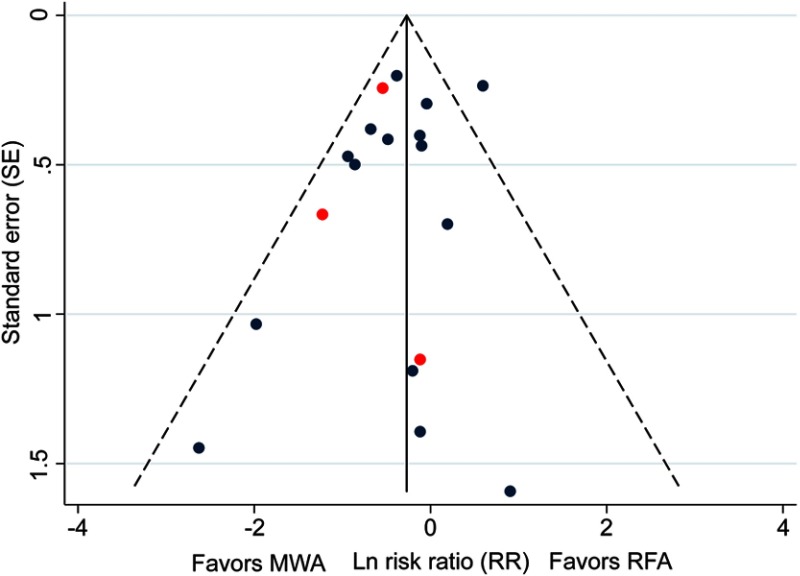
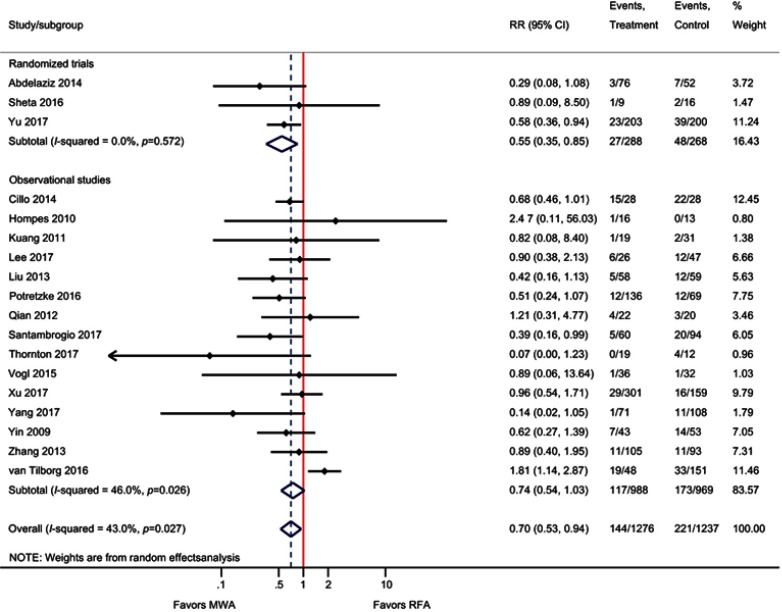
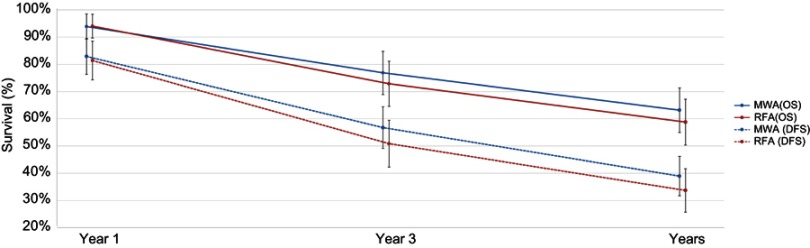
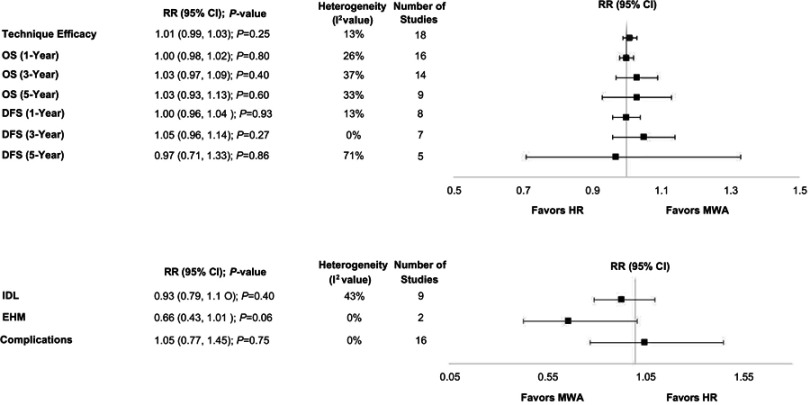
Of 1379 studies identified, 28 randomized and observational studies met inclusion criteria. The main analysis demonstrated that LTP was significantly reduced by 30% with MWA versus RFA (RR=0.70; P=0.02) (all studies) and by 45% with MWA versus RFA (RR=0.55; P=0.007) (randomized studies only). There were no significant differences between MWA and RFA for other efficacy and safety outcomes. Higher frequency (2450 MHz) and larger tumor size (≥2.5 cm) are amongst variables that may be associated with improved outcomes for MWA. Sensitivity analyses were generally congruent with the main results.
MWA is at least as safe and effective as RFA for treating liver cancer and demonstrated significantly reduced LTP rates. Future studies should assess time and costs associated with these two treatment modalities.
经皮消融技术,包括微波消融(MWA)和射频消融(RFA),已成为肝癌重要的微创治疗选择。本系统评价比较了MWA与RFA治疗肝癌的效果。
本系统评价和荟萃分析遵循系统评价和荟萃分析的首选报告项目(PRISMA)指南。对MEDLINE、EMBASE和Cochrane对照试验中央注册库进行系统检索,以查找2006年以后发表的随机和观察性研究。采用随机效应模型进行荟萃分析,并分析局部肿瘤进展(LTP)、技术疗效、总生存期(OS)、无病生存期(DFS)、肝内新生病灶(IDL)、肝外转移(EHM)、住院时间(LOS)和并发症。还进行了亚组分析和敏感性分析。
在1379项检索到的研究中,28项随机和观察性研究符合纳入标准。主要分析表明,与RFA相比,MWA使LTP显著降低30%(RR=0.70;P=0.02)(所有研究),与RFA相比,MWA使LTP显著降低45%(RR=0.55;P=0.007)(仅随机研究)。MWA和RFA在其他疗效和安全性结果方面无显著差异。较高频率(2450 MHz)和较大肿瘤大小(≥2.5 cm)是可能与MWA改善结局相关的变量。敏感性分析结果与主要结果基本一致。
MWA治疗肝癌至少与RFA一样安全有效,且LTP发生率显著降低。未来研究应评估这两种治疗方式的时间和成本。