Arata Yukinobu, Takagi Hiroaki
Cellular Informatics Laboratory, RIKEN, Saitama, Japan.
Department of Physics, School of Medicine, Nara Medical University, Nara, Japan.
Front Physiol. 2019 Aug 19;10:1022. doi: 10.3389/fphys.2019.01022. eCollection 2019.
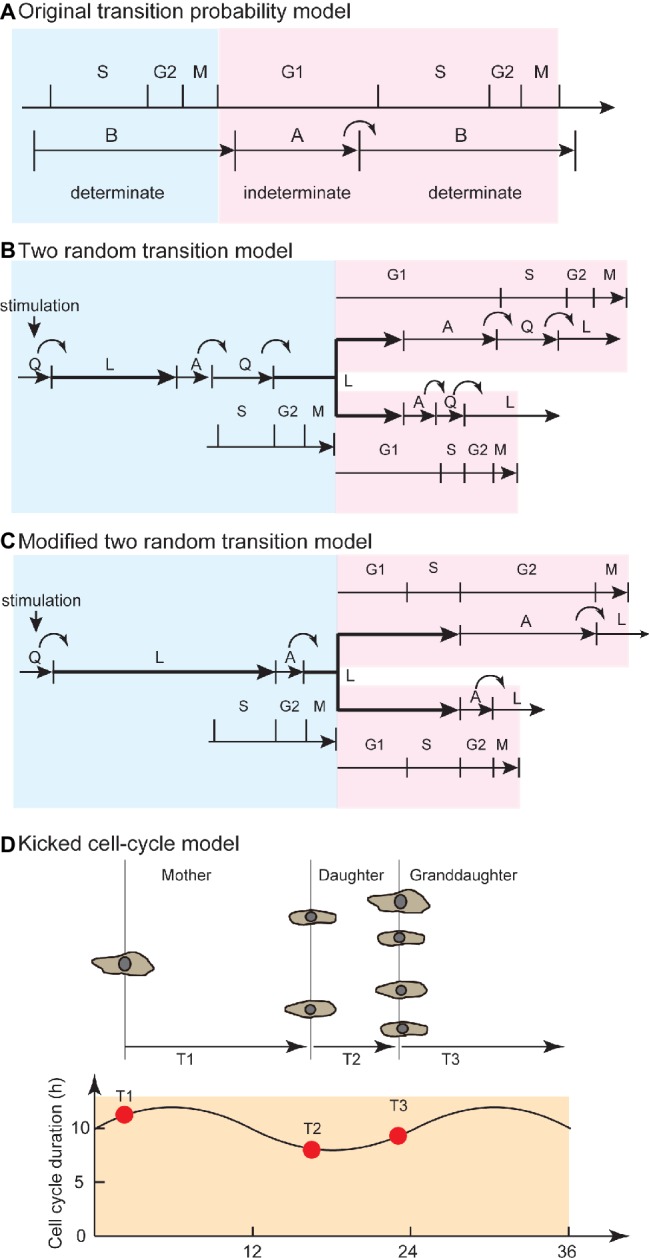
The cell-division cycle (CDC) is driven by cyclin-dependent kinases (CDKs). Mathematical models based on molecular networks, as revealed by molecular and genetic studies, have reproduced the oscillatory behavior of CDK activity. Thus, one basic system for representing the CDC is a biochemical oscillator (CDK oscillator). However, genetically clonal cells divide with marked variability in their total duration of a single CDC round, exhibiting non-Gaussian statistical distributions. Therefore, the CDK oscillator model does not account for the statistical nature of cell-cycle control. Herein, we review quantitative studies of the statistical properties of the CDC. Over the past 70 years, studies have shown that the CDC is driven by a cluster of molecular oscillators. The CDK oscillator is coupled to transcriptional and mitochondrial metabolic oscillators, which cause deterministic chaotic dynamics for the CDC. Recent studies in animal embryos have raised the possibility that the dynamics of molecular oscillators underlying CDC control are affected by allometric volume scaling among the cellular compartments. Considering these studies, we discuss the idea that a cluster of molecular oscillators embedded in different cellular compartments coordinates cellular physiology and geometry for successful cell divisions.
细胞分裂周期(CDC)由细胞周期蛋白依赖性激酶(CDK)驱动。分子和遗传学研究揭示,基于分子网络的数学模型再现了CDK活性的振荡行为。因此,一种表示CDC的基本系统是生化振荡器(CDK振荡器)。然而,基因克隆细胞在单个CDC周期的总持续时间上表现出明显的变异性,呈现非高斯统计分布。因此,CDK振荡器模型无法解释细胞周期控制的统计学性质。在此,我们综述了关于CDC统计特性的定量研究。在过去70年中,研究表明CDC由一组分子振荡器驱动。CDK振荡器与转录和线粒体代谢振荡器耦合,这导致了CDC的确定性混沌动力学。动物胚胎的最新研究提出了一种可能性,即CDC控制背后的分子振荡器动力学受细胞区室间异速生长体积缩放的影响。考虑到这些研究,我们讨论了这样一种观点,即嵌入不同细胞区室的一组分子振荡器协调细胞生理学和几何学以实现成功的细胞分裂。