Tounkara Kadidia, Kwiatek Olivier, Niang Mamadou, Abou Kounta Sidibe Cheik, Sery Amadou, Dakouo Martin, Salami Habib, Lo Modou Moustapha, Ba Aminata, Diop Mariame, El Mamy Ahmed Bezeid, El Arbi Ahmed Salem, Barry Yahya, Isselmou Ekaterina, Habiboullah Habiboullah, Lella Abdellahi Salem, Doumbia Baba, Gueya Mohamed Baba, Savadogo Joseph, Ouattara Lassina, Minougou Germaine, Libeau Geneviève, Bataille Arnaud
CIRAD, UMR ASTRE, Montpellier, France.
ASTRE, Univ. Montpellier, CIRAD, INRA, Montpellier, France.
Front Vet Sci. 2019 Aug 21;6:275. doi: 10.3389/fvets.2019.00275. eCollection 2019.
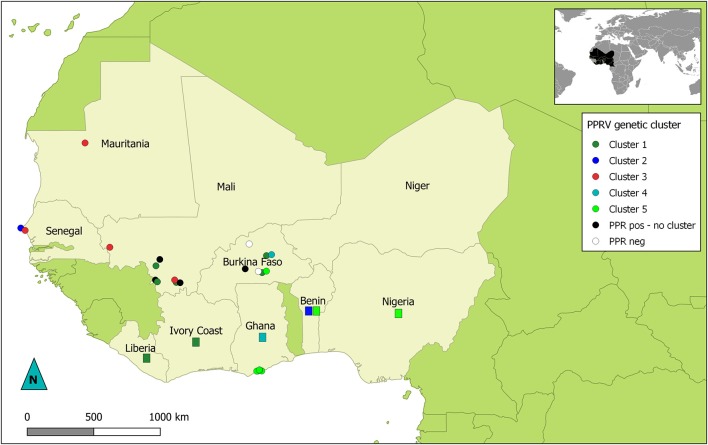
Peste des Petits Ruminants (PPR) is a viral disease affecting predominantly small ruminants. Due to its transboundary nature, regional coordination of control strategies will be key to the success of the on-going PPR eradication campaign. Here, we aimed at exploring the extent of transboundary movement of PPR in West Africa using phylogenetic analyses based on partial viral gene sequences. We collected samples and obtained partial nucleoprotein gene sequence from PPR-infected small ruminants across countries within West Africa. This new sequence data was combined with publically available data from the region to perform phylogenetic analyses. A total of fifty-five sequences were obtained in a region still poorly sampled. Phylogenetic analyses showed that the majority of virus sequences obtained in this study were placed within genetic clusters regrouping samples from multiple West African countries. Some of these clusters contained samples from countries sharing borders. In other cases, clusters grouped samples from very distant countries. Our results suggest extensive and recurrent transboundary movements of PPR within West Africa, supporting the need for a regional coordinated strategy for PPR surveillance and control in the region. Simple phylogenetic analyses based on readily available data can provide information on PPR transboundary dynamics and, therefore, could contribute to improve control strategies. On-going and future projects dedicated to PPR should include extensive genetic characterization and phylogenetic analyses of circulating viral strains in their effort to support the campaign for global eradication of the disease.
小反刍兽疫(PPR)是一种主要影响小反刍动物的病毒性疾病。由于其具有跨界性质,控制策略的区域协调将是正在进行的PPR根除运动取得成功的关键。在此,我们旨在利用基于部分病毒基因序列的系统发育分析,探究PPR在西非的跨界传播程度。我们收集了样本,并从西非各国感染PPR的小反刍动物中获得了部分核蛋白基因序列。将这些新的序列数据与该地区公开可用的数据相结合,进行系统发育分析。在一个采样仍然不足的地区共获得了55个序列。系统发育分析表明,本研究中获得的大多数病毒序列位于将来自多个西非国家的样本重新分组的遗传簇内。其中一些簇包含来自接壤国家的样本。在其他情况下,簇将来自非常遥远国家的样本归为一组。我们的结果表明PPR在西非存在广泛且反复的跨界传播,这支持了在该地区制定PPR监测和控制区域协调策略的必要性。基于现有数据的简单系统发育分析可以提供有关PPR跨界动态的信息,因此有助于改进控制策略。正在进行的和未来致力于PPR的项目应包括对流行病毒株进行广泛的遗传特征分析和系统发育分析,以支持全球根除该疾病的运动。