Department of Cancer Epidemiology, National Cancer Center/National Clinical Research Center for Cancer/Cancer Hospital, Chinese Academy of Medical Sciences and Peking Union Medical College, Beijing, China.
Metabolic Epidemiology Branch, Division of Cancer Epidemiology & Genetics, National Cancer Institute, National Institutes of Health, Rockville, Maryland.
Cancer Epidemiol Biomarkers Prev. 2019 Dec;28(12):2022-2029. doi: 10.1158/1055-9965.EPI-19-0512. Epub 2019 Sep 9.
Autoimmune gastritis is understudied and possibly associated with gastric noncardia adenocarcinoma (GNCA) and esophageal squamous cell carcinoma (ESCC) in Western populations when it presents as pernicious anemia.
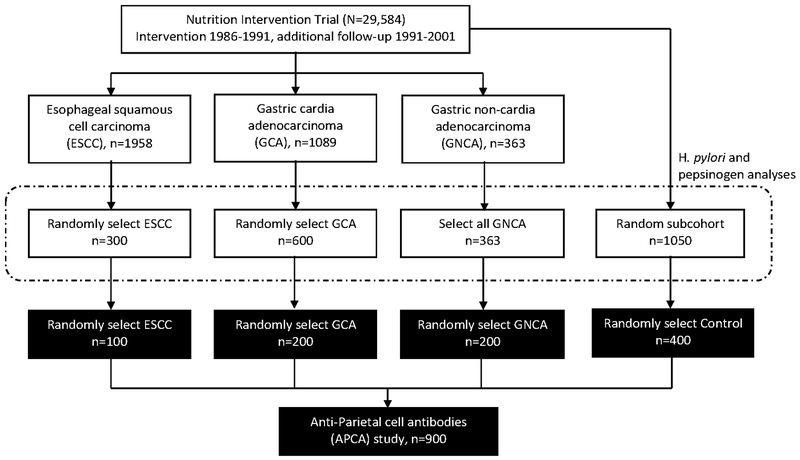
A nested case-control study within a Chinese cohort included 100 ESCC, 200 gastric cardia adenocarcinoma (GCA), and 200 GNCA cases diagnosed between 1986 and 2001 and 400 controls. Serostatus of antiparietal cell antibodies (APCA), antibodies, and pepsinogens were measured using commercial kits and serum collected at baseline. We used logistic regression to calculate odds ratios (OR) and 95% confidence interval (CI) for associations between serologic biomarkers and cancer risk adjusted for numerous potential confounders.
There was an average interval of 8 years between baseline blood draw and cancer diagnosis. The baseline prevalence of APCA seropositivity was 10.0% and 14.5% in subjects who developed GCA and GNCA, respectively. APCA seropositivity was inversely associated with later development of GCA (OR = 0.42; 95% CI, 0.24-0.75), but not significantly associated with later development of GNCA (OR = 0.82; 95% CI, 0.50-1.36) or ESCC (OR = 1.05; 95% CI, 0.58-1.88). APCA seropositivity was significantly associated with low pepsinogen I/II ratios (OR = 3.69; 95% CI, 1.66-8.21), and individuals with low pepsinogen I/II ratios who were seronegative for APCA had the highest risk of both GCA and GNCA.
APCA seropositivity measured years prior to diagnosis was associated with prevalent atrophic gastritis but inversely associated with incident GCA in this Chinese population.
APCA may contribute to a growing list of serologic markers that can improve risk stratification for gastric cancer.
在西方人群中,当自身免疫性胃炎表现为恶性贫血时,其研究较少,且可能与胃非贲门腺癌(GNCA)和食管鳞状细胞癌(ESCC)相关。
本研究为中国队列内的巢式病例对照研究,纳入了 1986 年至 2001 年间诊断的 100 例 ESCC、200 例胃贲门腺癌(GCA)和 200 例 GNCA 病例以及 400 例对照。使用商业试剂盒测量抗壁细胞抗体(APCA)、抗体和胃蛋白酶原的血清状态,并在基线时采集血清。我们使用逻辑回归计算血清生物标志物与癌症风险之间的比值比(OR)和 95%置信区间(CI),调整了许多潜在混杂因素后,用于评估癌症风险。
从基线采血到癌症诊断的平均间隔为 8 年。基线时,APCA 阳性率分别为 GCA 和 GNCA 组的 10.0%和 14.5%。APCA 阳性与 GCA 的发生呈负相关(OR=0.42;95%CI,0.24-0.75),但与 GNCA(OR=0.82;95%CI,0.50-1.36)或 ESCC(OR=1.05;95%CI,0.58-1.88)的发生无显著相关性。APCA 阳性与低胃蛋白酶原 I/II 比值显著相关(OR=3.69;95%CI,1.66-8.21),并且 APCA 阴性且低胃蛋白酶原 I/II 比值的个体患 GCA 和 GNCA 的风险最高。
在本中国人群中,诊断前数年测量的 APCA 阳性与普遍存在的萎缩性胃炎相关,但与 GCA 的发生呈负相关。
APCA 可能是越来越多的血清标志物之一,可以提高胃癌的风险分层。