Department of Psychiatry, University of California San Diego, La Jolla, CA, 92093, USA.
Committee on Neurobiology, The University of Chicago, Chicago, IL, 60637, USA.
Transl Psychiatry. 2019 Sep 9;9(1):222. doi: 10.1038/s41398-019-0558-7.
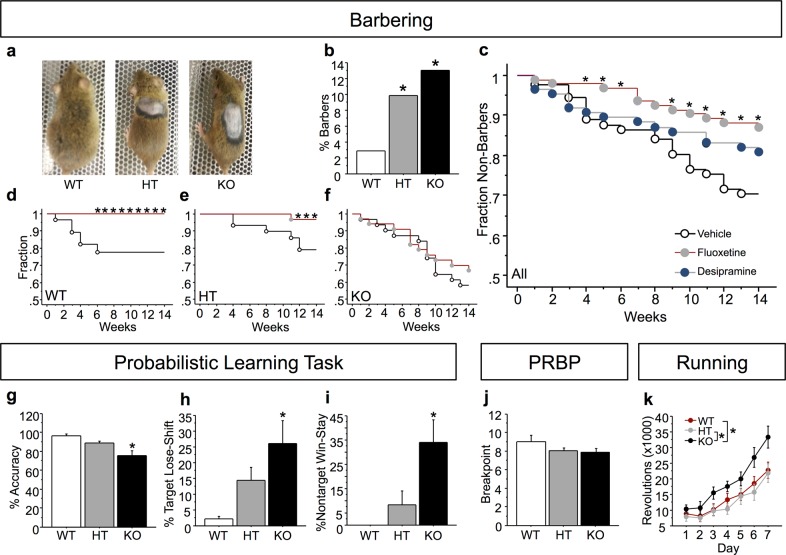
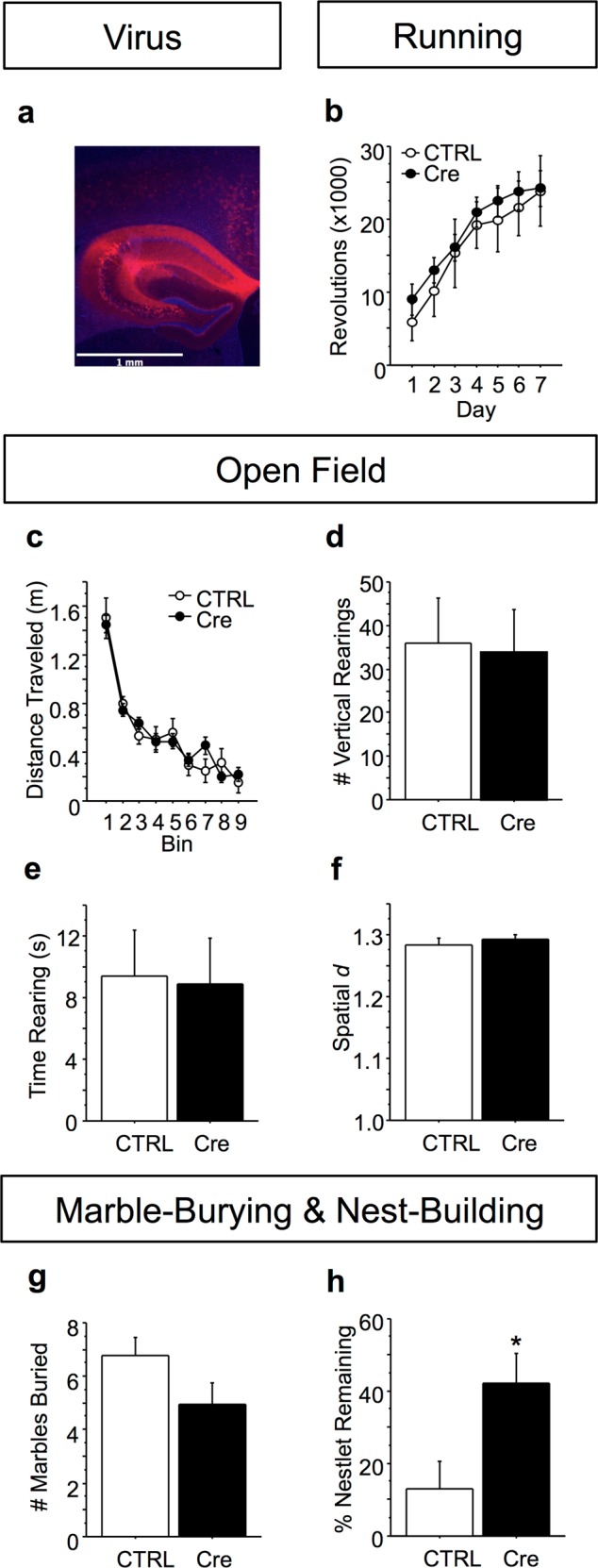
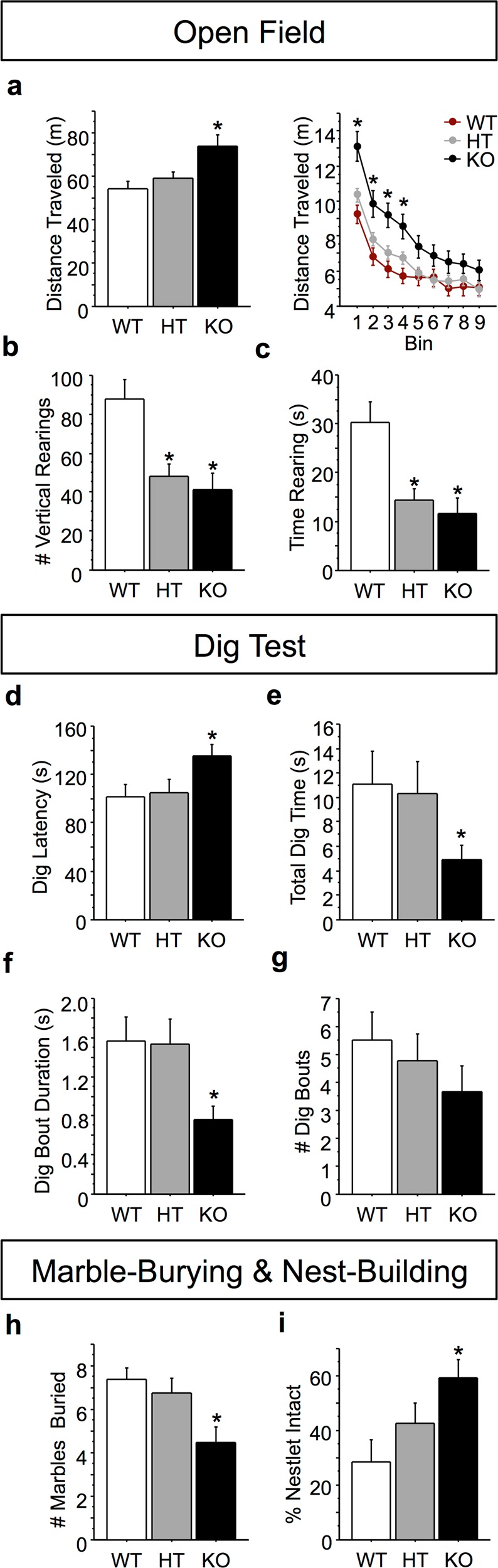
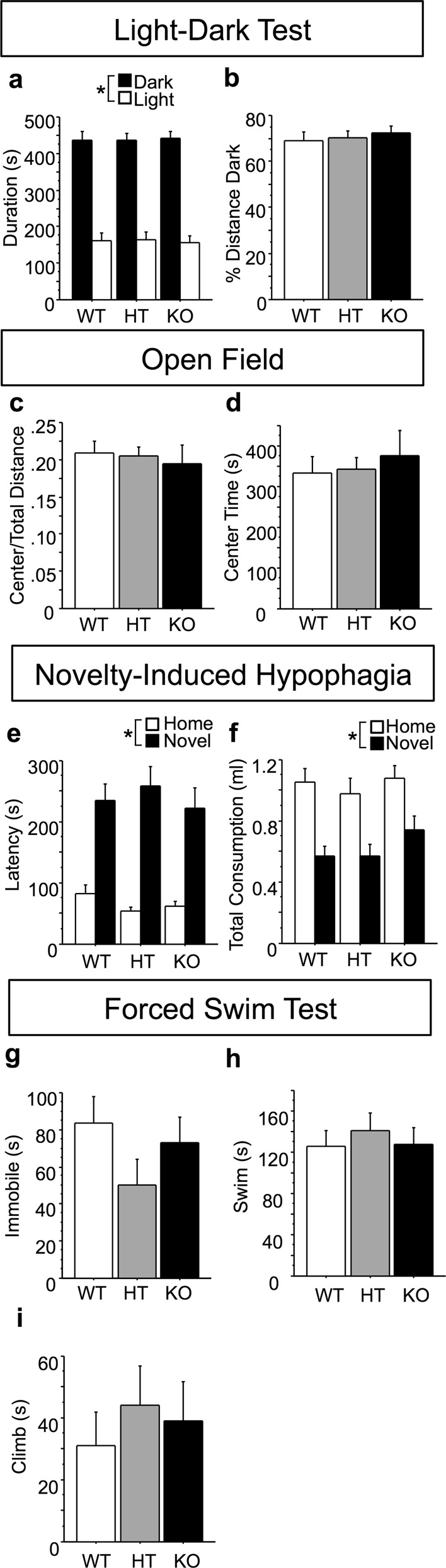
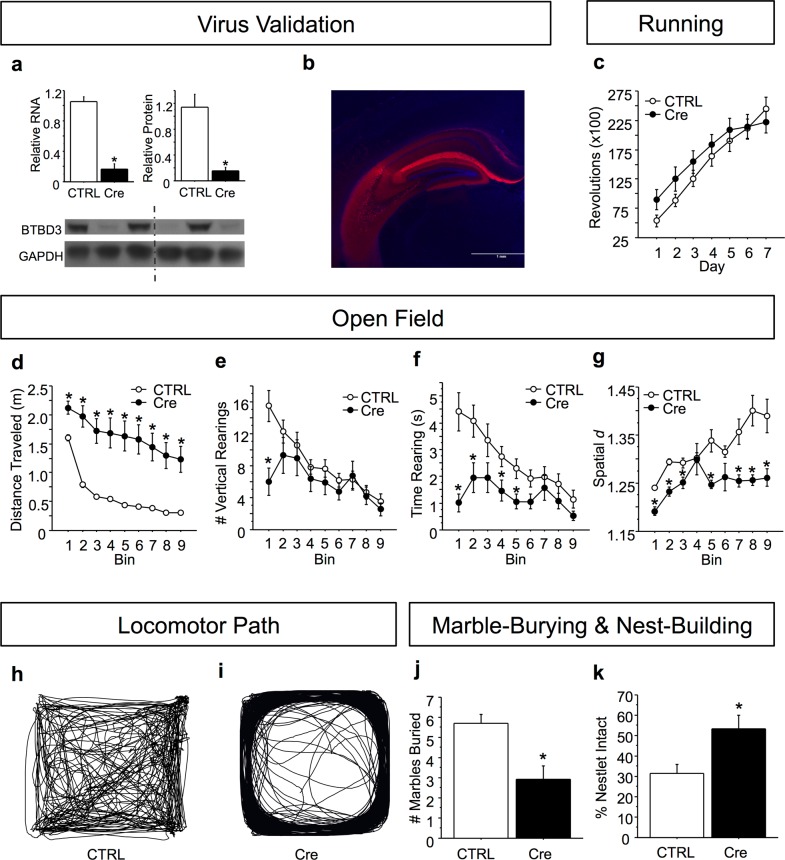
BTB/POZ domain-containing 3 (BTBD3) was identified as a potential risk gene in the first genome-wide association study of obsessive-compulsive disorder (OCD). BTBD3 is a putative transcription factor implicated in dendritic pruning in developing primary sensory cortices. We assessed whether BTBD3 also regulates neural circuit formation within limbic cortico-striato-thalamo-cortical circuits and behaviors related to OCD in mice. Behavioral phenotypes associated with OCD that are measurable in animals include compulsive-like behaviors and reduced exploration. We tested Btbd3 wild-type, heterozygous, and knockout mice for compulsive-like behaviors including cage-mate barbering, excessive wheel-running, repetitive locomotor patterns, and reduced goal-directed behavior in the probabilistic learning task (PLT), and for exploratory behavior in the open field, digging, and marble-burying tests. Btbd3 heterozygous and knockout mice showed excessive barbering, wheel-running, impaired goal-directed behavior in the PLT, and reduced exploration. Further, chronic treatment with fluoxetine, but not desipramine, reduced barbering in Btbd3 wild-type and heterozygous, but not knockout mice. In contrast, Btbd3 expression did not alter anxiety-like, depression-like, or sensorimotor behaviors. We also quantified dendritic morphology within anterior cingulate cortex, mediodorsal thalamus, and hippocampus, regions of high Btbd3 expression. Surprisingly, Btbd3 knockout mice only showed modest increases in spine density in the anterior cingulate, while dendritic morphology was unaltered elsewhere. Finally, we virally knocked down Btbd3 expression in whole, or just dorsal, hippocampus during neonatal development and assessed behavior during adulthood. Whole, but not dorsal, hippocampal Btbd3 knockdown recapitulated Btbd3 knockout phenotypes. Our findings reveal that hippocampal Btbd3 expression selectively modulates compulsive-like and exploratory behavior.
BTB/POZ 结构域蛋白 3(BTBD3)在强迫症(OCD)的全基因组关联研究中被确定为一个潜在的风险基因。BTBD3 是一种假定的转录因子,参与发育中的初级感觉皮层中的树突修剪。我们评估了 BTBD3 是否也调节边缘皮质-纹状体-丘脑-皮质回路内的神经回路形成以及与 OCD 相关的行为。可在动物中测量的与 OCD 相关的行为表型包括强迫样行为和探索减少。我们测试了 Btbd3 野生型、杂合型和敲除型小鼠的强迫样行为,包括笼中梳理、过度转轮运动、重复运动模式和概率学习任务(PLT)中减少的目标导向行为,以及在旷场、挖掘和大理石掩埋测试中的探索行为。Btbd3 杂合型和敲除型小鼠表现出过度梳理、转轮运动、PLT 中目标导向行为受损和探索减少。此外,氟西汀慢性治疗,但不是去甲丙咪嗪,减少了 Btbd3 野生型和杂合型但不是敲除型小鼠的梳理。相反,Btbd3 表达并未改变焦虑样、抑郁样或感觉运动行为。我们还量化了前扣带皮层、中背侧丘脑和海马体中 BTBD3 高表达的树突形态。令人惊讶的是,BTBD3 敲除型小鼠仅在前扣带体中表现出适度增加的棘密度,而其他部位的树突形态没有改变。最后,我们在新生儿发育期间通过病毒敲低整个或仅背侧海马体中的 Btbd3 表达,并评估成年期的行为。整个但不是背侧海马体中的 Btbd3 敲低重现了 Btbd3 敲除型的表型。我们的研究结果表明,海马体中的 BTBD3 表达选择性调节强迫样和探索行为。