Kenya Medical Research Institute/Wellcome Trust Research Programme, Nairobi, Kenya.
Department of Paediatrics and Child Health, University of Nairobi, Nairobi, Kenya.
Clin Infect Dis. 2020 Jul 11;71(2):372-380. doi: 10.1093/cid/ciz844.
The malaria prevalence has declined in western Kenya, resulting in the risk of neurological phenotypes in older children. This study investigates the clinical profile of pediatric malaria admissions ahead of the introduction of the RTS,S/AS01 vaccine.
Malaria admissions in children aged 1 month to 15 years were identified from routine, standardized, inpatient clinical surveillance data collected between 2015 and 2018 from 4 hospitals in western Kenya. Malaria phenotypes were defined based on available data.
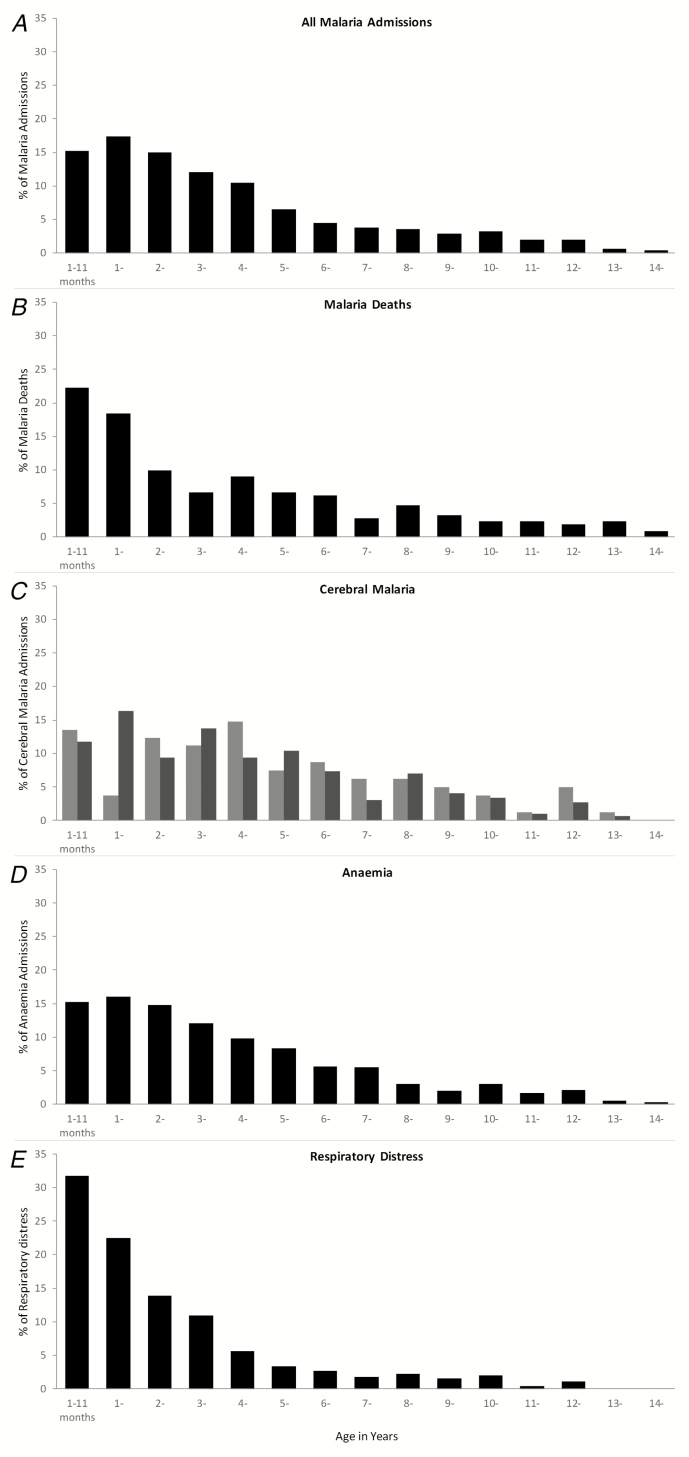
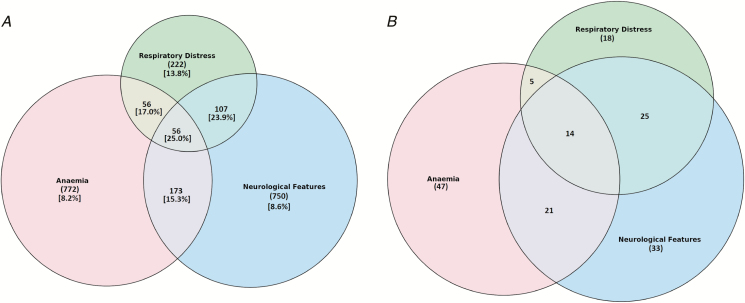
There were 5766 malaria admissions documented. The median age was 36 months (interquartile range, 18-60): 15% were aged between 1-11 months of age, 33% were aged 1-23 months of age, and 70% were aged 1 month to 5 years. At admission, 2340 (40.6%) children had severe malaria: 421/2208 (19.1%) had impaired consciousness, 665/2240 (29.7%) had an inability to drink or breastfeed, 317/2340 (13.6%) had experienced 2 or more convulsions, 1057/2340 (45.2%) had severe anemia, and 441/2239 (19.7%) had severe respiratory distress. Overall, 211 (3.7%) children admitted with malaria died; 163/211 (77% deaths, case fatality rate 7.0%) and 48/211 (23% deaths, case fatality rate 1.4%) met the criteria for severe malaria and nonsevere malaria at admission, respectively. The median age for fatal cases was 33 months (interquartile range, 12-72) and the case fatality rate was highest in those unconscious (44.4%).
Severe malaria in western Kenya is still predominantly seen among the younger pediatric age group and current interventions targeted for those <5 years are appropriate. However, there are increasing numbers of children older than 5 years admitted with malaria, and ongoing hospital surveillance would identify when interventions should target older children.
肯尼亚西部的疟疾发病率有所下降,导致年长儿童出现神经学表型的风险增加。本研究旨在探讨 RTS,S/AS01 疫苗推出前儿童疟疾住院患者的临床特征。
从肯尼亚西部 4 家医院 2015 年至 2018 年期间常规、标准化的住院临床监测数据中,确定了 1 个月至 15 岁儿童的疟疾住院病例。根据现有数据定义疟疾表型。
共记录了 5766 例疟疾住院病例。中位年龄为 36 个月(四分位间距 18-60 个月):15%的患儿年龄在 1-11 个月之间,33%的患儿年龄在 1-23 个月之间,70%的患儿年龄在 1 个月至 5 岁之间。入院时,2340 例(40.6%)患儿患有重症疟疾:2208 例中有 421 例(19.1%)意识障碍,2240 例中有 665 例(29.7%)无法进食或哺乳,2340 例中有 317 例(13.6%)出现 2 次或更多次惊厥,2340 例中有 1057 例(45.2%)严重贫血,2239 例中有 441 例(19.7%)有严重呼吸窘迫。总体而言,211 例(3.7%)因疟疾住院的患儿死亡;163/211(77%死亡,病死率 7.0%)和 48/211(23%死亡,病死率 1.4%)在入院时符合重症疟疾和非重症疟疾的标准。死亡病例的中位年龄为 33 个月(四分位间距 12-72),无意识患儿的病死率最高(44.4%)。
肯尼亚西部的重症疟疾仍主要见于年龄较小的儿科人群,目前针对<5 岁儿童的干预措施是合适的。然而,越来越多的 5 岁以上儿童因疟疾住院,持续的医院监测将确定何时应将干预措施针对年长儿童。