Okada Shuntaro, Ohzeki Masayuki, Taguchi Shinichiro
Electronics R & I Division, DENSO CORPORATION, Tokyo, 108-0075, Japan.
Graduate School of Information Sciences, Tohoku University, Sendai, 980-8579, Japan.
Sci Rep. 2019 Sep 10;9(1):13036. doi: 10.1038/s41598-019-49539-6.
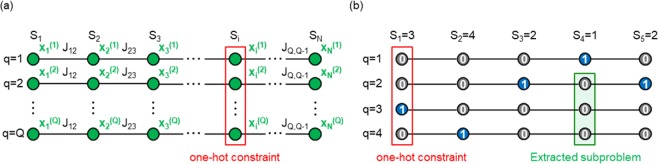
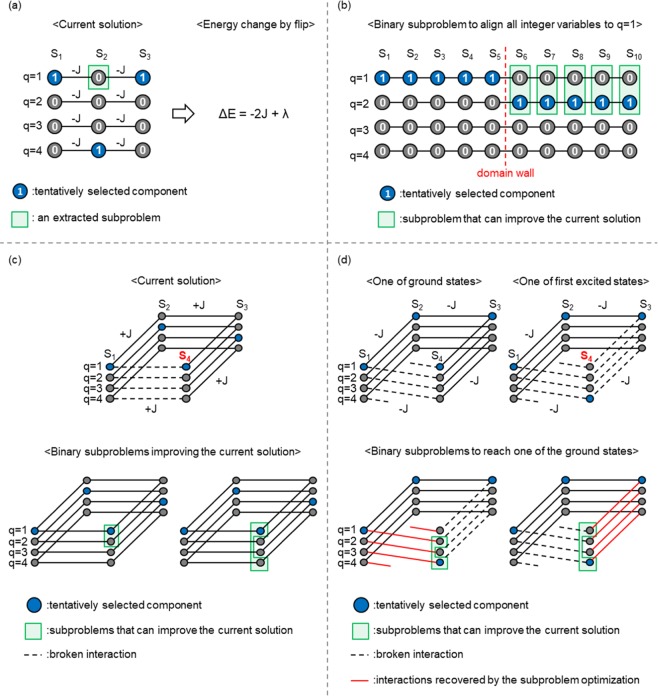
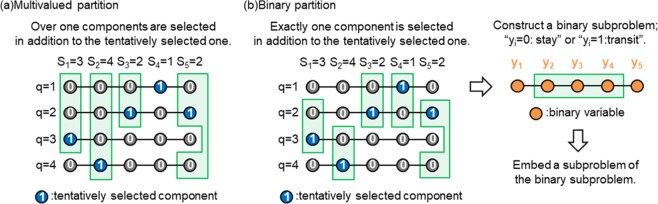
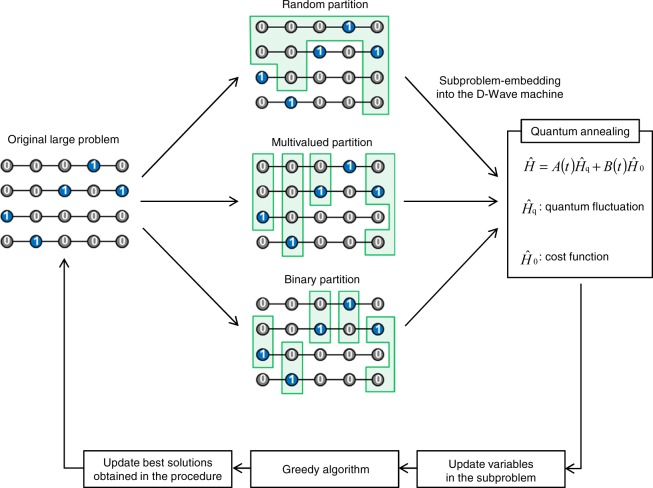
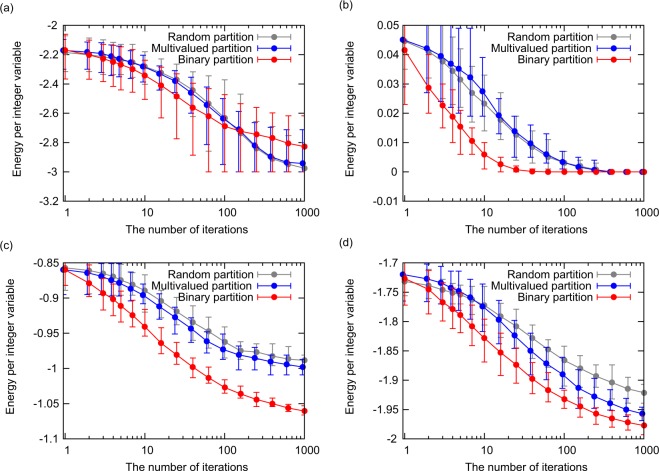
Quantum annealing is a heuristic algorithm for solving combinatorial optimization problems, and hardware for implementing this algorithm has been developed by D-Wave Systems Inc. The current version of the D-Wave quantum annealer can solve unconstrained binary optimization problems with a limited number of binary variables. However, the cost functions of several practical problems are defined by a large number of integer variables. To solve these problems using the quantum annealer, integer variables are generally binarized with one-hot encoding, and the binarized problem is partitioned into small subproblems. However, the entire search space of the binarized problem is considerably larger than that of the original integer problem and is dominated by infeasible solutions. Therefore, to efficiently solve large optimization problems with one-hot encoding, partitioning methods that extract subproblems with as many feasible solutions as possible are required. In this study, we propose two partitioning methods and demonstrate that they result in improved solutions.
量子退火是一种用于解决组合优化问题的启发式算法,D-Wave系统公司已开发出用于实现该算法的硬件。D-Wave量子退火器的当前版本能够解决具有有限数量二元变量的无约束二元优化问题。然而,一些实际问题的成本函数是由大量整数变量定义的。为了使用量子退火器解决这些问题,通常采用独热编码将整数变量二值化,并将二值化后的问题划分为小的子问题。然而,二值化问题的整个搜索空间比原始整数问题的搜索空间大得多,并且由不可行解主导。因此,为了使用独热编码有效地解决大型优化问题,需要采用能够提取尽可能多可行解的子问题的划分方法。在本研究中,我们提出了两种划分方法,并证明它们能得到改进的解。