Obstetric and Fetal Medicine Unit, Maternite Regionale Adolphe Pinard de Nancy, Nancy, France
Université de Lorraine, INSERM U1254, IADI, CHU Nancy, Nancy, France.
BMJ Open. 2019 Sep 11;9(9):e030353. doi: 10.1136/bmjopen-2019-030353.
Knowledge about the mechanisms leading to the establishment of uteroplacental vascularisation is inadequate, and some of what has been thought to be known for decades has recently been challenged by showing that the intervillous space, the major area of maternal-fetal exchange, appears to be perfused by maternal blood at as early as 6 weeks of gestation. The vascular flow then seems relatively constant until 13 weeks when it appears to increase suddenly.
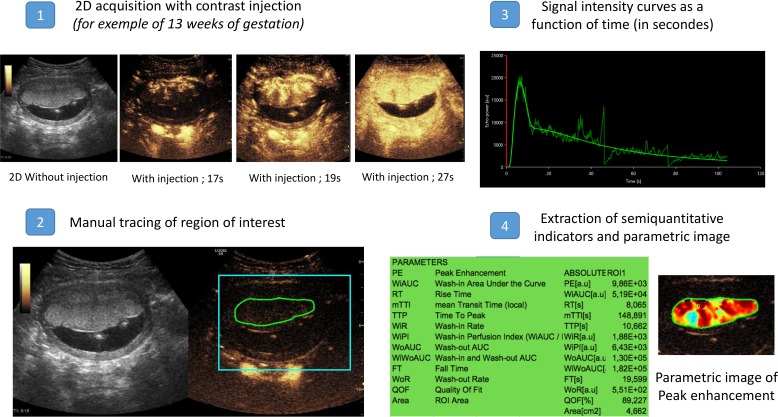
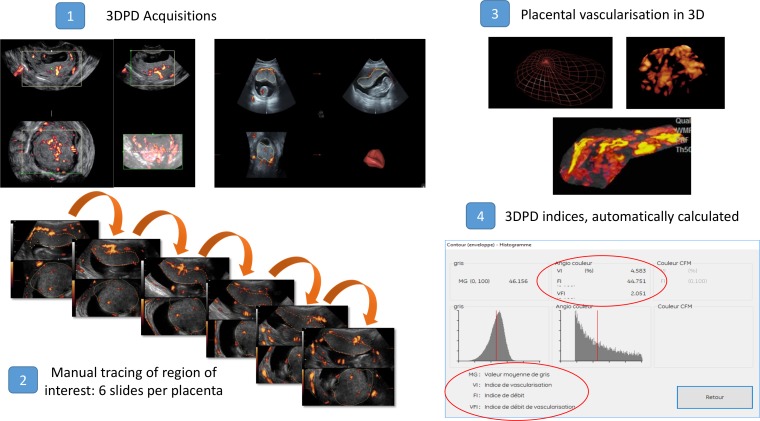
The principal objective is to quantify the perfusion of the intervillous space by contrast-enhanced ultrasonography (CEUS) during the first-trimester at three different gestational ages (8, 11 and 13 weeks). The secondary objectives are to: (1) describe the indicators of vascularisation of the placenta (intervillous space) and the myometrium at the three gestational ages, measured by CEUS and three-dimensional power Doppler (3DPD) angiography; (2) compare the diagnostic performance of CEUS and 3DPD for the demonstration and quantification of uteroplacental vascularisation and (3) establish a biological collection of placentas to increase knowledge about placental development and functions during pregnancy.
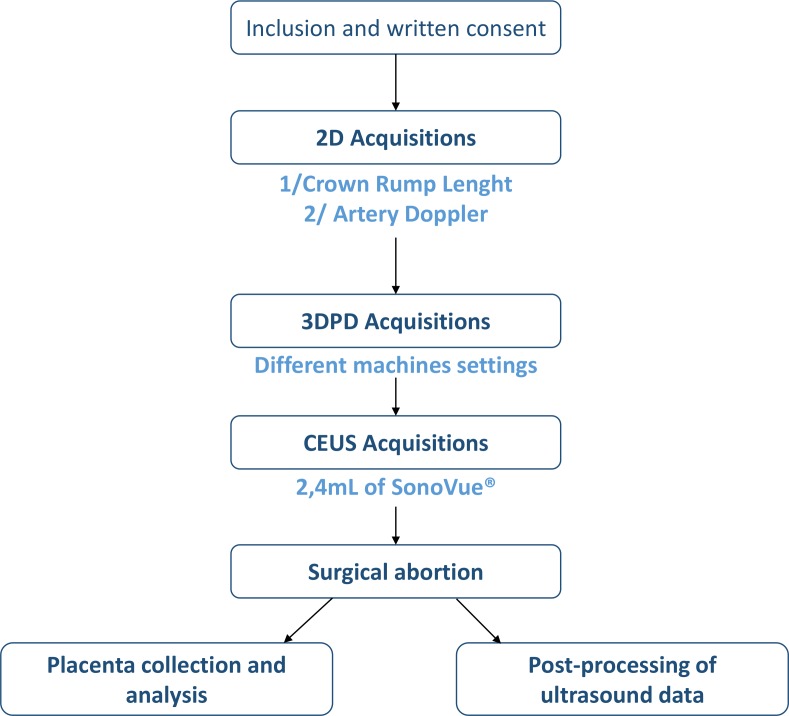
This is a prospective, cross-sectional, multicentre and non-randomised open study. We will include 42 women with ongoing pregnancy and divided into three groups of gestational ages (ie, 14 women by per group): 8, 11 and 13 weeks of gestation. 3DPD and then CEUS will be performed and the data about the perfusion kinetics and the 3DPD indices will be calculated and then compared with each other and for each gestational age.
The appropriate French Ethics Committee Est III approved this study and the related consent forms on 5 April 2016, and the competent authority (Agence Nationale de Sécurité du Médicament et des Produits de Santé) authorised the study on 21 June 2016. The results of this study will be published in a peer-reviewed journal and will be presented at relevant conferences.
ClinicalTrials.gov registry (NCT02884297); EudraCT registry (2015-005655-27).
导致胎盘血管形成的机制知之甚少,有些已经被认为是已知的知识,最近却受到了挑战,因为研究表明,绒毛间隙(胎儿与母体交换的主要区域)早在妊娠 6 周时似乎就被母体血液灌注。此后,血流似乎相对稳定,直到 13 周时才突然增加。
本主要目的是通过对比增强超声(CEUS)在三个不同妊娠周龄(8、11 和 13 周)时定量评估绒毛间隙的灌注。次要目标是:(1)描述三个妊娠周龄时 CEUS 和三维能量多普勒(3DPD)血管造影评估的胎盘(绒毛间隙)和子宫肌血管化指标;(2)比较 CEUS 和 3DPD 对显示和定量评估胎盘血管生成的诊断性能;(3)建立胎盘生物样本库,以增加对妊娠期间胎盘发育和功能的认识。
这是一项前瞻性、横断面、多中心和非随机开放研究。我们将纳入 42 名妊娠妇女,并分为三个妊娠年龄组(每组 14 名妇女):妊娠 8、11 和 13 周。然后进行 3DPD 和 CEUS,计算灌注动力学和 3DPD 指数的数据,并将其相互比较,并对每个妊娠年龄进行比较。
适当的法国伦理委员会 Est III 于 2016 年 4 月 5 日批准了这项研究及其相关同意书,主管当局(国家药品和保健产品安全局)于 2016 年 6 月 21 日批准了这项研究。这项研究的结果将发表在同行评议的期刊上,并将在相关会议上展示。
ClinicalTrials.gov 注册(NCT02884297);EudraCT 注册(2015-005655-27)。