Waheed Abdul, Chohan Muhammad Mansha, Ahmed Dildar, Ullah Nisar
Department of Chemistry, Forman Christian College (A Chartered University), Lahore 54600, Pakistan.
Chemistry Department, King Fahd University of Petroleum and Minerals, Dhahran 31261, Saudi Arabia.
Saudi J Biol Sci. 2019 Sep;26(6):1253-1261. doi: 10.1016/j.sjbs.2018.05.025. Epub 2018 May 24.
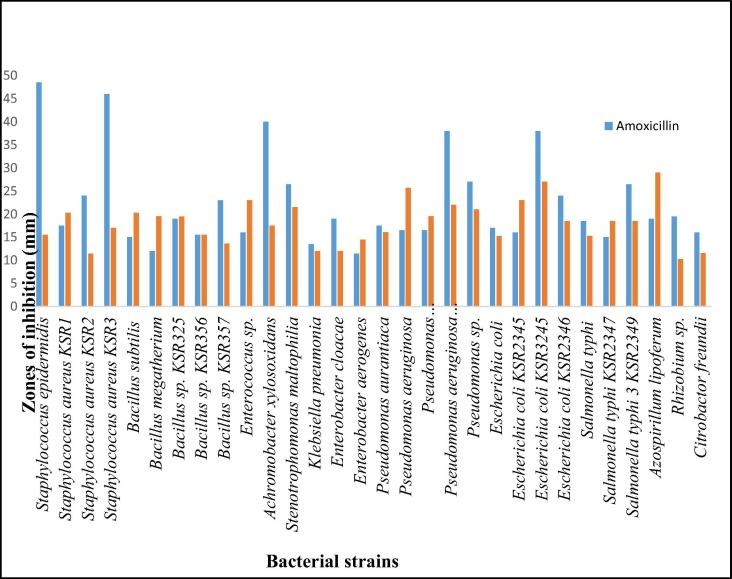
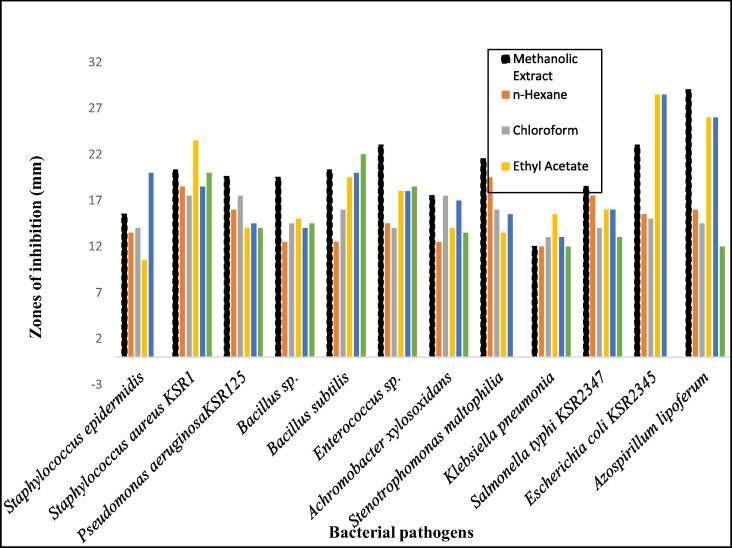
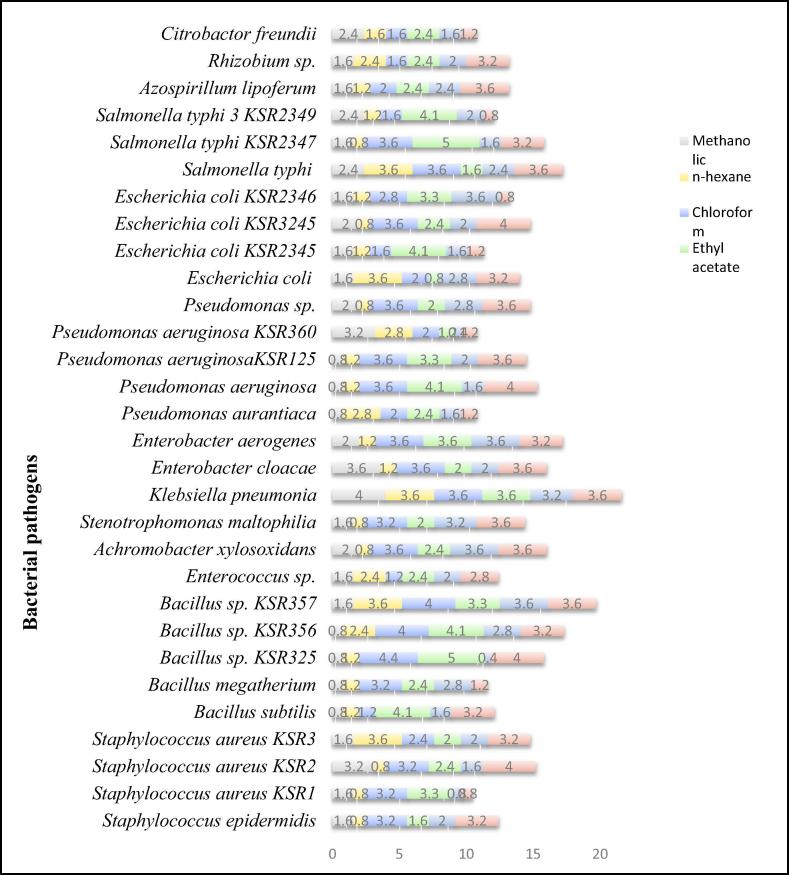
The increasing resistance of infectious microbial organisms to the existing arsenal of antibiotic drugs is on the rise. There is a growing demand for the new antibiotics that are cost effective and easily available to the common people. In search of new antimicrobial entities, this report deals with the antimicrobial activities of the crude extracts of leaves of . The methanolic extract and its sub-fractions namely -hexane, chloroform, ethyl acetate, -butanol and residual water fraction were screened against a range of 30 different bacterial strains and their zones of inhibition (ZI) and minimum inhibitory concentration (MIC) were subsequently evaluated. Methanolic extract has shown activity against all the tested microorganisms such as and sp. with ZOI ranged from 10.3 to 29.0 mm Moreover, the MIC values of methanolic extract and its sub-fractions against the tested bacteria ranged from 0.8 to 5.1 mg/mL. GC-MS analysis of sub-fractions revealed the presence of mono (2-ethylexyl) 1,2-benzenedicarboxylate, diisooctyl-1,2-benzenedicarboxylate, 3,5-dehydro-6-methoxypivalate-cholest-22-ene-21-ol, and 3,5-bis (1,1-dimethylethyl)-4-hydroxybenzene-propanoic acid. This is the first report on the antimicrobial activities of leaves of
传染性微生物对抗现有抗生素药物的耐药性正在上升。人们对经济高效且普通民众易于获得的新型抗生素的需求日益增加。为了寻找新的抗菌物质,本报告探讨了[植物名称]叶片粗提物的抗菌活性。对甲醇提取物及其亚组分,即正己烷、氯仿、乙酸乙酯、正丁醇和残留水相组分,针对30种不同细菌菌株进行了筛选,并随后评估了它们的抑菌圈(ZI)和最低抑菌浓度(MIC)。甲醇提取物对所有测试微生物,如[微生物名称]和[微生物名称]菌株均表现出活性,抑菌圈范围为10.3至29.0毫米。此外,甲醇提取物及其亚组分对测试细菌的MIC值范围为0.8至5.1毫克/毫升。亚组分的气相色谱-质谱分析显示存在邻苯二甲酸二(2-乙基己基)酯、邻苯二甲酸二异辛酯、3,5-脱氢-6-甲氧基新戊酸-胆甾-22-烯-21-醇以及3,5-双(1,1-二甲基乙基)-4-羟基苯丙酸。这是关于[植物名称]叶片抗菌活性的首次报告。