Hajat Cother, Hasan Ali, Subel Shaun, Noach Adam
The Vitality Group, Chicago, IL USA.
Vitality Health, London, UK.
NPJ Digit Med. 2019 Sep 16;2:91. doi: 10.1038/s41746-019-0164-3. eCollection 2019.
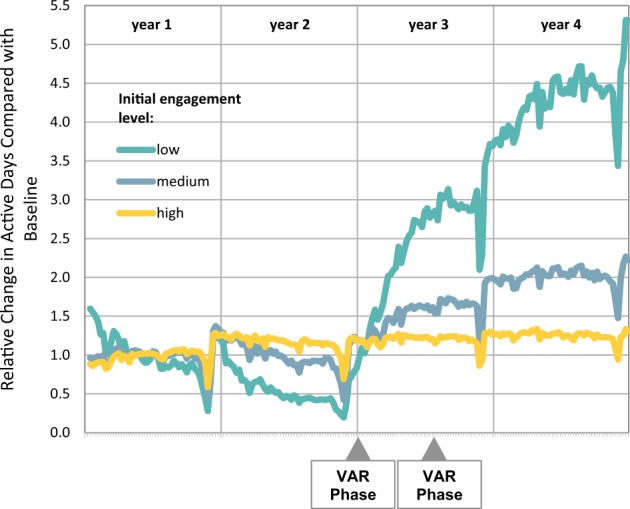
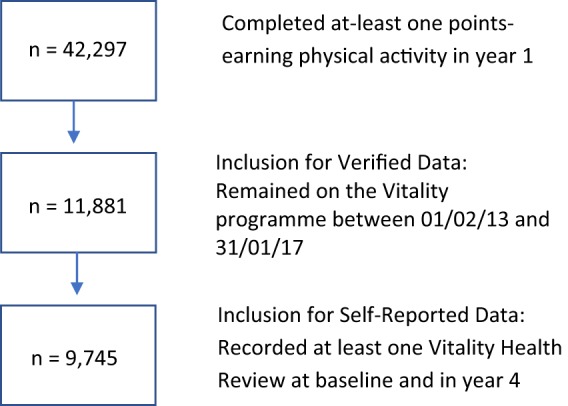
This observational study investigates whether the provision of ongoing short-term-incentives for verified physical activity increases and sustains levels of physical activity. We compared UK members at baseline (years 1 and 2) prior to Vitality's Active Rewards (VAR) intervention commencing (year 3) and follow-up (year 4) for verified, self-reported (encompassing additional physical activities), mortality relative risk and satisfaction with physical activity. Members were categorised into low-active, medium-active and high-active by tertiles of baseline physical activity. Of 11,881 participants, 6477(54.5%) were male, with mean age 39.7(SD 9.8) years. At follow-up, annual active days had increased by 56% overall [60.8(59.7-61.9)-94.8(93.0-96.5)]; 554% in low-active [8.5(8.3-8.7)-47.1(44.7-49.5)]; 205% in medium-active [39.8(39.4-40.2)-81.4(78.7-84.1)] and 17% in high-active members [131.7(129.9-133.5)-153.7(150.7-156.7)] (all < 0.001). Annual weeks of attaining international physical activity recommendations increased by 19% overall [22.2(42.8%)-26.4(50.8%)] and by 316% for low-active members [4.9(9.5%)-15.5(29.8%)]. Self-reported active minutes/week increased by 45% overall [1423(139.4-145.2)-207.0(201.8-212.3)] and 712% in low-active members [20.1(19.3-21.0)-143.2(134.6-151.9)]. Happiness with exercise levels also increased from 1985(49.4%) to 3414(84.9%) members (all < 0.001). The relative risk of mortality from a lack of physical activity reduced by 7% for low-active members [from 0.99 to 0.92], 5% for medium-active [0.94-0.89] and 3% for high-active [0.89-0.86]( < 0.001) and by 0.02% for each additional year of age ( = 0.02). This large-scale, real-world, short-term-incentives intervention led to a dramatic increase in physical activity which was sustained for, and still increasing after, two years. If applied at broader level, this approach could considerably aid progress towards WHO targets in its Global Action Plan for Physical Activity.
这项观察性研究调查了为经核实的体育活动提供持续短期激励措施是否能提高并维持体育活动水平。我们比较了活力运动奖励计划(VAR)干预开始前(第3年)的基线(第1年和第2年)时以及随访(第4年)时英国会员经核实的自我报告(包括额外的体育活动)、死亡相对风险和对体育活动的满意度。会员根据基线体育活动的三分位数分为低活跃度、中等活跃度和高活跃度。在11881名参与者中,6477名(54.5%)为男性,平均年龄39.7(标准差9.8)岁。随访时,总体年度活动天数增加了56%[60.8(59.7 - 61.9) - 94.8(93.0 - 96.5)];低活跃度会员增加了554%[8.5(8.3 - 8.7) - 47.1(44.7 - 49.5)];中等活跃度会员增加了205%[39.8(39.4 - 40.2) - 81.4(78.7 - 84.1)];高活跃度会员增加了17%[131.7(129.9 - 133.5) - 153.7(150.7 - 156.7)](均P < 0.001)。达到国际体育活动建议的年度周数总体增加了19%[22.2(42.8%) - 26.4(50.8%)],低活跃度会员增加了316%[4.9(9.5%) - 15.5(29.8%)]。自我报告的每周活跃分钟数总体增加了45%[1423(139.4 - 145.2) - 207.0(201.8 - 212.3)],低活跃度会员增加了712%[20.1(19.3 - 21.0) - 143.2(134.6 - 151.9)]。对运动水平感到满意的会员人数也从1985名(49.4%)增加到3414名(84.9%)(均P < 0.001)。低活跃度会员因缺乏体育活动导致的死亡相对风险降低了7%[从0.99降至0.92],中等活跃度会员降低了5%[从0.94降至0.89],高活跃度会员降低了3%[从0.89降至0.86](P < 0.001),且每增加一岁风险降低0.02%(P = 0.02)。这项大规模的、真实世界的短期激励干预导致体育活动显著增加,且在两年内持续并仍在增加。如果在更广泛层面应用,这种方法可以极大地助力实现世界卫生组织《体育活动全球行动计划》中的目标。