Big Data Institute, Li Ka Shing Centre for Health Information and Discovery, Nuffield Department of Population Health, University of Oxford, Oxford, UK.
Division of Biostatistics, University of California, San Diego, CA, USA.
Neuroimage. 2019 Dec;203:116187. doi: 10.1016/j.neuroimage.2019.116187. Epub 2019 Sep 15.
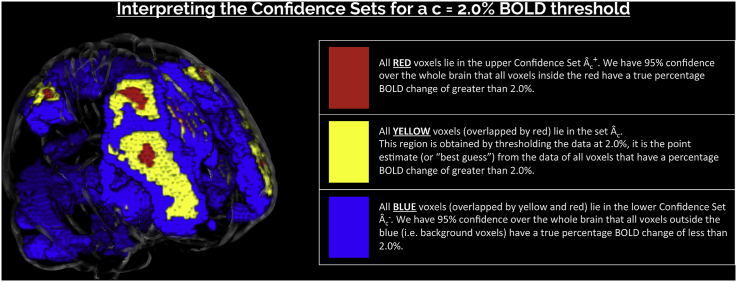
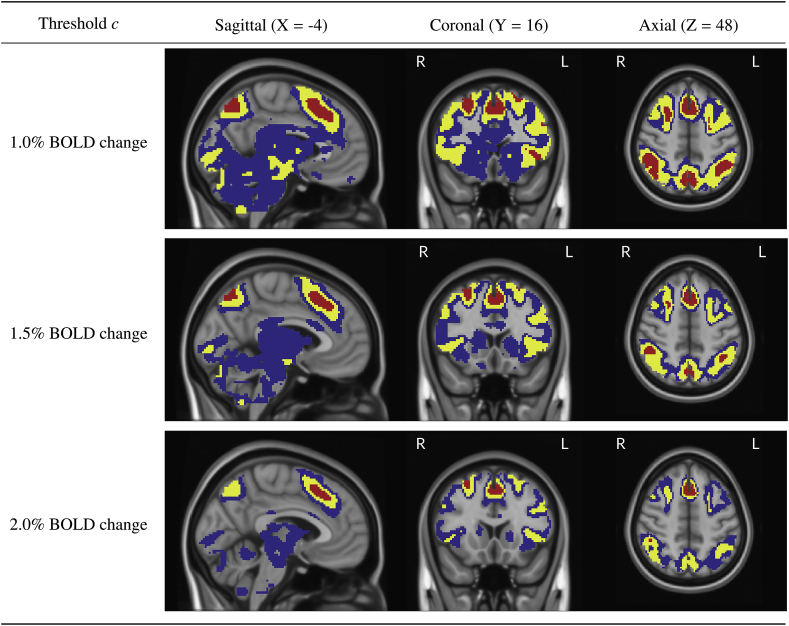
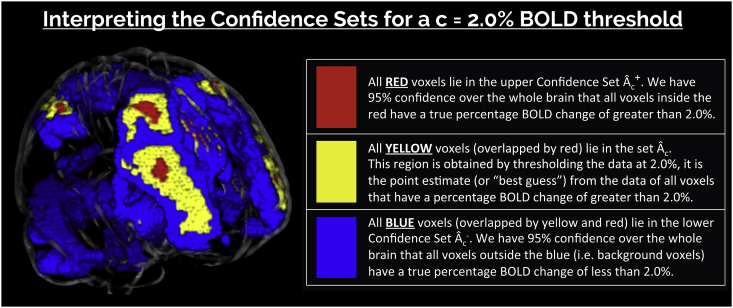
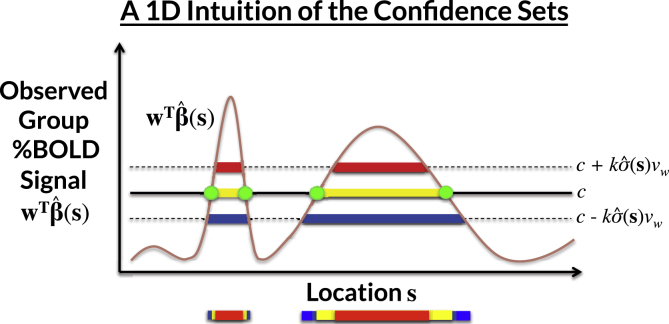
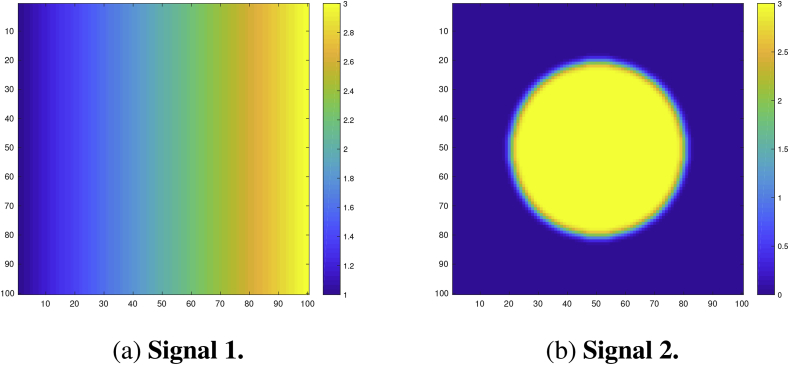
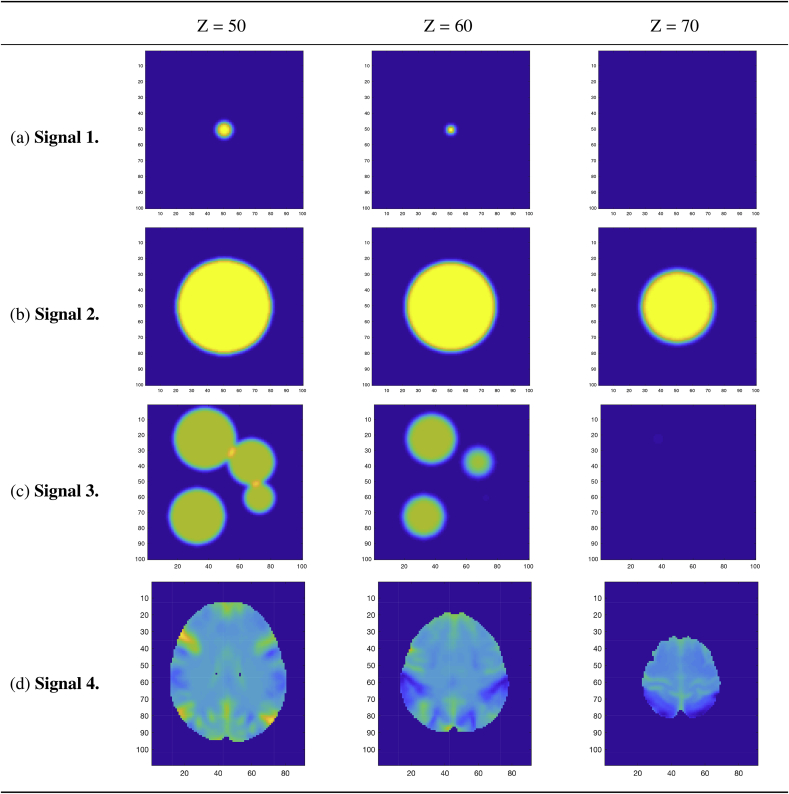
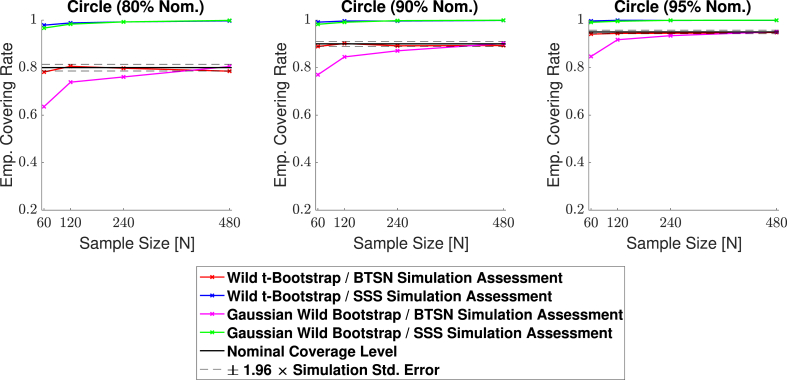
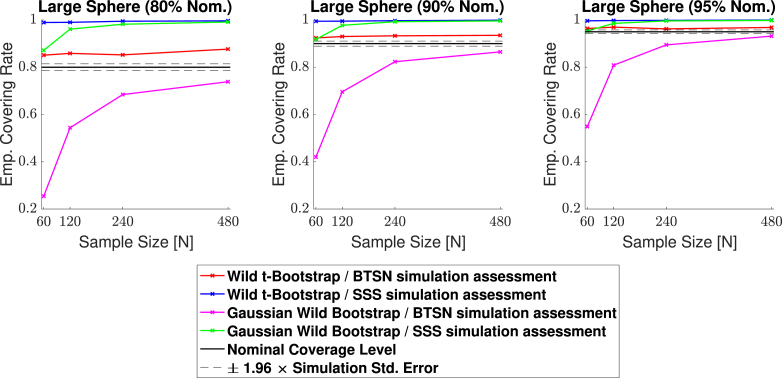
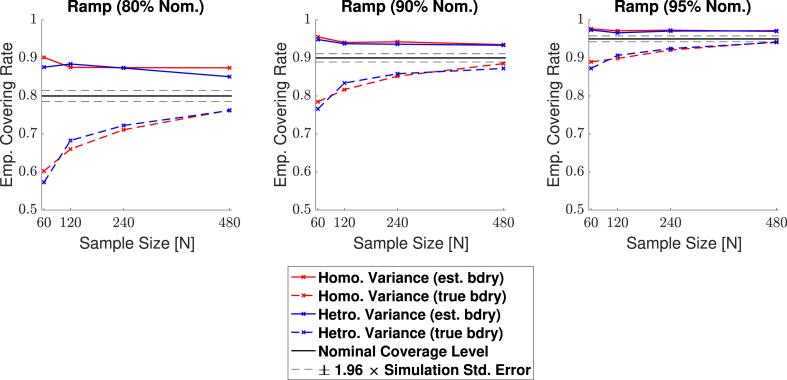
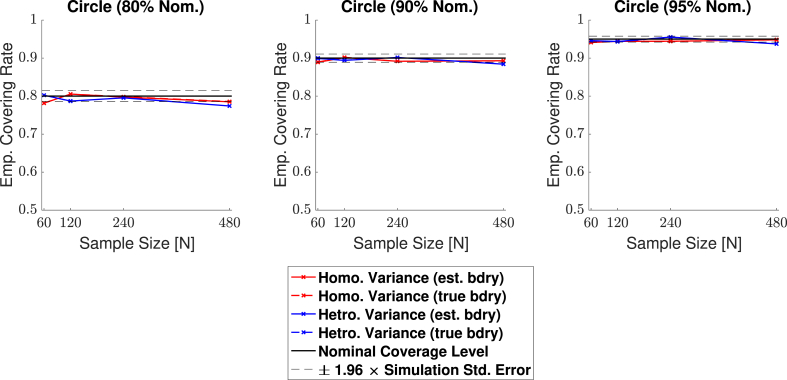
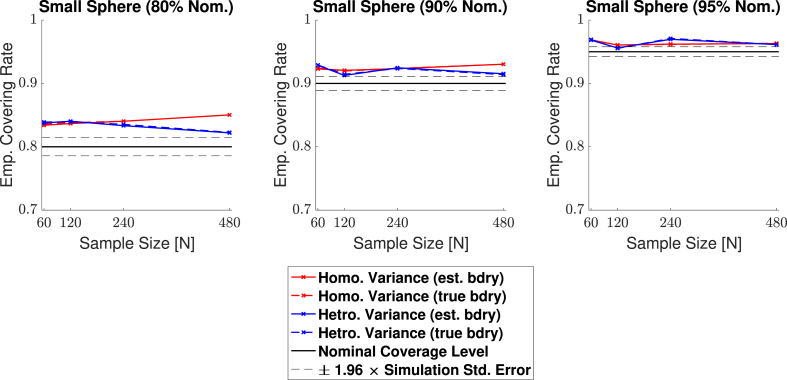
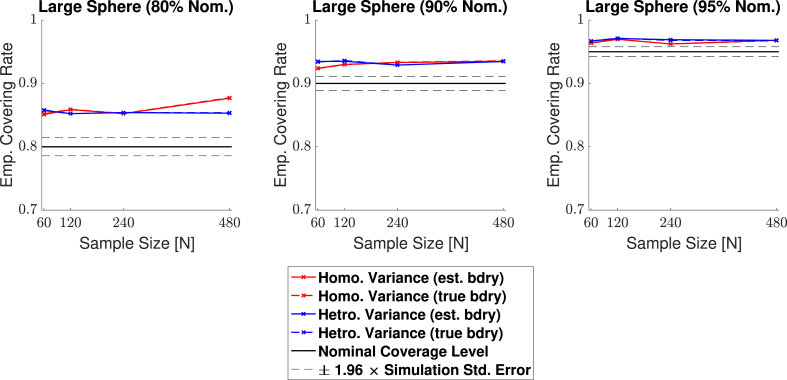
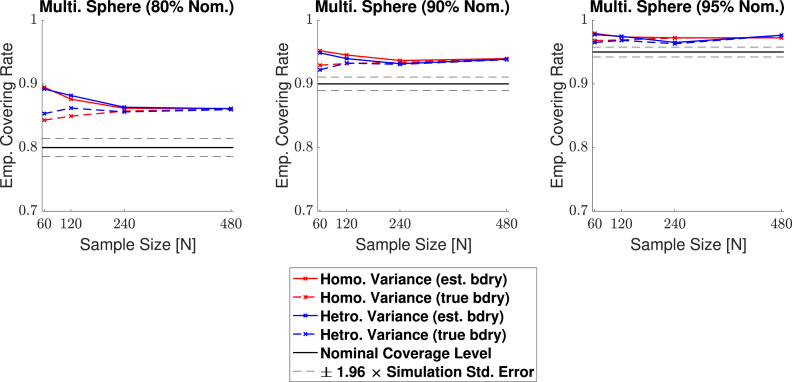
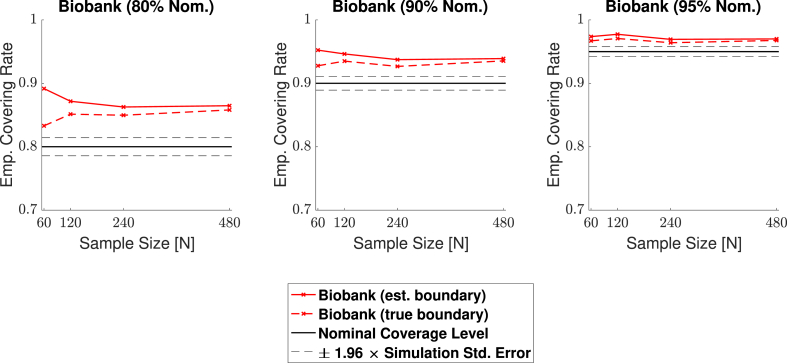
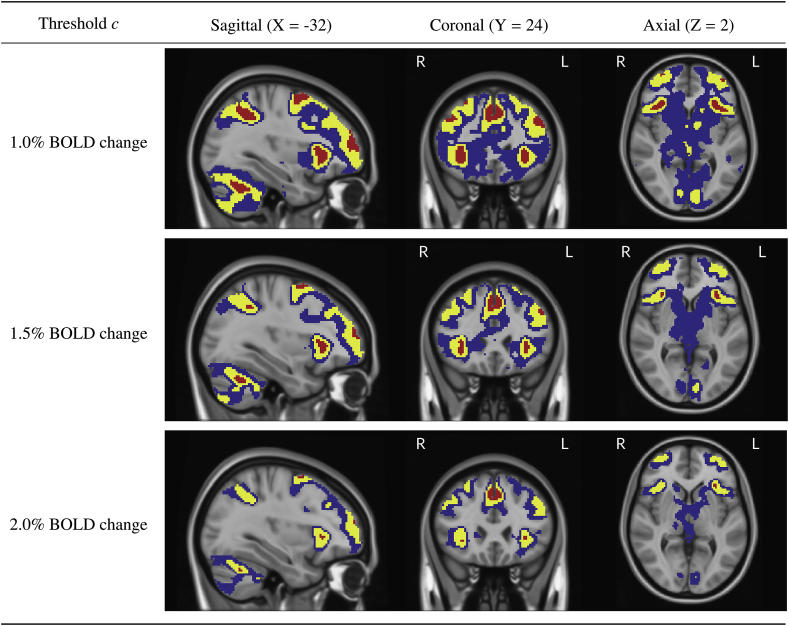
The mass-univariate approach for functional magnetic resonance imaging (fMRI) analysis remains a widely used statistical tool within neuroimaging. However, this method suffers from at least two fundamental limitations: First, with sufficient sample sizes there is high enough statistical power to reject the null hypothesis everywhere, making it difficult if not impossible to localize effects of interest. Second, with any sample size, when cluster-size inference is used a significant p-value only indicates that a cluster is larger than chance. Therefore, no notion of confidence is available to express the size or location of a cluster that could be expected with repeated sampling from the population. In this work, we address these issues by extending on a method proposed by Sommerfeld et al. (2018) (SSS) to develop spatial Confidence Sets (CSs) on clusters found in thresholded raw effect size maps. While hypothesis testing indicates where the null, i.e. a raw effect size of zero, can be rejected, the CSs give statements on the locations where raw effect sizes exceed, and fall short of, a non-zero threshold, providing both an upper and lower CS. While the method can be applied to any mass-univariate general linear model, we motivate the method in the context of blood-oxygen-level-dependent (BOLD) fMRI contrast maps for inference on percentage BOLD change raw effects. We propose several theoretical and practical implementation advancements to the original method formulated in SSS, delivering a procedure with superior performance in sample sizes as low as N=60. We validate the method with 3D Monte Carlo simulations that resemble fMRI data. Finally, we compute CSs for the Human Connectome Project working memory task contrast images, illustrating the brain regions that show a reliable %BOLD change for a given %BOLD threshold.
基于体素的多元分析方法仍是神经影像学中广泛应用的统计工具。然而,这种方法至少存在两个基本限制:首先,随着样本量足够大,有足够高的统计能力来拒绝零假设,这使得很难(如果不是不可能的话)定位感兴趣的效应。其次,对于任何样本量,当使用聚类大小推断时,显著的 p 值仅表示聚类大于偶然。因此,没有置信的概念来表达可以从人群中重复抽样获得的聚类的大小或位置。在这项工作中,我们通过扩展 Sommerfeld 等人(2018 年)提出的方法(SSS)来解决这些问题,以在阈值原始效应大小图中找到的聚类上开发空间置信集(CS)。虽然假设检验表明在哪里可以拒绝零假设,即原始效应大小为零,但 CS 给出了原始效应大小超过和低于非零阈值的位置的陈述,提供了上限和下限 CS。虽然该方法可以应用于任何基于体素的多元线性模型,但我们在血氧水平依赖(BOLD)fMRI 对比映射的背景下,为基于百分比 BOLD 变化原始效应的推断,对该方法进行了说明。我们对 SSS 中提出的原始方法进行了若干理论和实际实施方面的改进,提供了一种在低至 N=60 的样本量下性能优越的程序。我们使用类似于 fMRI 数据的 3D 蒙特卡罗模拟验证了该方法。最后,我们为人类连接组计划工作记忆任务对比图像计算了 CS,说明了在给定的 BOLD 阈值下显示出可靠的 BOLD 变化的大脑区域。